Brake Repair & Replacement
AKA 'Stoppy Boys' — Because trees aren't meant to be hugged at 60mph.
Your brakes are literally the only thing between you and a very expensive conversation with your insurance company. Let's keep them happy.
See our upfront pricingQuick Facts
What's This All About Then?
Look, we get it. Brakes are boring until they're not. That weird squealing sound? That's your car screaming for help. Those vibrations when you stop? Your discs are basically waving a white flag. We'll sort your stoppy boys out before they turn your daily commute into an extreme sport. We come to you, fix your brakes, and you get to keep not crashing into things. Everyone wins.
How it works
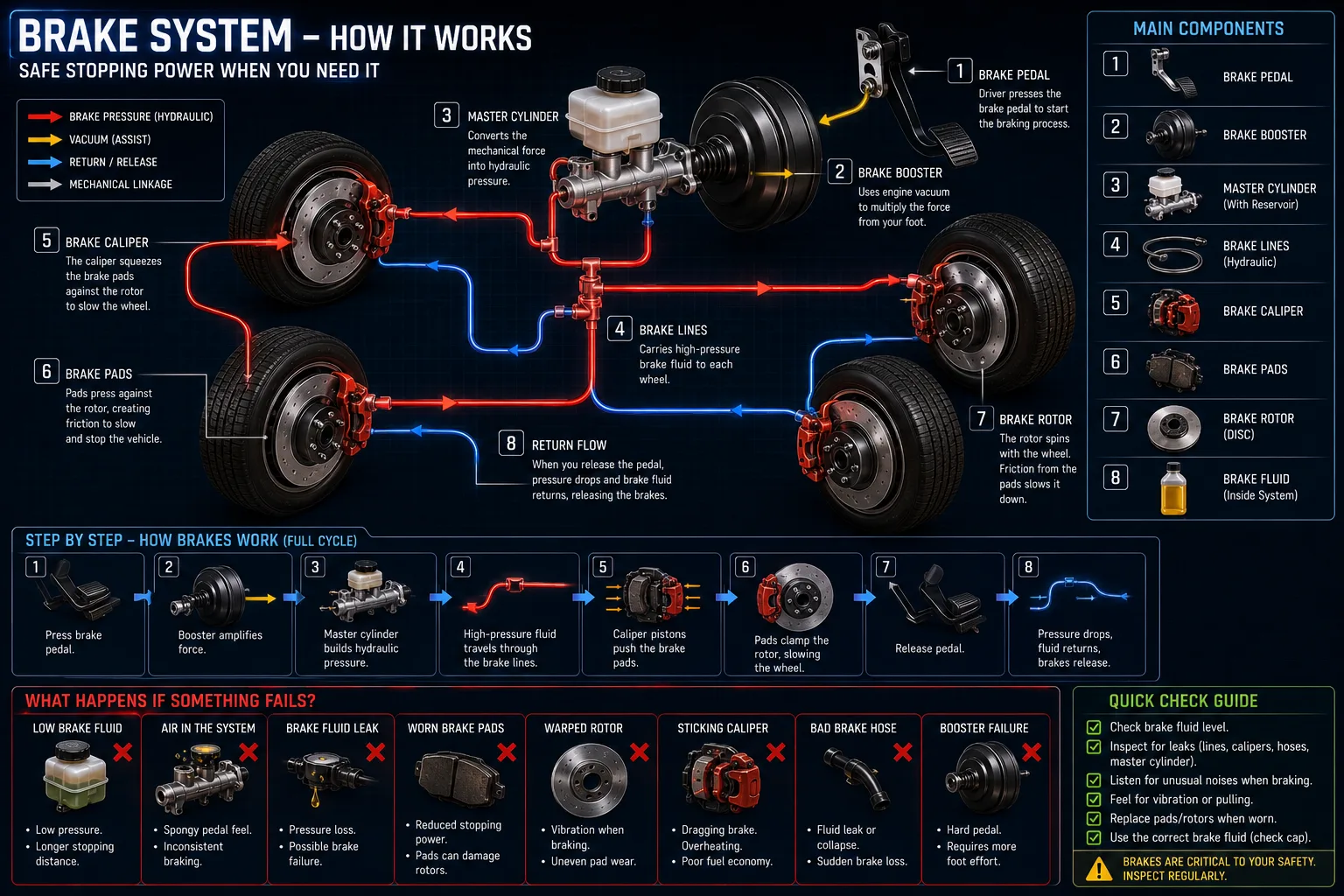
Most modern cars use disc brakes at the front (and often the rear). When you press the pedal, hydraulic fluid pushes a piston in the caliper, which squeezes two brake pads against a spinning metal disc (the rotor) bolted to the wheel. That friction turns your car's momentum into heat — a hard stop from 70mph can briefly push the discs past 300°C. The pads are designed as the sacrificial part: they wear down over time so the much more expensive discs and calipers don't. Some cars still use drum brakes at the rear, where curved 'shoes' press outward against a spinning drum instead.
Warning signs to watch for
- •Squealing or screeching when you brake — most pads have a wear indicator that deliberately squeals when they're low
- •A grinding or metal-on-metal sound — usually means the pads are gone and the metal backing is scoring the disc (act fast)
- •A soft, spongy or sinking brake pedal — often air or a leak in the hydraulic system
- •The car pulling to one side under braking — a sticking caliper or uneven wear
- •Vibration or judder through the pedal or steering wheel when braking — commonly warped discs
- •Longer stopping distances, or a brake warning light on the dash
Common causes
What we do
We inspect pad thickness, disc condition and wear, caliper movement and the brake fluid, then give you a clear, itemised quote before touching anything. On the job we replace pads (and discs if they're below the manufacturer's minimum or warped), free off or replace sticking calipers, clean and lubricate the slides, bed everything in, and check the fluid. Because we come to you, it's done on your driveway or at work — no garage drop-off, no waiting room.
Brake Repair & Replacement — FAQs
How do I know if I need new brake pads or new discs too?
Pads are the wear part and get replaced most often. Discs are replaced when they're below the manufacturer's minimum thickness, deeply scored, or warped (causing judder). A quick measurement during the inspection tells us — and we'll only quote discs if they genuinely need it.
Is it safe to keep driving with squealing brakes?
Squealing usually means the wear indicator is telling you the pads are low — it's a 'book it in soon' warning, not an emergency. Grinding (metal-on-metal) is different: that means the pad is gone and you're damaging the disc, so you should stop driving and get it looked at straight away.
How long does a brake job take?
A straightforward pad change is usually under an hour per axle; pads and discs together a bit longer. Seized calipers or drum brakes can add time. We confirm the time when we quote.
What You Actually Get
Common Brake Repair & Replacement Faults We Fix
Random Knowledge You Didn't Ask For
Fun fact: Your brakes convert motion into heat. They're basically tiny ovens. Tasty.
Average brake pads last 30,000-70,000 miles. Yours? Let's find out together.
Why Get Your Brake Repair & Replacement Done By Us?
We're Quick
Fast response, efficient work. No dragging things out.
We Come To You
Your driveway, your office, wherever. We travel.
We Guarantee It
If we mess up, we fix it. Simple as that.
Ready for Brake Repair & Replacement?
That thing's not going to fix itself. We've checked.