Brake Fluid Change & Bleeding
Your brake fluid has a hobby nobody warned you about. From the moment it enters the reservoir, it starts quietly sipping atmospheric moisture through every microscopic gap it can find — the reservoir cap, the hoses, the seals — like it sneaked into a free bar and has absolutely no intention of leaving sober. That would be fine, except water does terrible things to a hydraulic fluid under heat. Fresh DOT 4 has a boiling point north of 230°C. At just 3.7% water content — a level most cars quietly reach within two or three years — that figure can collapse below 155°C. The brakes that shrug off town traffic start lying to you the moment you hit a long descent and really need them. SOSCarFix comes to you, drains the compromised stuff, bleeds the system clean, and refills it with fresh fluid. No hill needed to find out it was overdue.
See our upfront pricingBrake fluid silently drinks moisture from the air and repays you by boiling on the first long hill. SOSCarFix mobile mechanics change and bleed your brake fluid at your door, anywhere in the UK.
How it actually works
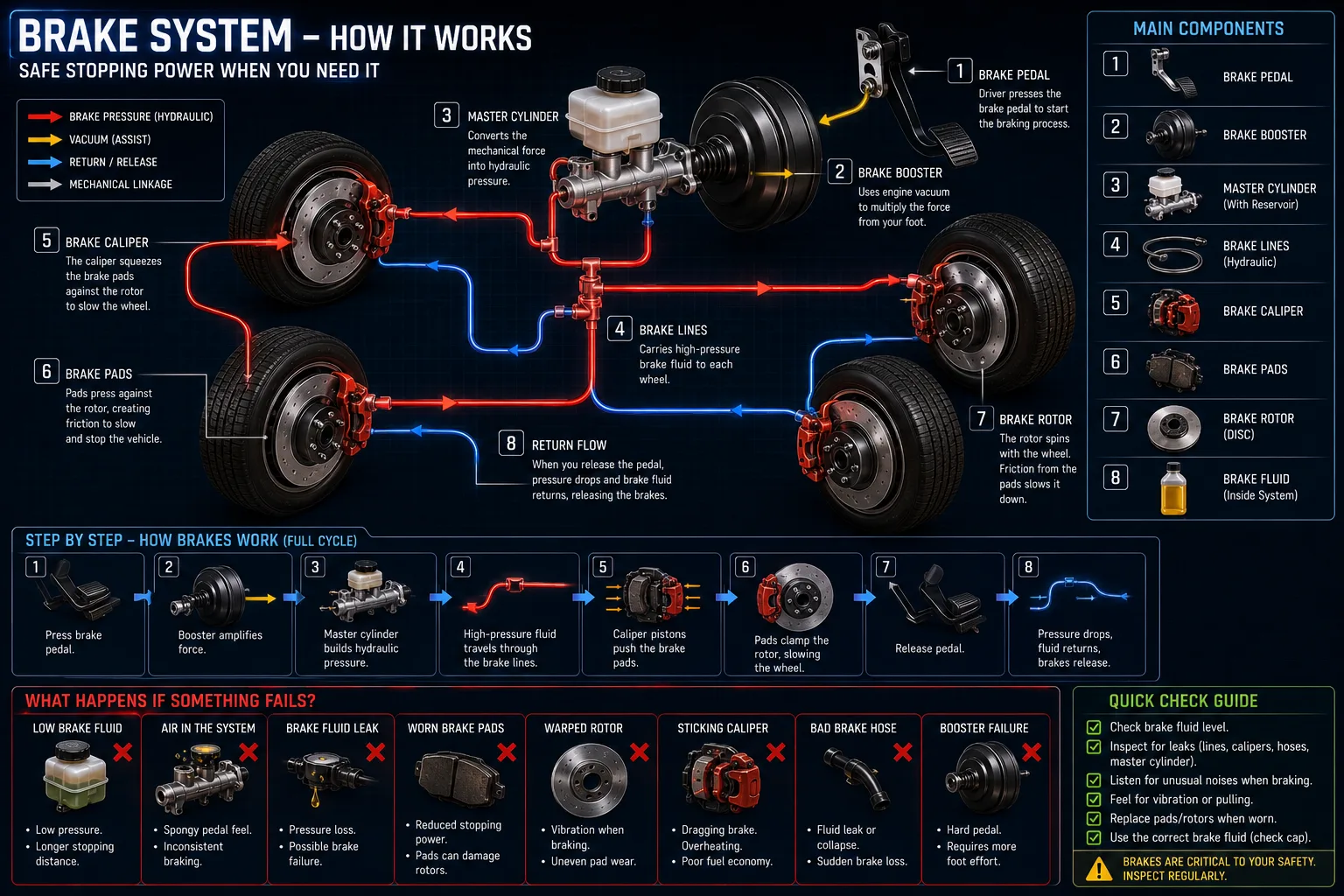
We rock up — driveway, car park, layby, wherever suits you — with the fluid, the equipment, and a healthy respect for gravity. First we check the existing fluid with a calibrated tester that reads moisture content directly; it tells us exactly how far gone things are, rather than guessing by the colour of the tea. Then we flush the old fluid out of the system: master cylinder, ABS modulator if fitted, and every caliper in turn. The bleeding sequence matters — get it wrong and air stays trapped in the lines, which is its own special problem. We work corner by corner until the fluid running out is clean, the pedal is firm, and the boiling point is back where it belongs. We check the reservoir level, cap it up, and test the pedal feel before we leave. The whole job typically takes thirty to forty-five minutes. Your hill is ready for you.
“7% water content — a level most cars quietly reach within two or three years — that figure can collapse below 155°C.”
Sound familiar?
So what's behind it?
What we do — at your door
We carry out a full brake fluid flush and bleed at your location — no ramps required, just level ground and access to all four corners of the car. We test moisture content before and after so you can see the actual numbers rather than take our word for it. We bleed the system in the correct sequence for your vehicle, including through the ABS modulator where applicable, and we use the correct fluid specification for your car (DOT 3, DOT 4, or DOT 5.1 — whichever the manufacturer specified). We will also tell you honestly if the spongy pedal is something the fluid change will fix or whether there is air, a failing caliper, or a weeping seal that needs attention first. We are mechanics, not a production line, so if we find something else while we are in there, we will say so rather than quietly not notice it.
What affects the price
The price varies based on a few honest variables: the DOT specification your vehicle requires (DOT 4 LV or DOT 4 Plus, as specified by many modern German and performance vehicles, costs more than standard DOT 4), whether the ABS modulator needs to be bled as part of the process (some systems require a diagnostic tool to cycle the pump valves — that takes time and kit), the number of brake circuits and calipers on your vehicle, and your location within our coverage area. Some cars are straightforward thirty-minute jobs. Some have multi-channel ABS, electronic parking brake actuators, and four-pot calipers that all want their own bleeding procedure. We quote for your specific vehicle and situation, so you know what you are paying before we touch a spanner.
Random knowledge you didn't ask for
Questions you're probably asking
How often should I change my brake fluid?
Every two years is the standard recommendation, and it is not a suggestion invented by mechanics to generate business — it is the interval at which moisture accumulation in glycol-based fluids starts to meaningfully compromise the boiling point under real driving conditions. Some manufacturers specify shorter intervals for performance vehicles or heavy towing use. If you genuinely cannot remember the last time it was changed, it was overdue before you started wondering.
Can I just top up the brake fluid rather than flushing it?
Topping up adds fresh fluid on top of old, moisture-saturated fluid. The system still contains the degraded fluid sitting in the calipers, lines, and ABS modulator where the heat is actually generated. It is roughly equivalent to pouring fresh orange juice into a glass that still has last week's in the bottom. A flush removes the old fluid from the whole system; a top-up does not.
My brakes feel fine — do I still need to change the fluid?
Almost certainly yes, if it has been more than two years. The insidious thing about moisture-saturated brake fluid is that it performs perfectly adequately in everyday driving — town speeds, light loads, flat roads — right up until it does not. The boiling point only becomes relevant when brakes are worked hard. Feeling fine on the school run is not the same as being fine on a mountain pass with a full car.
Why do my brakes need bleeding — what does that actually mean?
Bleeding is the process of pushing all the air out of the hydraulic lines. Air compresses; brake fluid does not. Any air in the system means pedal travel is partially spent compressing a bubble rather than building hydraulic pressure at the caliper. Bleeding involves opening bleed nipples at each caliper in sequence and pushing fluid through until no air comes out with it. It is done during a fluid change as a matter of course, and also any time the hydraulic circuit has been opened — after a caliper replacement, for example.
Red brake warning light (circle with exclamation mark) on — is it safe to drive?
Short answer: no. That light means low brake fluid, a pressure fault, or your handbrake sensor is playing up. The first two are genuinely dangerous — if fluid is low, you either have a leak or the pads are worn to the bone. Either way, your stopping distances could be compromised before you even notice. Park it, check the reservoir under the bonnet. If it's low, don't top it up and carry on — get it properly diagnosed. We can come to you.
Brake Fluid Change & Bleeding — sorted at your door
Stop procrastinating. Get a transparent quote and we'll come to you.