Brake Disc Replacement — We Fix the Shimmy, Not Just the Disc
You know the feeling. You're doing a perfectly normal 30mph crawl through a speed-camera village and you touch the brakes — and your steering wheel starts vibrating like a tumble dryer with a brick in it. That, my friend, is a warped or worn brake disc doing its signature paint-mixer impression, and it's not getting better on its own. Brake discs are one of those components that fast-fit chains absolutely love replacing, because they can do it badly in eight minutes and have your car back on the road before the vibration's even had a chance to say goodbye. We take a bit longer. We do it properly. And the difference is whether your steering wheel shakes again in six weeks, or doesn't.
See our upfront pricingYour steering wheel doing a paint-mixer impression? SOSCarFix replaces brake discs at your door — properly, with hub faces cleaned to bare metal. No corner-cutting. Book now.
How it actually works
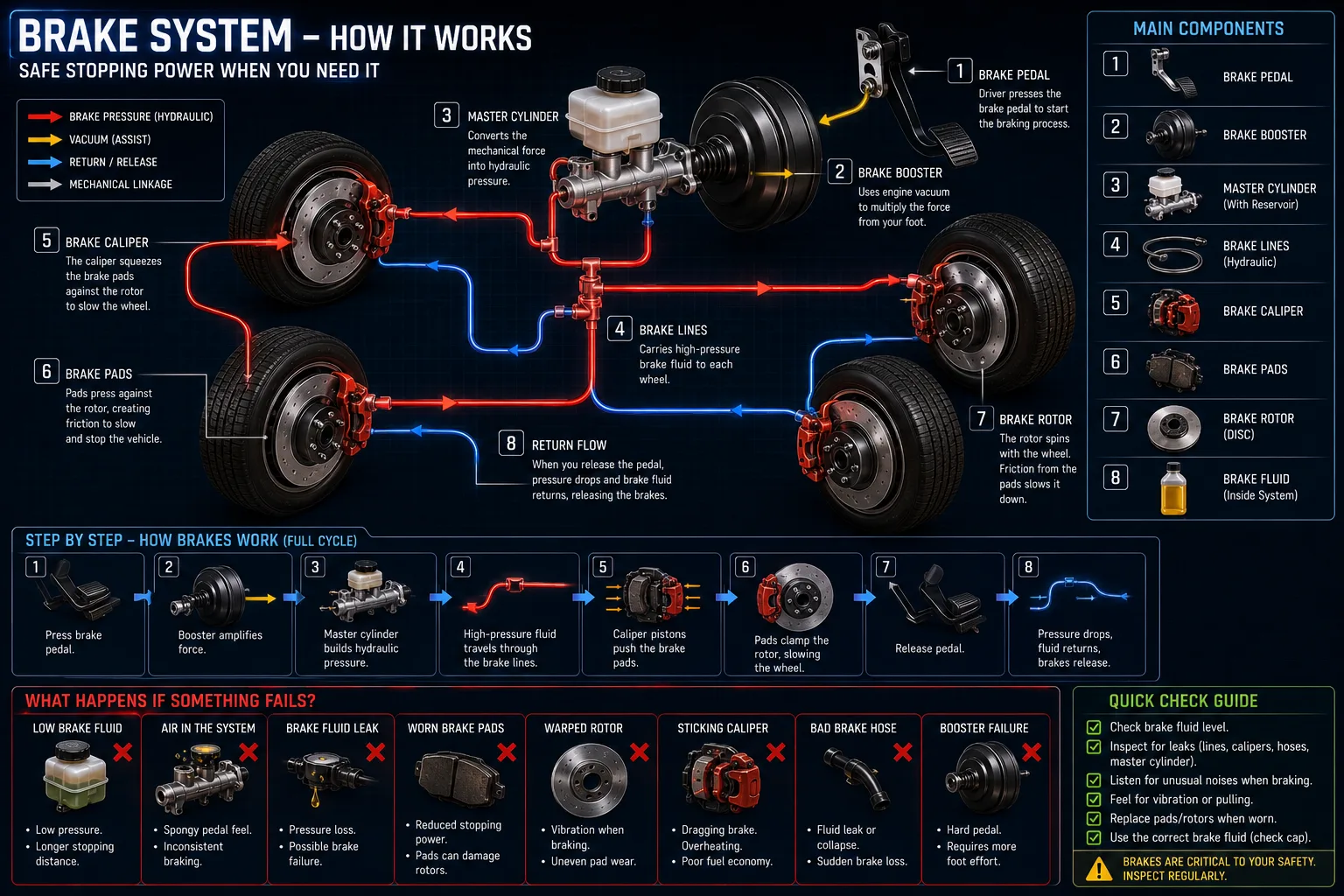
Here's the bit where we explain brakes without making it boring. Your brake disc is a big flat metal ring that spins with your wheel. When you press the pedal, hydraulic pressure clamps brake pads against both faces of the disc, friction converts speed into heat, and you stop. Beautifully simple. The disc needs to be flat and true — like a record on a turntable, not like a warped one from a loft that spent twenty years next to a radiator. When a disc develops lateral runout (the polite engineering term for "it's wobbling off-true"), the pad contact point shifts every revolution, and that pulsing force travels straight up the steering column to your hands. Even 0.1mm of runout at the disc face — roughly the thickness of a human hair — is enough to generate noticeable judder. Now here's the bit the fast-fit lads don't tell you: discs genuinely do warp from heat. Repeated hard stops heat the metal unevenly; uneven cooling can cause the metallurgical structure to shift and the disc to distort. That's real. But the far more common cause of premature judder — the one we see constantly — is rust contamination between the disc and the hub face. A thin skim of rust on the hub is invisible to the eye but can throw a new disc off true by 0.1mm or more before you've even left the car park. We clean the hub face back to bare metal every single time. It takes an extra ten minutes. It's why your brakes are still smooth six months later rather than shaking again before your next service.
“And the difference is whether your steering wheel shakes again in six weeks, or doesn't.”
Sound familiar?
So what's behind it?
What we do — at your door
We come to wherever the car lives — your driveway, your workplace, the car park where it's been sitting shaming you — and we replace the brake discs properly. That means: we remove the wheel and caliper, we clean the hub face back to bare metal (not a quick wipe — actual metal, actual clean), we fit the new disc, torque everything to manufacturer spec, and we bed the new pads and discs in correctly. We always recommend replacing pads at the same time as discs; putting new discs against old pads is the mechanical equivalent of buying new soles and keeping the uppers — the worn pad shape won't bed in cleanly and you'll have uneven contact from day one. We carry quality parts and we'll advise you on the right spec for your car and how you drive it. No upselling theatre, no fake urgency — just an honest assessment of what's gone and what needs doing.
What affects the price
Several things affect what brake disc replacement costs on your specific car: the make and model (a disc for a Ford Focus and a disc for a BMW 5 Series are very different objects with very different prices); whether you need fronts, rears, or all four (fronts do the majority of braking work and tend to wear faster); the specification of disc — standard, grooved, or drilled-grooved performance discs all sit at different price points; and whether the pads need replacing at the same time, which they almost always do. We give bespoke quotes based on your actual car — contact us and we'll price it up properly, with no nasty surprises when the job's done.
Random knowledge you didn't ask for
Questions you're probably asking
My new brake discs are already juddering after a few weeks — did you fit them wrong?
Almost certainly not us, but this is the most common brake complaint after a fast-fit or DIY job. The overwhelming cause is a hub face that was not cleaned properly before fitting. Even microscopic rust between the hub and the back of the new disc can throw it off true by enough to cause judder. We clean the hub face to bare metal every time, specifically to prevent this. If you've had discs fitted elsewhere and they're already shaking, give us a call — this is very fixable.
Do I really need to replace the pads at the same time as the discs?
Yes, almost always. A worn pad has a contact profile that matches the old disc surface — grooves, wear patterns and all. A new disc surface is flat. Put the two together and you get uneven contact, uneven bedding-in, and premature wear on your new disc. It's a false economy. The exception is if the pads are nearly new and the disc failed for an unrelated reason, but we'll assess and tell you honestly.
Is it safe to drive on warped or worn brake discs?
The vibration is unpleasant but the real concern is that worn or severely warped discs compromise your stopping distance and braking consistency. A disc that flexes under load, runs unevenly hot, or has deep grooves is not doing its job properly. If the grinding is metal-on-metal, the disc has worn through and that needs sorting before the car moves further. If you're unsure, get it looked at — it's the sort of thing that's inconvenient to fix and catastrophic to ignore.
Can I just replace one disc, or does it have to be both sides?
Always replace in axle pairs — both fronts or both rears together. Brake discs on the same axle need to be matched in thickness and condition so the braking force is balanced left to right. Fit a new disc on one side only and your car will pull to the side with the old disc under braking, which is exactly as much fun as it sounds.
Why does my steering wheel shake or vibrate when I brake?
Almost always the brake discs. When a disc develops lateral runout — engineering-speak for "it's no longer perfectly flat" — the pad contact point shifts slightly with every revolution, and that pulsing force travels straight up the steering column to your hands. Even 0.1mm of distortion, roughly the thickness of a human hair, is enough to generate noticeable judder. It can come from heat warping, a disc worn below minimum thickness, or — the culprit nobody mentions — rust contamination between the disc and the hub face. Get it diagnosed before it progresses from annoying to expensive.
Brake Disc Replacement — sorted at your door
Stop procrastinating. Get a transparent quote and we'll come to you.