Brake Flexi Hose Replacement: The Rubber Bit Your Brakes Literally Cannot Live Without
Somewhere between your brake caliper and the rigid steel pipe that runs up your car's body is a short length of rubber hose. It flexes every time your suspension moves, every time you steer, every time you hit a pothole on the A-road that the council has collectively decided doesn't exist. It does this for years, quietly, ignored by everyone including the previous owner. Then one day it perishes, swells up like an angry sausage, or starts weeping brake fluid somewhere near a wheel — and suddenly your pedal goes spongy, your brakes pull to one side, or a tester at the MOT station starts writing things down in a concerned way. Brake flexi hoses are a safety-critical item. Not "probably worth looking at eventually" critical — more "you will not stop properly without working ones" critical. SOSCarFix comes to you, replaces the offending hose, bleeds the system properly, and sends you on your way with brakes that actually brake.
See our upfront pricingPerished, bulging or leaking brake flexi hose? MOT failure waiting to happen. SOSCarFix comes to you, replaces it, bleeds the system. Get a quote.
How it actually works
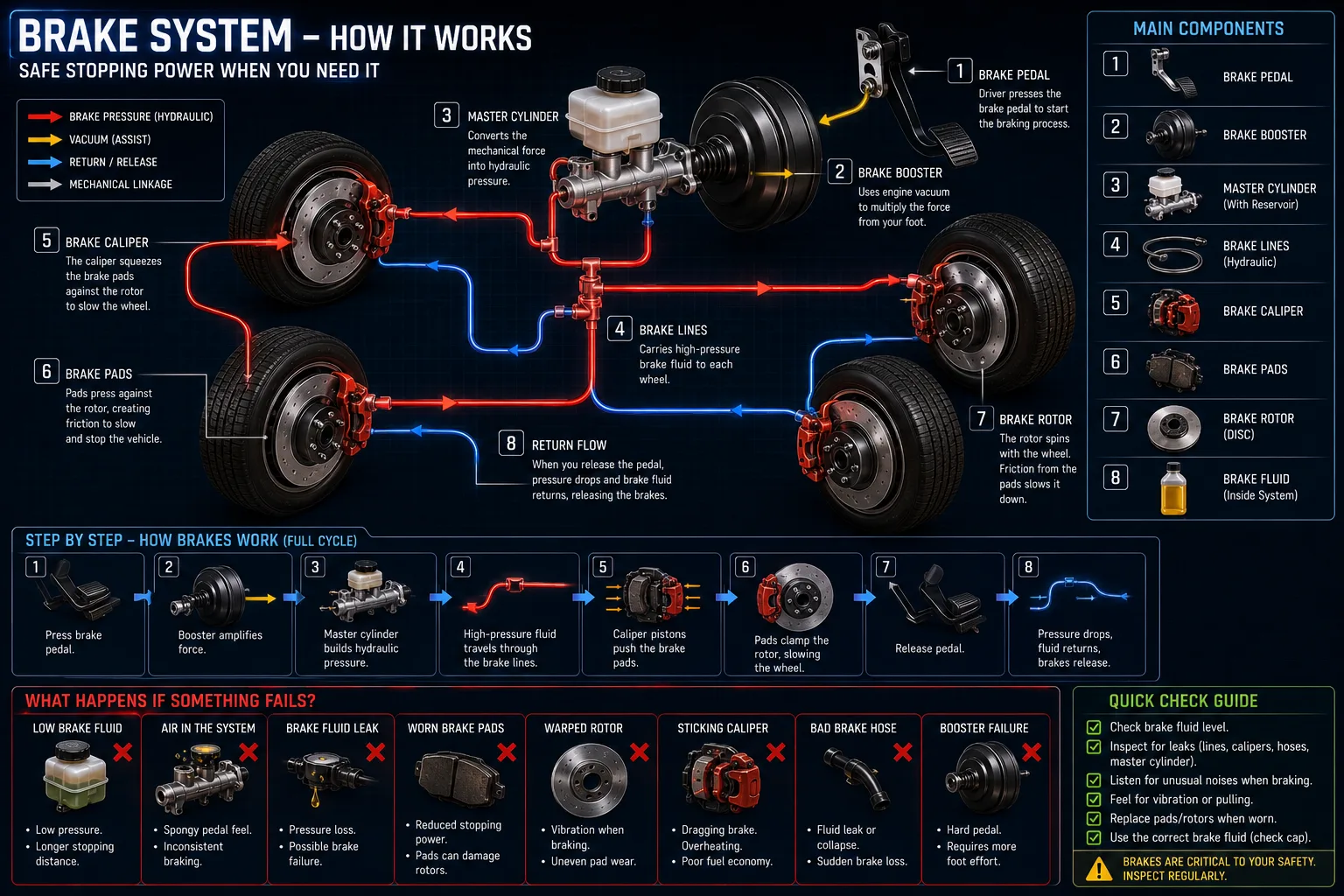
Your hydraulic brake system is a closed loop of fluid under pressure. When you press the pedal, that pressure travels down steel hard lines to each corner of the car. But steel can't flex — so the last few inches before each brake caliper or wheel cylinder are bridged by a short rubber hose. These flexi hoses have to survive constant movement, heat cycles from the brakes, exposure to road grime, salt, and the full misery of UK winters. They're not designed to last forever. When a flexi hose starts to fail internally, the inner lining can delaminate and create a one-way valve — fluid goes to the caliper when you press the pedal, but can't return when you release it. This keeps the caliper partially applied, causing the brake to drag, the disc to overheat, and eventually the wheel to get very warm in a way that has nothing to do with enthusiasm. Externally, you might see cracking, swelling (the hose balloons under pressure instead of transmitting it), or visible fluid seeping from the end fittings. Any of these is an MOT failure and, more importantly, a genuine hazard. We come to you, inspect all four flexi hoses (there's one per wheel, sometimes more on rear axles), replace the failed one (or all of them if age suggests they're all on the way out), and perform a proper brake bleed to purge any air from the system. No spongy pedal, no pulling, no creative excuses from the MOT tester.
“Somewhere between your brake caliper and the rigid steel pipe that runs up your car's body is a short length of rubber hose.”
Sound familiar?
So what's behind it?
What we do — at your door
We come to your driveway, workplace, or wherever the car is sitting. No garage required, no towing, no sitting in a waiting room pretending to enjoy the complimentary biscuits. We start by inspecting all the brake flexi hoses — there's typically one at each front wheel and one or two on the rear axle, depending on whether the car has individual rear calipers or a rear axle with a single junction point. We check for visible cracking, swelling, seeping fluid, and corroded fittings. Where the hose looks borderline rather than obviously failed, we ask someone to press the pedal while we watch — a ballooning hose tells you everything you need to know instantly. Once we've identified the culprit (or culprits), we replace the hose with a quality equivalent meeting the original spec — correct length, correct end fittings, correct pressure rating. We also inspect the hard lines at the connection points, because a corroded union is its own adventure. After fitting, we bleed that brake circuit properly to clear any air introduced during the job and restore a firm, consistent pedal. We road-test it before we leave. Not a quick roll down the road — actual braking, to confirm the dragging has gone, the pedal is correct, and there are no more unwanted puddles.
What affects the price
The cost of a brake flexi hose replacement in the UK depends on several honest variables. The hose itself is typically not expensive — most standard hoses are £10–40 per corner at trade. What varies is the labour time and the difficulty of the job. Front hoses are usually straightforward. Rear hoses on cars with independent rear suspension can be more involved, especially when the fitting has corroded solid into the hard line. If a union damages during removal (very common on older UK cars that have spent their lives being enthusiastically salted), that becomes an additional repair. Most single-hose replacements are a one-to-two hour job. Replacing all four at once is sensible on high-mileage or older vehicles and won't cost four times as much in labour since the bleed procedure is largely shared. Bleeding the entire brake system after the job is included in any honest quote — the hose must be bled to remove air. Factor in the cost of brake fluid too; we use the correct spec for your car, not whatever's cheapest on the shelf.
Random knowledge you didn't ask for
Questions you're probably asking
How do I know if my brake flexi hose is failing?
The most common signs are a spongy brake pedal, the car pulling to one side when braking, or a wheel that gets unusually hot after normal driving. A dragging brake — where the caliper doesn't release properly — is often a failed flexi hose acting as a one-way valve. Visible cracking, swelling, or fluid seeping near a wheel are also clear signs. If your MOT tester has written 'brake hose perished' on an advisory, don't leave it — advisories on safety-critical items become failures at the next test, and the hose won't improve on its own.
Can I drive with a leaking or swollen brake hose?
No. A leaking brake hose can drop system pressure and extend stopping distances. A swollen or ballooning hose can fail completely without warning, causing total loss of braking at that corner. A hose acting as a one-way valve will cause the brake to drag, overheat the disc, potentially cause a tyre fire in severe cases, and at minimum wear through components faster than you'd like. It's one of those faults that sounds minor until it isn't. Get it sorted before driving further.
How long do brake flexi hoses last?
There's no fixed replacement interval in the UK, which means they tend to get ignored until they fail or get flagged at an MOT. In practice, hoses on cars over ten years old should be inspected carefully at every service. Vehicles that live in coastal areas or anywhere that sees heavy road salt will degrade faster at the metal fittings even if the rubber looks acceptable. Budget replacements or pattern-part hoses fitted previously may fail earlier than OE. If your car is over a decade old and the hoses have never been touched, they're overdue for a proper look.
Why does the mechanic need to bleed the brakes after replacing a hose?
When you disconnect a brake hose, air enters the hydraulic circuit. Air compresses; brake fluid doesn't. Any air in the system gives you a spongy, inconsistent pedal and reduces braking efficiency. A proper bleed — methodically pushing fresh fluid through the circuit until all air bubbles are expelled — restores a firm, consistent pedal. This is non-negotiable after any brake hydraulic work. Anyone who fits a hose and doesn't bleed the system afterwards has not finished the job. We bleed every circuit we open, every time, as a matter of course.
Should I replace all four brake flexi hoses at once or just the failed one?
That depends on the car's age and history. On a newer vehicle where one hose has failed due to a specific fault (chafing, damage), replacing just the failed one is reasonable. On an older car where one hose has perished, the remaining three are the same age and likely in a similar condition — replacing all four costs only a fraction more in parts and saves you booking the same job again in six months. We'll inspect all hoses when we're there and give you an honest recommendation rather than replacing everything 'just in case' or, equally unhelpfully, leaving three worn hoses to fail individually over the next year.
Brake Flexi Hose Replacement — sorted at your door
Stop procrastinating. Get a transparent quote and we'll come to you.