Rear Wheel Cylinder Replacement: When Your Drum Brakes Spring a Leak and Ruin Everything
The rear wheel cylinder is the unassuming little hydraulic piston that actually makes your drum brakes work — and when its rubber seals give up, it starts quietly weeping brake fluid into places brake fluid absolutely should not be. That means contaminated shoes, a spongy pedal, a floppy handbrake, and inevitably, an MOT failure. It's not glamorous, it's not expensive as brake jobs go, and it's entirely fixable on your driveway. SOSCarFix comes to you — no garage, no waiting room, no trumped-up ancillary charges — strips the drum, fits a new cylinder, sorts the shoes if they're contaminated, and puts it all back together properly before your next advisory becomes an outright fail.
See our upfront pricingLeaking rear wheel cylinder? Brake fluid in the drum, MOT fail, spongy pedal. SOSCarFix replaces it on your driveway. Get a quote.
How it actually works
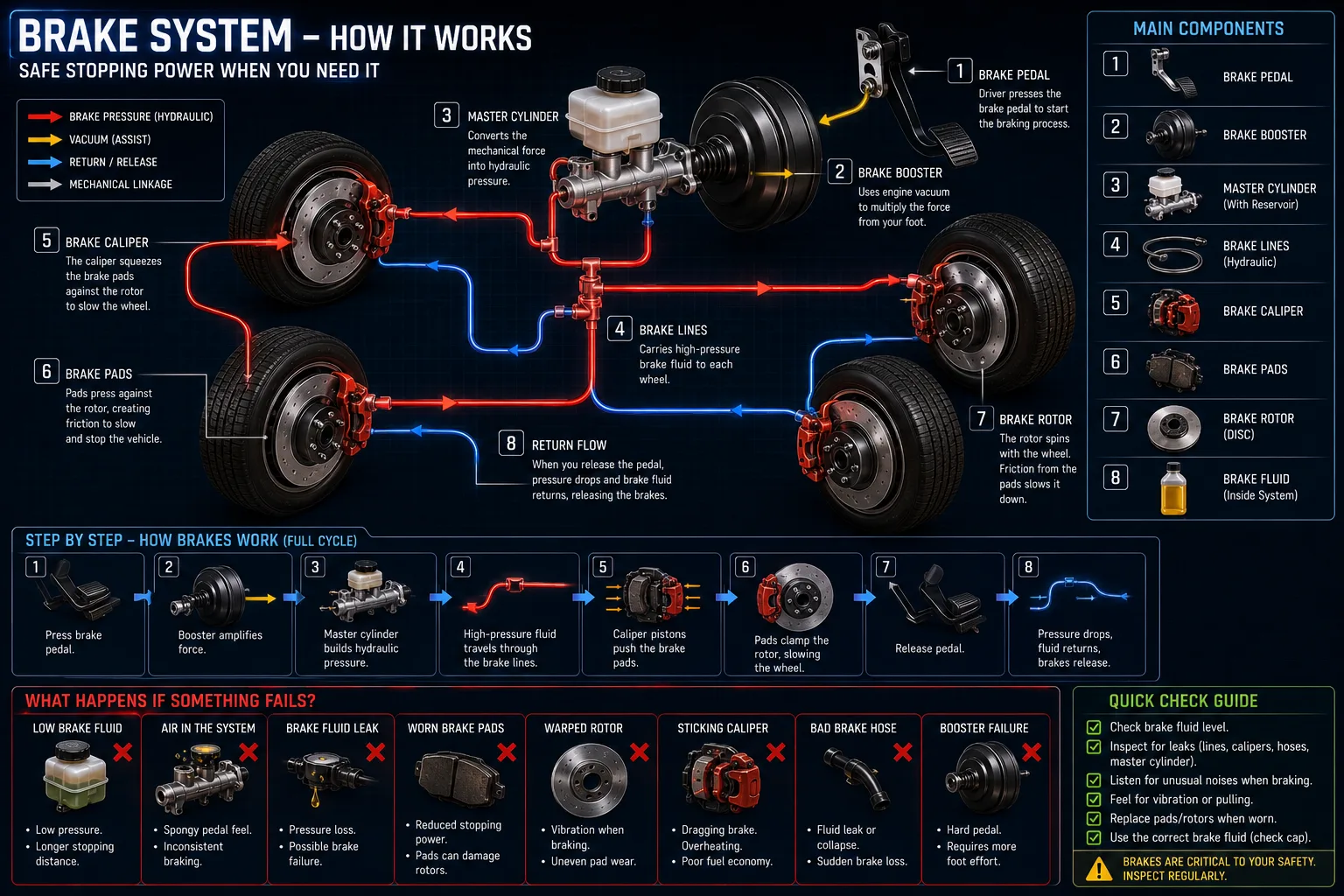
Drum brakes — still fitted to the rear of a huge number of mainstream cars — work on a delightfully old-fashioned principle. Press the brake pedal, and hydraulic pressure travels down the brake line to the wheel cylinder, a small double-acting piston unit mounted inside the drum. The cylinder pushes two curved brake shoes outward against the inside of the spinning drum, friction does its job, and you slow down. Simple enough. The wheel cylinder relies on a pair of rubber cup seals to contain the hydraulic pressure. Those seals are submerged in brake fluid their entire working life, exposed to heat cycles, and eventually they harden, crack, or perish — usually somewhere between 60,000 and 100,000 miles, though corrosion from road salt can accelerate things considerably, especially on UK cars that spend winters behind gritting lorries. When a seal fails, fluid weeps past it and into the drum. Brake fluid is catastrophically effective at contaminating friction material — even a small amount renders the shoes useless, glazing them so they can't generate reliable friction. You end up with an asymmetric braking effect (the car pulls), a spongy pedal (reduced hydraulic efficiency), and a handbrake that no longer holds properly on a slope. At MOT, an inspector will spot brake fluid contamination or a weeping cylinder and it will fail — correctly, because this is a genuine safety defect, not jobsworth box-ticking.
“It's not glamorous, it's not expensive as brake jobs go, and it's entirely fixable on your driveway.”
Sound familiar?
So what's behind it?
What we do — at your door
We come to you — driveway, car park, or wherever the car lives — with everything needed to do the job properly. We pull the wheel and drum, inspect the cylinder for leaks, check the bore condition, and assess the brake shoes for fluid contamination. If the shoes have been soaked, they get replaced too; no point fitting a new cylinder against shoes that'll glaze immediately. We fit a quality replacement wheel cylinder, bleed the brake circuit to purge any air introduced during the repair, and check the handbrake adjustment. If the cylinder bore is corroded beyond what a new cylinder can seal against, we'll tell you clearly before pressing on. Everything is done roadside with professional equipment — no ramps needed for this job. We test the pedal feel and handbrake hold before we leave. If you've had an MOT failure for this fault, we can supply the paperwork needed for the retest.
What affects the price
Wheel cylinder units themselves are modestly priced — this is not a complex or exotic component on most mainstream cars. What drives the total cost is whether the brake shoes need replacing too (contaminated shoes must come out; there's no cleaning brake fluid out of friction material), the condition of the drum (scored or heavily pitted drums may need skimming or replacement), whether both rear cylinders need doing (if one has perished, the other is often close behind and labour is very similar), and brake fluid replacement if it's overdue. Labour for a single cylinder is relatively quick; a full rear drum overhaul takes longer. We quote per-job after inspecting the drum — no guessing, no surprise add-ons.
Random knowledge you didn't ask for
Questions you're probably asking
Can I drive with a leaking rear wheel cylinder?
Briefly and carefully to get somewhere safe — yes. Indefinitely — absolutely not. A leaking cylinder progressively contaminates the brake shoes, reduces rear braking effectiveness, and can eventually cause brake fluid loss from the system. The handbrake will deteriorate too. It's an MOT failure and a genuine safety defect; get it sorted promptly rather than hoping it stabilises on its own.
Do I need to replace both rear wheel cylinders at the same time?
Not always compulsory, but often sensible. If one seal has perished, the other is usually the same age and condition. Replacing both while you've already got the drums off costs a modest amount in extra parts and very little in extra labour — versus coming back in six months for the same strip-down on the other side. We'll check the second cylinder and tell you honestly whether it's showing signs of weeping.
Will I need new brake shoes as well?
If brake fluid has reached the shoes, yes — replacement is mandatory. Brake fluid saturates the friction material and permanently reduces its grip, and no amount of cleaning reverses that. Contaminated shoes also glaze as they heat up, making braking unpredictable. Fitting a new cylinder against contaminated shoes is a false economy: you'll be back within weeks.
My car just failed its MOT for a leaking wheel cylinder. How quickly can you fix it?
Usually within a day or two of booking — this is a straightforward repair and we carry common wheel cylinder units and shoe sets. Once it's done, you'll have the documentation to take back for a free retest (most MOT stations allow a retest within 10 working days at reduced or no cost if the same items are re-presented). We can often accommodate short-notice bookings if you're in the retest window.
Why do some cars still have drum brakes at the rear in 2024?
Cost and practicality, mainly. The rear brakes on a front-engined car do only about 30% of the total braking work — the nose dives under braking and weight transfers forward. A drum setup handles that modest duty perfectly well, weighs less than a disc-and-caliper arrangement, and integrates the handbrake mechanism neatly. Disc rear brakes are better in high-performance applications; for a family hatchback's rear axle, drums are an entirely rational engineering choice.
Rear Wheel Cylinder Replacement — sorted at your door
Stop procrastinating. Get a transparent quote and we'll come to you.