Brake Judder: Why Your Steering Wheel Is Having a Meltdown Every Time You Slow Down
That rhythmic shudder through the steering wheel the moment you touch the brakes — not subtle, not easy to ignore, and absolutely not something that fixes itself. Brake judder is your car's way of telling you that something in the braking system is no longer running true. It might be the discs, it might be a lazy caliper, it might be a dirty hub face — but it is definitely not nothing, and it will get worse. The good news: it's usually very fixable. The less good news: you've probably been blaming "warped discs" when the physics of what's actually happening is considerably more interesting than that. SOSCarFix comes to you, diagnoses the actual cause on-site with proper tools, and fixes it in your driveway before the judder graduates into something genuinely alarming.
See our upfront pricingSteering wheel shaking when you brake? Usually discs, not "warped" ones. SOSCarFix diagnoses & fixes brake judder on your driveway. Get a quote.
How it actually works
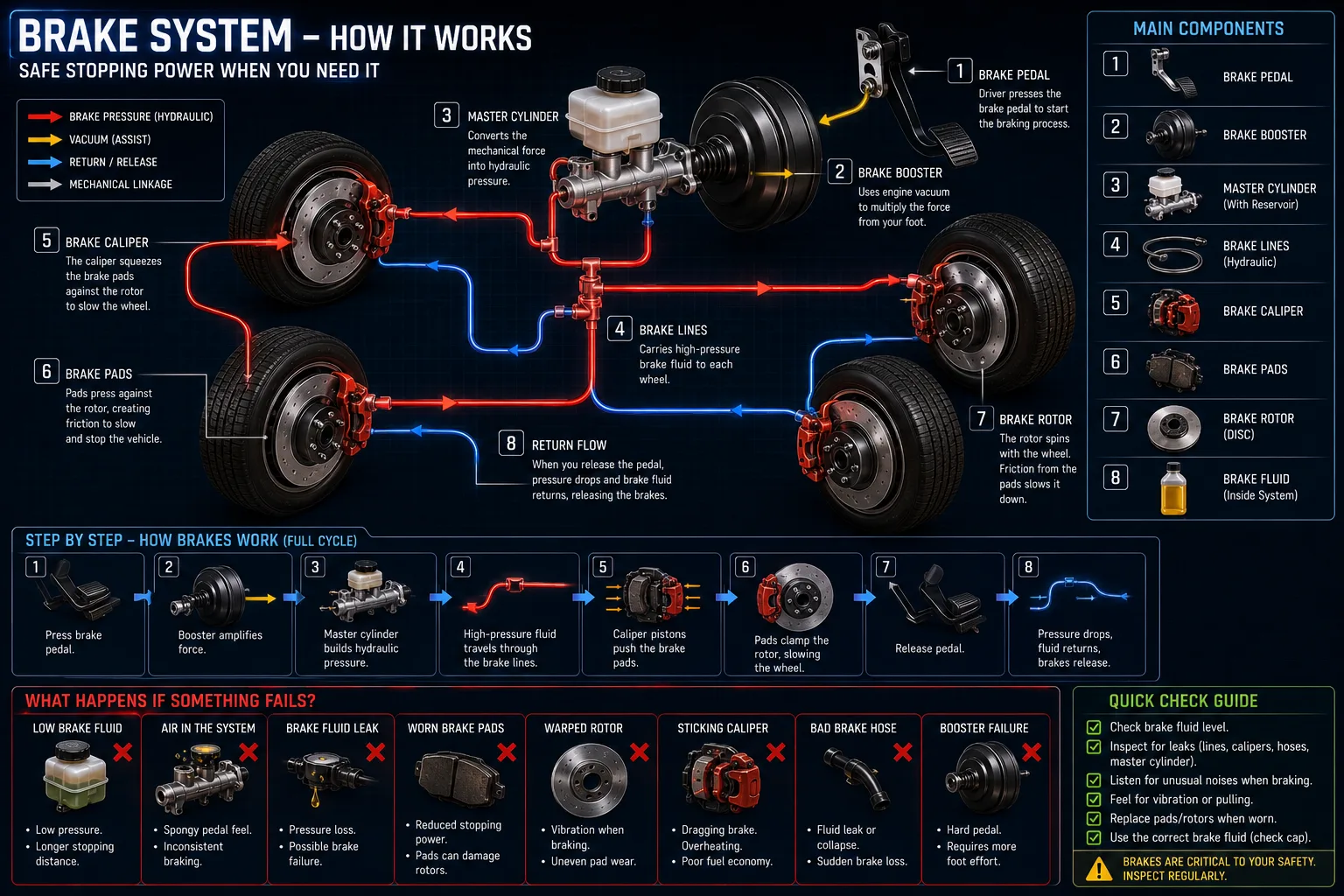
When you press the brake pedal, the caliper squeezes two pads against a spinning disc. For that to generate smooth, consistent stopping force, the disc's braking surface needs to be flat, round, and of uniform thickness as it rotates — every millimetre of it. If it isn't, each rotation delivers a slightly different friction force, which pulses back through the hydraulic fluid, into the pedal, and up through the steering column. That's judder. The common culprit is disc thickness variation — often called DTV. Despite what the internet insists, brake discs very rarely literally "warp" (distort under heat like a biscuit in the oven). What actually happens is that the disc develops uneven thickness, usually from uneven deposits of brake pad material or uneven corrosion, often caused by calipers that aren't releasing fully. Each revolution, the pads hit a thicker spot, then a thinner spot — and you feel every single one of them. Other causes include hub face contamination (rust or debris between the disc and wheel hub knocking the disc slightly off true) and high lateral runout — where the disc wobbles slightly side to side as it spins, which amounts to the same problem by a different route. The judder is typically worst at higher speeds and lighter braking, and may ease under heavy braking when thermal expansion temporarily smooths things out — which is one useful clue during diagnosis.
“Brake judder is your car's way of telling you that something in the braking system is no longer running true.”
Sound familiar?
So what's behind it?
What we do — at your door
We come to you — driveway, car park, workplace — and we don't guess. With the car on axle stands and a dial test indicator we measure actual disc runout and check for thickness variation around the disc face, which tells us whether we're dealing with DTV, runout, or both. We inspect caliper movement and piston retraction to catch sticking calipers before they ruin the new discs too. Hub faces get cleaned of rust and debris before anything goes back on, because fitting a disc to a crusty hub face and then wondering why there's judder is a surprisingly common own goal. If discs are below manufacturer minimum thickness or too far gone to resurface (most modern discs are too thin to safely skim), we replace them — pads too if needed, matched and properly bedded in. All on-site, no garage drop-off, and we quote before we do anything.
What affects the price
Cost varies considerably depending on which axle is affected, the vehicle, and what the root cause actually is. A single sticking caliper service (freeing off, lubricating, checking seals) is quite different from a full front axle disc-and-pad replacement on a large SUV with aftermarket discs on back order. Quality of parts matters too — budget discs from unknown brands have a poor record for DTV straight out of the box, which is exactly why you came in with judder in the first place. We use reputable OEM-quality brands. Labour for brake work is typically charged per axle, and if the hub face needs cleaning or a caliper slider service adds time, we'll tell you before we do it. Expect front discs and pads together to sit in the middle range for most common cars; rear jobs vary more depending on whether it's disc or drum, and whether the handbrake integrates into the caliper (it usually does, and it adds fiddliness).
Random knowledge you didn't ask for
Questions you're probably asking
Is it safe to drive with brake judder?
Depends on severity. Mild judder at low speeds with no loss of stopping power is irritating rather than immediately dangerous — but the underlying cause is either worsening disc wear or a sticking caliper, both of which will get worse. If the judder is severe, the car is pulling to one side under braking, or you notice longer stopping distances, stop driving and get it inspected. A sticking caliper especially can escalate quickly.
My discs were replaced six months ago. Why is it juddering again?
A few possibilities: the hub face wasn't properly cleaned before the new discs went on (contamination causes runout from day one); the new discs weren't bedded in correctly — short stops at speed with plenty of cooling time are essential; or the caliper is sticking and has already started building uneven deposits on the new disc surface. It's not always the part's fault.
Can warped discs be skimmed rather than replaced?
In theory yes — a lathe can resurface a disc. In practice, most modern cars have relatively thin discs with a tight minimum thickness tolerance, and skimming takes more material off. Most UK garages (us included) find it's usually more cost-effective and longer-lasting to replace them, especially if they're already near minimum thickness.
The judder only happens at higher speeds when I brake gently. Is that normal?
That's actually a very useful diagnostic clue — it points strongly toward disc thickness variation or runout rather than a sticking caliper (which typically causes judder at all speeds). Light braking at speed magnifies even small variations because the pads are just barely kissing the disc surface and every high spot is felt directly. Heavy braking often masks it because the pads are pressing hard enough to average it out.
Do you need to take the car anywhere or can you really fix brake judder on my driveway?
Genuinely on your driveway. We carry axle stands, a torque wrench, a dial indicator for runout measurement, and the parts most commonly needed. If we find something requiring specialist equipment we'll tell you honestly, but brake disc and pad jobs — including caliper services and hub face cleaning — are routine mobile work.
Brake Judder — sorted at your door
Stop procrastinating. Get a transparent quote and we'll come to you.