ABS Pump Replacement — Because 15 Pulses Per Second Is Slightly Beyond Human
Your foot thinks it's pretty good at braking. Stomp, hold, done. Except in an emergency stop, that approach locks the wheels, kills your steering, and turns your car into a very expensive toboggan. Enter the ABS pump — a compact hydraulic genius that modulates your brake pressure up to 15 times a second, keeping each wheel spinning just enough to stay in contact with the road while you aim for the gap in traffic. When it works, you never notice it. When it doesn't, that's when things get interesting. SOSCarFix replaces ABS pumps at your home, workplace, or anywhere else you've parked up — fully equipped, no ramp required.
See our upfront pricingABS pump failing? SOSCarFix replaces it at your door — no garage, no drama. The little machine doing 15 brake pulses a second so your foot doesn't have to. Get a quote today.
How it actually works
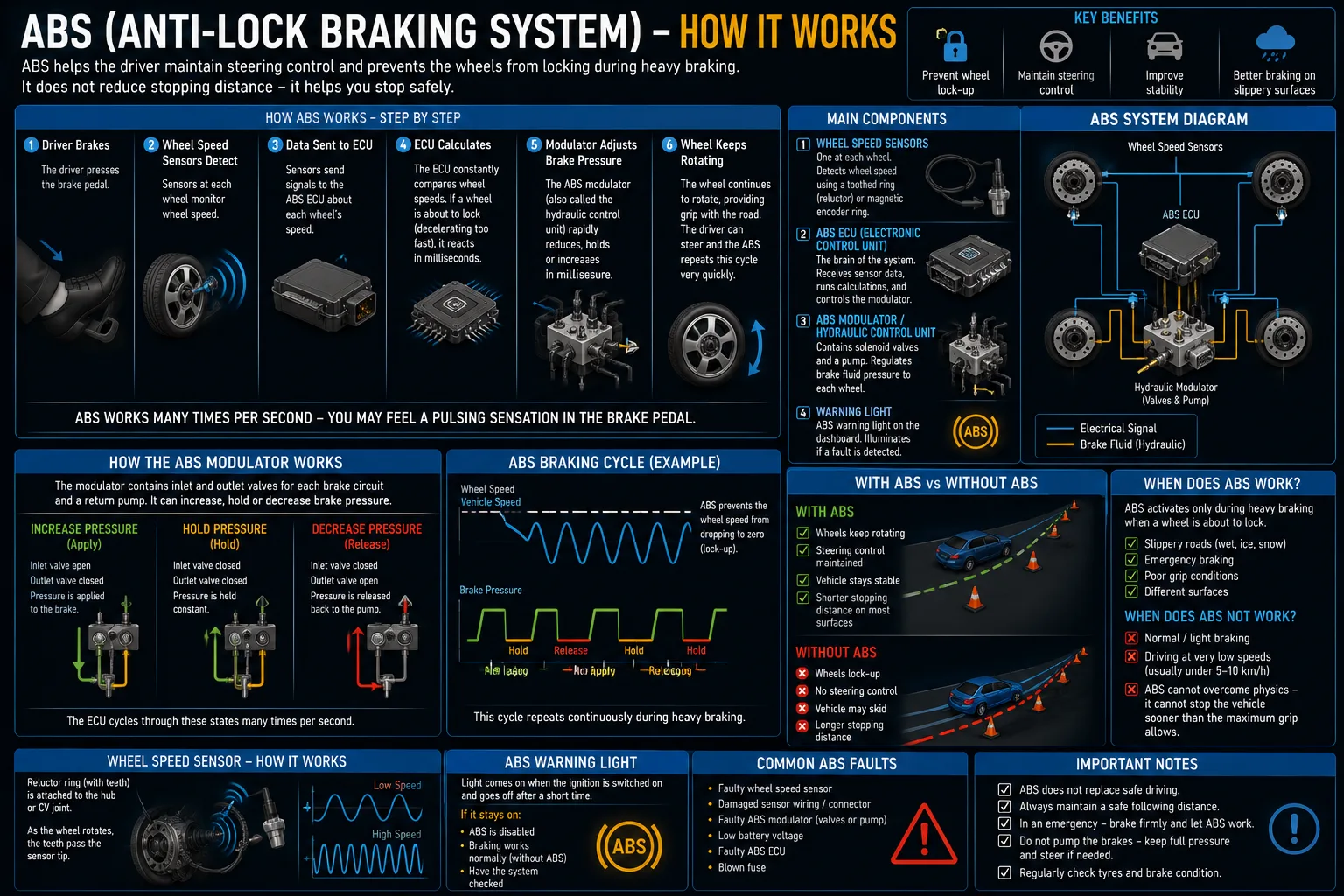
The ABS pump — more accurately called the hydraulic control unit or HCU — sits between your brake master cylinder and your individual calipers. The moment a wheel speed sensor reports that a wheel is decelerating faster than the others (i.e. it's about to lock), the ABS ECU triggers the pump to cycle through three phases in rapid succession: hold (inlet solenoid slams shut, pressure stops rising), reduce (outlet solenoid opens, fluid dumps into a low-pressure accumulator, wheel unlocks), then increase (pump motor fires up, pressure is pushed back into the circuit, braking resumes). This whole sequence repeats up to 15 to 20 times every single second — which is why you feel that characteristic stutter through the pedal during a hard stop. That's not a fault; that's the pump doing its one and only job at a pace your leg physically cannot match. Replacing the unit means disconnecting brake lines and electrical connectors, fitting the new pump, bleeding the entire hydraulic system to chase out any trapped air, and — on most modern cars — coding the new unit to the vehicle's VIN and running a software calibration. It's not a windscreen-wiper job. It needs the right tools, diagnostic equipment, and someone who knows what a spongy pedal after the bleed means.
“SOSCarFix replaces ABS pumps at your home, workplace, or anywhere else you've parked up — fully equipped, no ramp required.”
Sound familiar?
So what's behind it?
What we do — at your door
When you book an ABS pump replacement with SOSCarFix, we come to you — home, work, car park, wherever the car's sitting. We arrive with the diagnostic kit to confirm the fault codes first, because ABS warning lights can be triggered by wheel speed sensors and wiring faults too, and there's no point replacing a perfectly good pump. Once the correct component is confirmed, we remove the old unit, disconnect the brake lines and electrical connectors, fit the replacement, and bleed the entire brake circuit — using a scan tool where the system requires it to cycle the ABS valves and chase trapped air out of the HCU passages. On modern vehicles we also handle the coding and calibration, linking the new unit to your car's VIN and running the software routines to initialise the wheel speed and yaw sensors. Before we leave, the ABS and traction control warning lights are off, the pedal feel is solid, and the system is verified working. No dropping your car off, no waiting, no collecting it again.
What affects the price
What affects the quote: the make and model of the car (an ABS unit for a common Ford Focus is a very different part to one for a BMW 5 Series or a Land Rover), whether the unit is being replaced new or with a quality reconditioned part, how many brake lines connect to your specific HCU, whether your vehicle requires dealer-level coding and calibration to accept the new unit, and whether any secondary faults — corroded connectors, damaged wheel speed sensors, contaminated brake fluid — need addressing at the same time. We give bespoke quotes because a single price for ABS pump replacement across all UK cars would be either eye-watering or a lie. Get in touch with your registration and we'll give you a straight answer.
Random knowledge you didn't ask for
Questions you're probably asking
Is it safe to drive with an ABS warning light on?
Your standard brakes will usually still work — you haven't lost your ability to stop. What you've lost is the system that stops your wheels locking under hard braking, which means on a wet road or in an emergency stop, you're more likely to skid and lose steering control. It's legal to drive but not advisable, and it will fail an MOT. Get it looked at sooner rather than later.
Can a faulty wheel speed sensor cause the ABS light to come on instead of the pump?
Absolutely, yes — and this is exactly why we run diagnostics before recommending a pump replacement. Wheel speed sensors, their wiring, reluctor rings, and the ABS ECU can all throw the same warning light. Swapping a pump for a sensor fault is an expensive mistake. We check the fault codes first.
Why does ABS pump replacement sometimes involve coding?
On most modern vehicles, the ABS control module is paired to the car's ECU and VIN. Fit a new unit without coding it and the car either won't recognise it or the stability and traction control systems won't initialise correctly. Some vehicles also require a software calibration routine that cycles the pump and reads the yaw and wheel speed sensors to confirm everything is set up right. Our mobile setup handles this on-site.
How long does an ABS pump replacement take?
Typically two to three hours, depending on the vehicle. The physical swap is straightforward on most cars; the time is in bleeding the brake circuit properly — rushing that and leaving air in the HCU is how you end up with a spongy pedal — and running the coding and calibration if the car requires it. We do not rush the bleed.
ABS Pump Replacement — sorted at your door
Stop procrastinating. Get a transparent quote and we'll come to you.