Spongy Brake Pedal: The Whodunnit Under Your Foot
You press the brake pedal and instead of the firm, reassuring resistance of a properly functioning hydraulic system, your foot sinks into what feels like standing on a wet flannel. The car does eventually stop, but so does your confidence in it. That squidgy, bath-sponge sensation isn't your foot playing tricks — it's your brake system staging a quiet protest, and it's narrowing down a list of suspects that all require a proper investigation. The good news: a spongy pedal is almost always diagnosable. The less good news: it's never a symptom you get to ignore.
See our upfront pricingYour brake pedal feels like a bath sponge — and that's not a vibe. SOSCarFix mobile mechanics come to you, diagnose the culprit, and sort it. No garage faff.
How it actually works
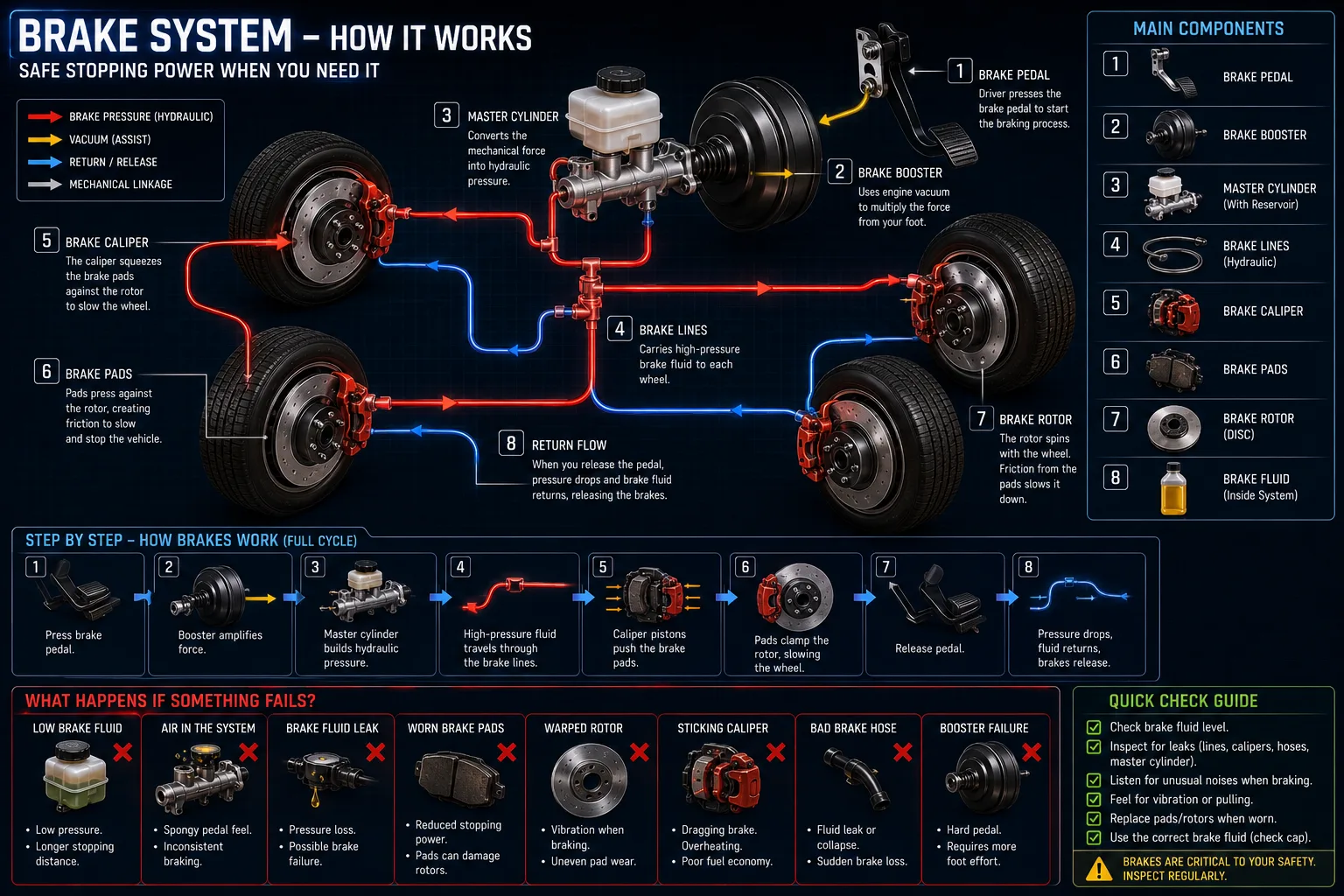
Your braking system is, at its heart, a hydraulic circuit. Press the pedal and you push a piston inside the master cylinder, which sends brake fluid — an incompressible liquid — through steel lines and rubber hoses to the caliper at each wheel. That fluid pressure pushes the caliper pistons outward, clamping the brake pads against the disc. Incompressible fluid means a firm, direct pedal feel — your foot's force goes straight to the wheel with no faffing about. Now introduce something compressible into that circuit — air, vapour, a flexy hose, or a weeping seal — and suddenly your pedal force is wasted squishing that compressible thing rather than stopping the car. The pedal travels further, feels marshy, and the whole system becomes a liability. The spongy pedal is the symptom. The suspect list is what we're here to work through.
“The car does eventually stop, but so does your confidence in it.”
Sound familiar?
So what's behind it?
What we do — at your door
When your SOSCarFix mobile mechanic arrives — at your driveway, workplace, or wherever the car has inconvenienced you — they run through the whodunnit properly rather than just reaching for the brake bleed kit and hoping. We'll check the fluid level and condition, inspect for external leaks at every component in the system, test pedal behaviour under sustained pressure to catch internal master cylinder bypass, and assess each caliper and hose. Once the actual suspect is identified, we'll advise on the repair — whether that's a full brake fluid flush and bleed to purge air and old fluid, caliper or master cylinder replacement, hose renewal, or a combination of the above. Everything we do is explained plainly, nothing is fitted without your sign-off, and the work is done to a standard your brakes can actually depend on.
What affects the price
The spread between a simple brake bleed and a full master cylinder replacement is genuinely significant, so the diagnosis matters before the quote. Factors that affect the final figure include: which component is actually at fault (air in the lines is considerably less involved than a failing master cylinder); whether one corner has a leaking caliper or the issue is system-wide; the age and condition of the rubber hoses, which often benefit from renewal as a set if one has already collapsed internally; the specific brake fluid specification your vehicle requires (some modern systems demand DOT 4 or higher-rated fluid at a premium over bog-standard DOT 3); and how much of the hydraulic system needs to be opened up and re-bled once the repair is complete. We give bespoke quotes based on what we actually find — not a menu price that assumes a best-case scenario before anyone has looked at the car.
Random knowledge you didn't ask for
Questions you're probably asking
Is it safe to drive with a spongy brake pedal?
Bluntly: no. A spongy pedal means your braking system has reduced or unpredictable hydraulic pressure, and the gap between 'it still stops eventually' and 'it doesn't stop at all' can close very quickly — particularly if a leak worsens, fluid boils under hard braking, or a caliper fails entirely. Get it looked at before driving further than is absolutely necessary, and avoid motorways or any situation requiring emergency stops.
Can I just top up the brake fluid and carry on?
Topping up the reservoir treats a symptom and ignores the cause. Brake fluid doesn't evaporate — if the level is low, fluid has gone somewhere, and whatever hole it escaped from will keep losing fluid until the problem is fixed. Topping up might buy you a day or two before the level drops again, but it doesn't address the air that's likely entered the system, and it certainly doesn't repair a leaking caliper or failing master cylinder.
How often should brake fluid be changed even if the pedal feels fine?
Most manufacturers recommend every two years regardless of mileage, and it's genuinely worth following. The hygroscopic nature of glycol-based brake fluid means moisture accumulation is constant and invisible — the pedal can feel perfectly fine right up until the fluid's boiling point has dropped far enough to cause vapour lock under a hard stop. A periodic fluid change is cheap insurance against a very inconvenient conversation with the armco.
Why does my pedal feel spongy only when the brakes are hot?
Heat is the tell-tale sign pointing toward moisture-contaminated brake fluid. Cold fluid behaves well enough; heat the system up with repeated braking and any absorbed water turns to vapour, creating compressible bubbles in the lines — the textbook definition of vapour lock. The pedal firms back up once everything cools down, which is why it can feel like a disappearing problem. It isn't. A full fluid flush and bleed will sort it.
There's a puddle near one of my wheels and my brake pedal feels soft — is it a brake fluid leak?
Almost certainly, yes. Brake fluid leaking at a wheel usually means a failing caliper seal, a weeping wheel cylinder (on drums), or a cracked brake pipe — and any of those will put air or low fluid pressure into the hydraulic circuit, which is exactly why the pedal feels like a sponge. This is not a "keep an eye on it" situation. Drive with compromised brakes and you may not stop at all. Get it diagnosed today.
Spongy Brake Pedal — sorted at your door
Stop procrastinating. Get a transparent quote and we'll come to you.