Brake Master Cylinder Replacement
Most brake problems are at least honest about themselves — a puddle on the drive, a squeal that embarrasses you at traffic lights, fluid that's clearly gone somewhere. The brake master cylinder, however, has mastered the art of silent sabotage. No puddle. No warning light. No drama. Just a pedal that, if you hold it long enough at a junction, quietly migrates toward the carpet like it's got somewhere better to be. It's the brake system's stealth villain: failing completely internally, bypassing its own seals and dumping pressure back into the reservoir while giving you precisely zero external evidence that anything is wrong. You're not imagining it. Your brakes are not fine. And no, pumping the pedal harder is not a long-term strategy. Let's sort it.
See our upfront pricingPedal slowly sinking to the floor but not a drop on the drive? That's your brake master cylinder playing stealth villain. SOSCarFix replaces it at your door — no garage, no faff.
How it actually works
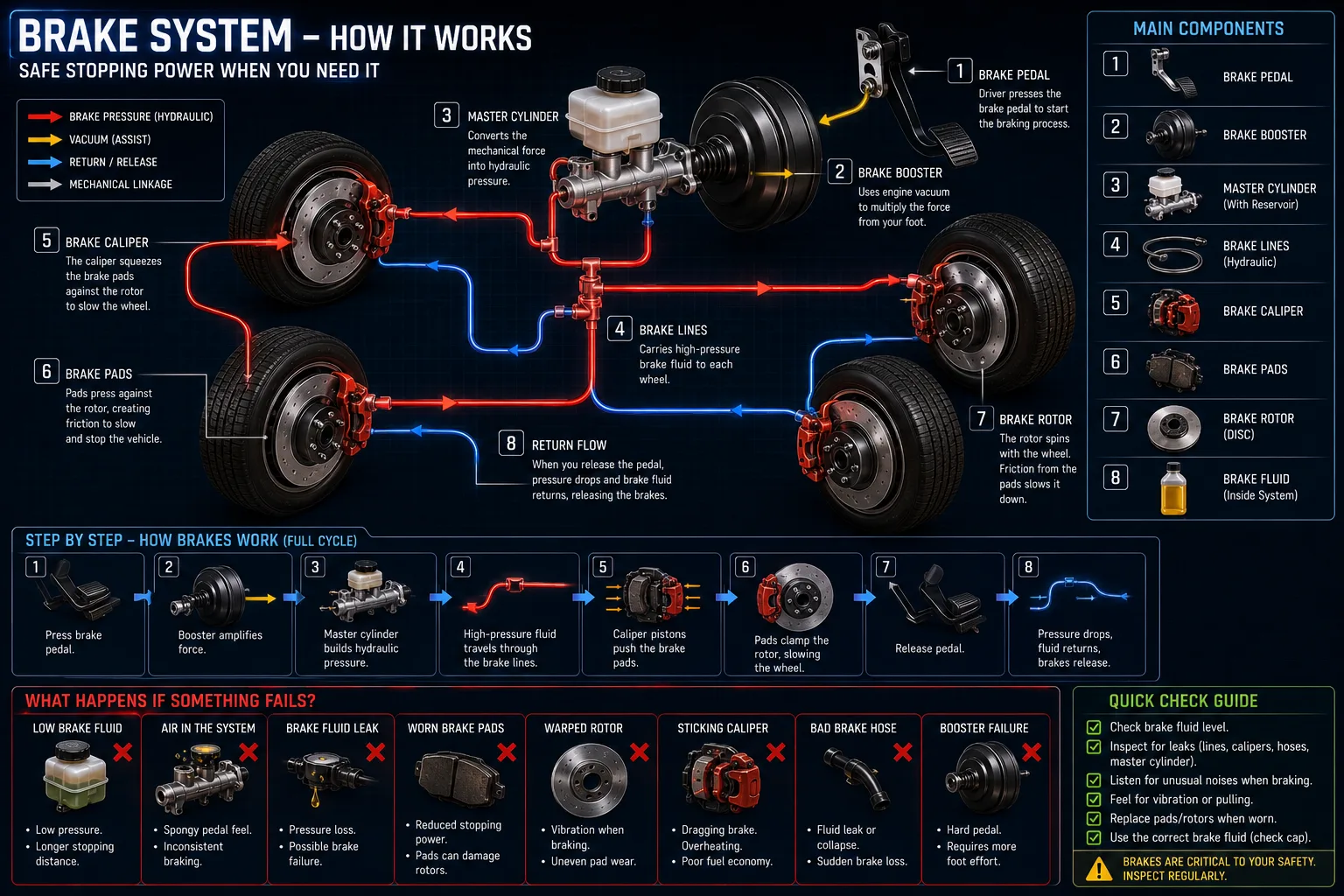
The master cylinder is the hydraulic heart of your braking system. Press the pedal, and two pistons inside the master cylinder pressurise brake fluid and push it down the brake lines to the callipers at each wheel — which then clamp the pads onto the discs and bring your two-tonne conveyance to a polite halt. Modern master cylinders are tandem units: two separate hydraulic circuits in a single bore, one behind the other, so that if one circuit has a catastrophic failure the other still works. Belt and braces. Sensible. The villain in our story is the internal rubber cup seal. Over time — helped along by heat, moisture in the brake fluid, and general mechanical misery — these seals wear and harden. When they go, instead of pushing pressurised fluid forward to your brakes, the pistons just let it slip past and return to the reservoir. Pressure builds, then bleeds away. The pedal moves, initially feels normal, then slowly keeps moving. The fluid isn't going anywhere you can see. It's just going the wrong way inside the cylinder. Your reservoir level might barely drop. There is no puddle. The car looks fine. It is not fine.
“The brake master cylinder, however, has mastered the art of silent sabotage.”
Sound familiar?
So what's behind it?
What we do — at your door
We come to you — home, work, or the car park where you wisely stopped rather than continuing to drive on a slowly dying brake system. Our mobile mechanics carry the tools and parts to replace your brake master cylinder on-site, no recovery truck required. We'll confirm the diagnosis first, because a sinking pedal can theoretically point to other hydraulic faults — we want to fix the right thing. Once confirmed, we remove the old master cylinder, fit the replacement (quality parts, not the cheapest thing with a warehouse address in a tax haven), bleed the entire system properly to remove any air and refresh the fluid in the lines, and road-test it before we consider the job done. We also won't leave you with a mystery. If something else is going on in the brake system — a caliper, a flexi-hose, a brake line that looks like it's had a difficult life — we'll tell you clearly, not in a vague 'it might need looking at' way that generates a follow-up invoice. Straight talk. Accurate diagnosis. Brakes that work properly at the end of it.
What affects the price
Several things move the price around, and we'll give you a proper quote rather than a number we've invented. The main factors: the make and model of your vehicle, because a master cylinder for a common Ford and one for a low-volume European sports saloon live in completely different price brackets; whether the job requires bleeding just the master cylinder circuit or the full system; whether the brake fluid is in a condition that means it needs a complete change while we're in there (it usually does — we'll tell you honestly); and whether any related components like the brake servo, reservoir cap, or brake lines need attention while access is already good. Labour time varies too — some installations are twenty minutes, others involve removing ancillary components to reach the unit. We'll tell you exactly what you're paying for before we start.
Random knowledge you didn't ask for
Questions you're probably asking
My pedal only sinks when I hold it, but feels fine when I first press it — is it definitely the master cylinder?
That specific symptom — builds pressure, then slowly bleeds away under a held pedal — is textbook internal master cylinder seal bypass. It means the seals are still moving fluid initially but can't hold the pressure. It's the master cylinder until proven otherwise, and it won't improve on its own.
Can I still drive the car to you?
Honestly? We'd rather come to you. A failing master cylinder can feel driveable right up until it isn't, and 'until it isn't' is a fairly terrible moment to discover that. Get it recovered or let us come to wherever it's safely parked — that's what mobile mechanics exist for.
Is it worth just rebuilding the seals rather than replacing the whole unit?
In theory, yes — seal kits exist. In practice, if the seals have failed, the bore has almost always seen some wear or corrosion too, and new seals in a worn bore just fail again sooner. A replacement unit is the reliable fix. We'll fit a quality part, not the cheapest option available, because it's your brakes.
How often should brake fluid be changed to prevent this?
Every two years is the standard recommendation, and it's one that most vehicles on UK roads are significantly overdue on. Old, moisture-laden fluid is the single biggest accelerant of master cylinder seal failure — a regular fluid change is genuinely preventative, not just a box-ticking exercise.
Brake Master Cylinder Replacement — sorted at your door
Stop procrastinating. Get a transparent quote and we'll come to you.