Brake Servo Repair: When Your Hidden Gym Buddy Goes AWOL
There's a quiet, unsung hero bolted between your brake pedal and master cylinder. It asks for nothing, gets zero credit, and works invisibly every single time you slow down. The brake servo — aka the vacuum booster — takes the gentle suggestion your foot offers and multiplies it into the kind of force that actually stops a moving tonne of metal. When it's working, you stop with a confident nudge of the pedal. When it stops working, suddenly your leg needs to do the full heavy lifting. Unaided. At speed. Which is, to put it mildly, not ideal.
See our upfront pricingYour brake servo is the hidden muscle that turns a gentle toe-press into serious stopping force. When it packs in, your leg pays the price. SOSCarFix fixes it at your door — no garage required.
How it actually works
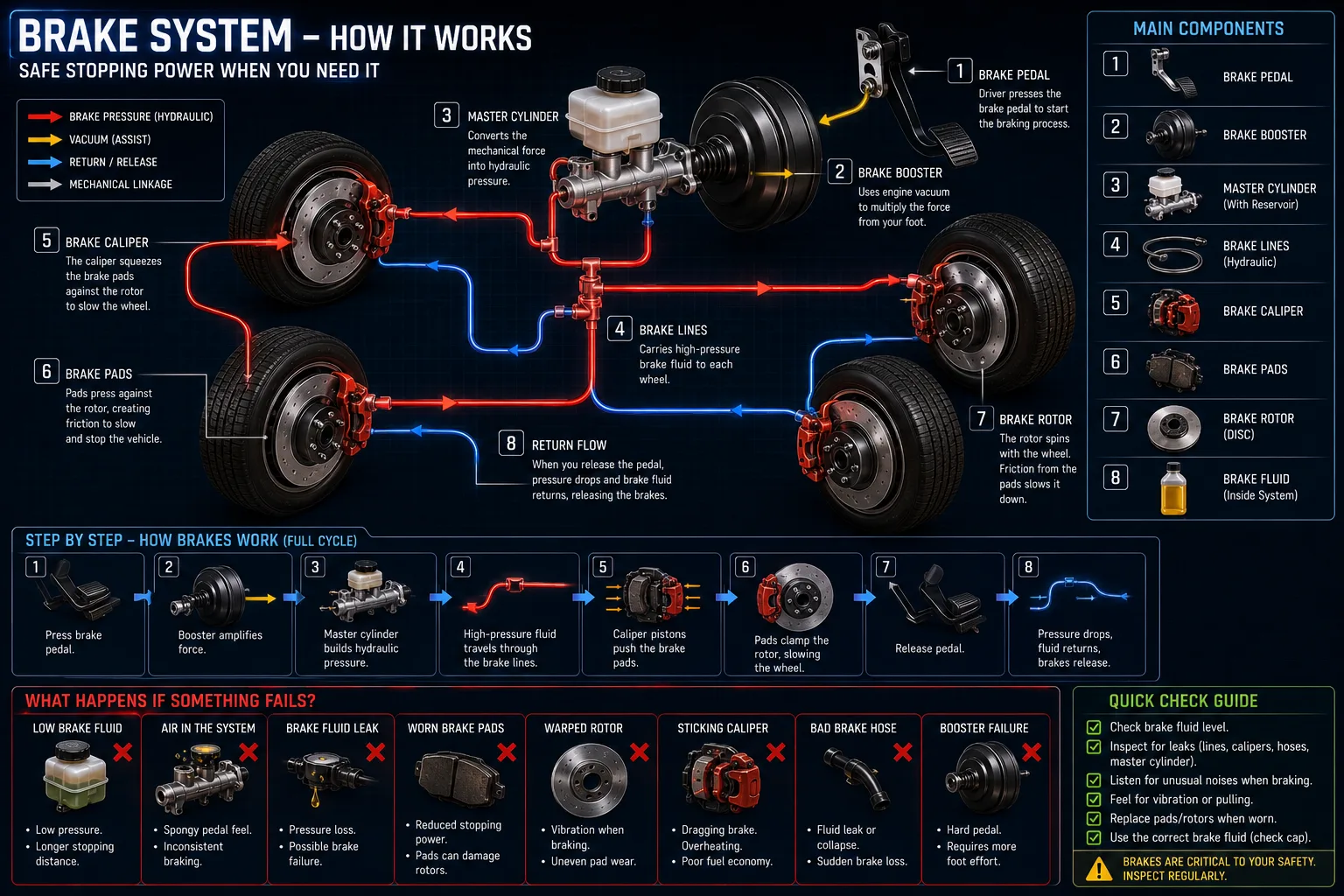
Your brake servo is a sealed canister — typically about the size of a large Tupperware bowl — mounted right behind the brake pedal on the bulkhead. Inside sits a rubber diaphragm dividing the canister into two chambers. When the engine runs, one side of that diaphragm is held under vacuum drawn from the intake manifold (or a dedicated vacuum pump on diesels and modern petrol engines). The other side sees atmospheric pressure the moment you press the pedal — and that pressure difference shunts the diaphragm forward with considerable force, dramatically amplifying what your foot put in. We're talking about potentially hundreds of pounds of extra force generated from a pressure differential of roughly 7 psi across 60–80 square inches of diaphragm. In short: atmospheric pressure is doing your leg's gym work, quietly, every single time. Push the pedal, the valve opens, physics does the rest, the amplified force hits the master cylinder, and your car stops like it means it. The whole thing resets when you lift off. No electricity involved. Beautifully simple — right up until the rubber perishes, a hose cracks, or the diaphragm decides it's done.
“It asks for nothing, gets zero credit, and works invisibly every single time you slow down.”
Sound familiar?
So what's behind it?
What we do — at your door
A faulty brake servo is a safety issue, full stop — we don't mess about with those. When our mobile mechanic arrives, we start with a proper diagnostic: the classic pump-and-hold test (pump the pedal to firm with the engine off, hold it down, start the engine — it should drop slightly as vacuum kicks in), a vacuum gauge on the system, and a thorough inspection of every hose, the non-return valve, and the servo housing itself. We'll tell you exactly what's failed and why before we touch anything. If it's the vacuum hose or the non-return valve, that's often a straightforward repair on your driveway. If the servo unit itself is done for, we replace it — and while we're in there, we check the master cylinder too, because the two live in close quarters and sometimes suffer together. Everything done at your home, your workplace, or wherever the car happens to be parked. No tow truck needed.
What affects the price
Several things affect what a brake servo job actually costs: the make and model of the vehicle (a servo for a Volkswagen Golf is a very different proposition to one for a Land Rover Defender, in both sourcing and labour time); whether it's the servo itself or just associated components like the vacuum hose or non-return valve — the latter are considerably simpler jobs; whether a dedicated vacuum pump has also failed, which adds parts and labour; and the accessibility of the servo in your specific engine bay, since some manufacturers seem to hide it behind everything else they own. We assess all of this on arrival and give you a bespoke quote before we start — no guesswork, no surprises.
Random knowledge you didn't ask for
Questions you're probably asking
Is it safe to drive with a faulty brake servo?
Technically the brakes still work without servo assistance — the hydraulics are still connected and your foot still operates the master cylinder. But you'll need to press significantly harder to achieve the same stopping force, and in a genuine emergency stop that extra reaction time and physical effort matters. We'd strongly advise against using the car beyond what's strictly necessary to get it seen to. This one goes in the 'don't hang about' column.
How do I know if it's the servo or the master cylinder that's failed?
They're neighbours and their symptoms can overlap, which is why proper diagnosis matters. A classic servo failure gives a hard pedal with normal (or near-normal) pedal height — the brakes work, they just require force. A master cylinder issue more commonly shows up as a pedal that sinks to the floor, feels spongy, or drops under sustained pressure. That said, they can fail together, and occasionally a dodgy servo creates back-pressure that accelerates master cylinder wear. We test both as a matter of course.
Can the brake servo be repaired rather than replaced?
Usually not in any meaningful sense. The servo housing is typically crimped or welded shut, and the diaphragm inside isn't a serviceable item on most modern vehicles. If the failure is in the external vacuum hose, the non-return valve, or the vacuum pump feeding the servo, those absolutely can be repaired or replaced individually — and we'll always do that if it's the appropriate fix. But if the servo unit itself has failed internally, a replacement unit is the correct call.
My car has an electric brake booster rather than a vacuum one — does that change anything?
Yes, increasingly so. Hybrids and full EVs don't run a conventional intake vacuum system, so they use an electric vacuum pump or a fully electrohydraulic booster instead. The symptoms of failure are broadly similar — hard pedal, warning lights, inconsistent assistance — but the diagnosis and repair route is different. We work on these too; just flag it when you book and we'll make sure we arrive prepared for the right system.
Brake Servo Repair — sorted at your door
Stop procrastinating. Get a transparent quote and we'll come to you.