Cooling System Service
AKA 'Spicy Water Department' — The forbidden Kool-Aid your engine drinks.
Overheating? Coolant leak? Temperature gauge doing scary things? We fix radiators, water pumps, thermostats, and everything that keeps your engine cool.
See our upfront pricingQuick Facts
What's This All About Then?
Engines like to be warm. They do NOT like to be on fire. Your cooling system is the difference between 'running fine' and 'head gasket failure' (which costs roughly one mortgage payment). If your temperature gauge is climbing, there's steam coming from somewhere, or you're leaving puddles of sweet-smelling liquid everywhere - that's coolant, and it should be inside your car. We diagnose cooling system issues, fix leaks, replace radiators, water pumps, thermostats, hoses, and make sure your engine stays at the temperature the engineers intended.
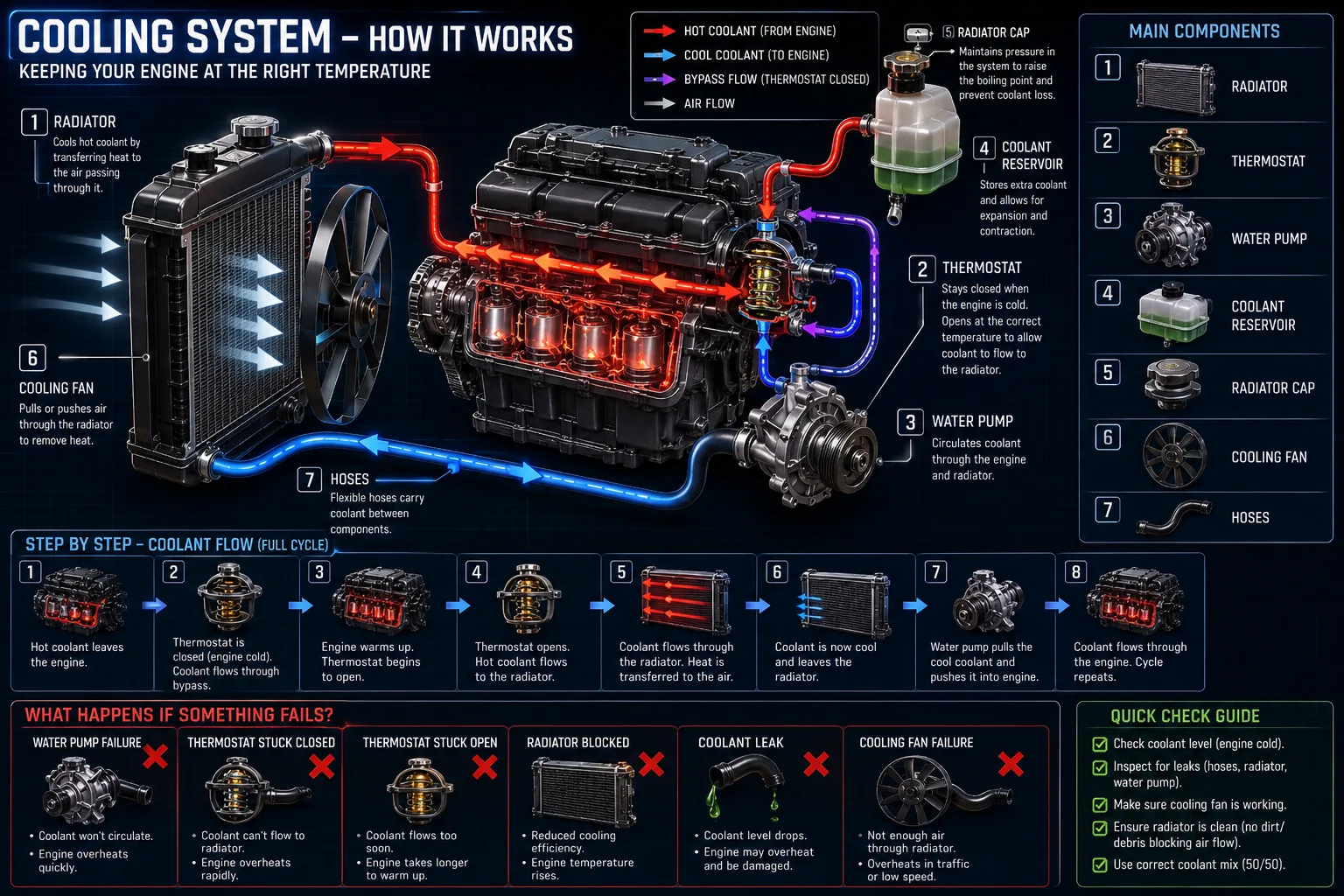
How it works
Burning fuel makes huge heat, and a lot of it goes into the engine's metal. To stop it cooking, coolant — a mix of water and antifreeze — is pumped around passages inside the engine by the water pump. Hot coolant flows to the radiator at the front, where airflow (helped by an electric fan) draws the heat away, then it circulates back. A thermostat acts as a gatekeeper: it stays shut when the engine's cold so it warms up quickly, then opens to let coolant reach the radiator once it's up to temperature. The whole system is pressurised — which raises the coolant's boiling point — and sealed by the cap. That pressure is exactly why you must never open a hot cooling system: superheated coolant can flash to steam and scald badly.
Warning signs to watch for
- •The temperature gauge creeping up or into the red — the clearest sign something's wrong; stop and let it cool
- •A sweet, syrupy smell — the distinctive scent of leaking coolant
- •A puddle of coloured fluid under the car — usually pink, orange, blue or green coolant
- •The heater blowing cold when the engine's warm — often low coolant or an airlock
- •Coolant level dropping and needing regular topping up — a leak somewhere in the system
- •Steam from under the bonnet — an overheating engine; stop safely and switch off
Common causes
What we do
We pressure-test the system to find leaks, check the pump, thermostat, fan and hoses, and inspect the coolant's condition. We replace failed pumps, thermostats, radiators and hoses, then refill and properly bleed the system so there are no air pockets left to cause hot spots. If we suspect a head gasket we'll test and tell you honestly. It's all done at your home or workplace, no drop-off needed.
Cooling System Service — FAQs
My car is overheating — what should I do right now?
Stop as soon as it's safe and switch the engine off to prevent serious damage; overheating can wreck an engine fast. Do not open the coolant cap while it's hot — the system is pressurised and can spray scalding coolant and steam. Let it cool right down first. Then call us: we'll come to you, diagnose the cause, and get it sorted rather than risk a costly engine failure.
Why can't I just top it up with water?
Plain water in an emergency will get you moving, but it's not a fix. Proper coolant contains antifreeze that raises the boiling point and, importantly, carries corrosion inhibitors that stop the inside of your engine and radiator rusting up. Watered-down coolant also freezes in winter, which can crack the engine block. And if you're constantly topping up, you have a leak that needs finding and fixing, not masking.
Is a coolant leak an emergency?
It can become one. A small leak may just need topping up and a hose or clip replaced, but if the level drops enough the engine overheats — and that can cause expensive damage like a warped head or blown gasket. So while it isn't always urgent, it should never be ignored. Get it diagnosed promptly; we can pressure-test to find exactly where it's escaping and fix it.
What You Actually Get
Common Cooling System Service Faults We Fix
Random Knowledge You Didn't Ask For
Your engine runs at about 90°C normally. Boiling point of coolant is around 120°C. Closer than you'd like.
Coolant doesn't just cool - it also prevents corrosion and freezing. It's basically engine blood.
Why Get Your Cooling System Service Done By Us?
We're Quick
Fast response, efficient work. No dragging things out.
We Come To You
Your driveway, your office, wherever. We travel.
We Guarantee It
If we mess up, we fix it. Simple as that.