Car Overheating: The Temp Gauge Horror Film Nobody Booked Tickets For
You glance at the dashboard. The temperature gauge — the one you've never once paid attention to — is doing a slow, steady climb toward the red. It's got the same energy as a horror film where the music gets just slightly louder every few seconds and nobody in the audience can believe the protagonist hasn't noticed yet. But you've noticed. And here you are. The good news: you found this page before the steam made the decision for you. The bad news: your engine is not having a good time, and the next few minutes matter enormously. SOSCarFix mobile mechanics deal with overheating cars all over the UK. We come to wherever you've pulled over — because pulling over is exactly what we need to talk about first.
See our upfront pricingThat temperature gauge creeping into the red is not a suggestion — it's a horror film and your engine is the victim. SOSCarFix mobile mechanics come to you before the plot twist.
How it actually works
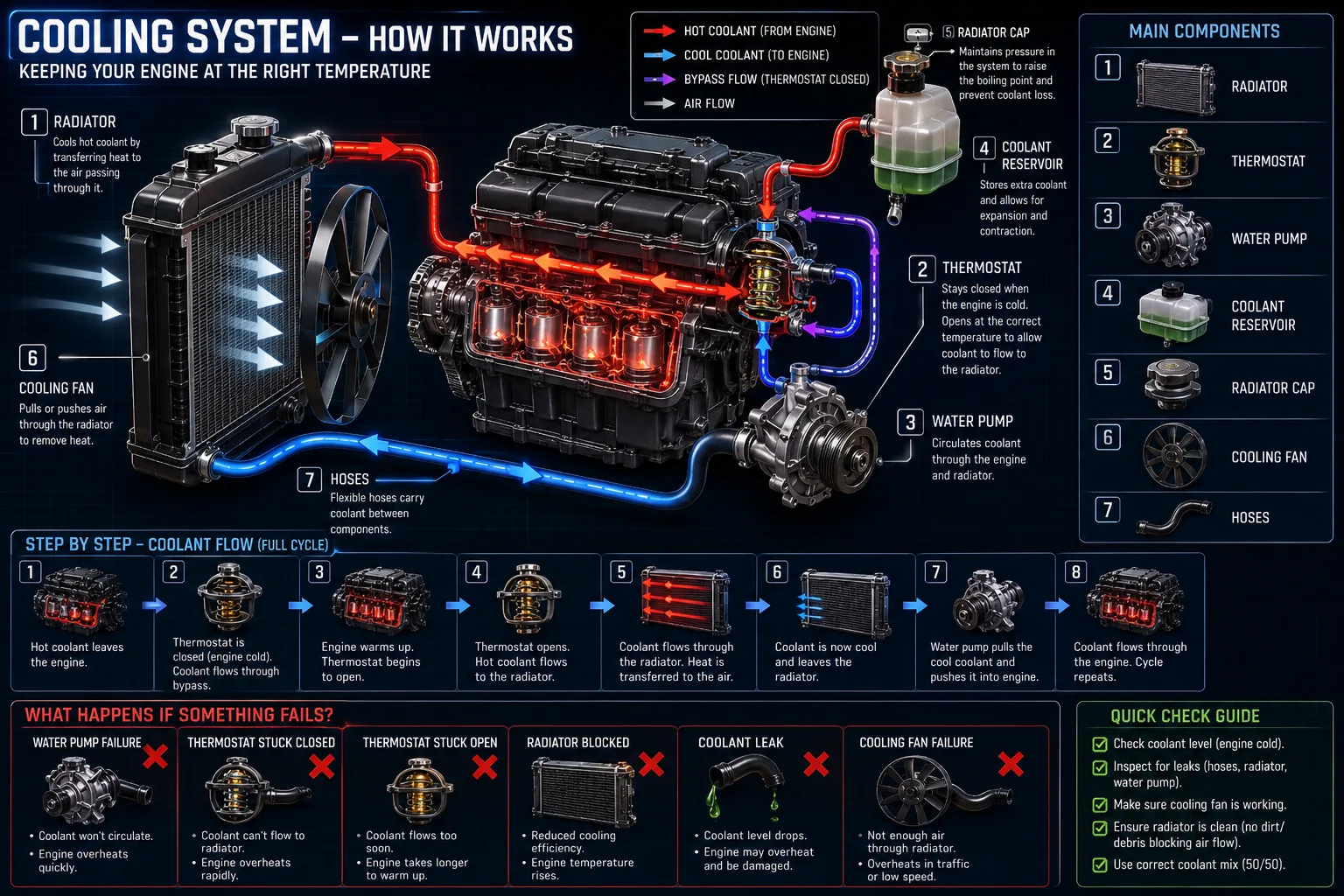
Your engine burns fuel at temperatures that would make a foundry worker flinch. Left to its own devices, it would destroy itself in minutes — so your car runs an entire cooling system just to keep things survivable. Coolant (a mixture of water and antifreeze) circulates through passages in the engine block, soaking up heat like a thermal sponge. It then travels to the radiator at the front of the car, where airflow pulls that heat away. A water pump keeps everything moving. A thermostat acts as the bouncer — it stays shut while the engine warms up, then opens to let hot coolant through to the radiator once things are up to temperature. When any one part of that chain breaks down — a leak, a blockage, a seized pump, a stuck thermostat — the heat has nowhere to go. The coolant sits there getting hotter and hotter. The gauge begins its slow horror-film climb. If you keep driving, the metal components start expanding beyond their designed tolerances. The head gasket — a thin layer of metal doing a heroic job between the cylinder head and engine block — starts to fail. Past a certain point, you're looking at a warped head, a cracked block, or an engine that simply gives up the ghost entirely. All of which is why "pull over now" is not a suggestion from us — it's the cheapest advice you'll ever receive.
“The temperature gauge — the one you've never once paid attention to — is doing a slow, steady climb toward the red.”
Sound familiar?
So what's behind it?
What we do — at your door
When you call SOSCarFix, a real mechanic comes to where you are — whether that's a layby on the A-road, your driveway, or a supermarket car park where you've been sat nervously for forty minutes. We carry diagnostics kit and a working knowledge of what a cooling system looks like when it's given up. We'll identify whether you're dealing with a leak, a failed component, or something more involved like a head gasket issue. We'll give you a straight answer, not a vague "could be a few things" followed by a lengthy quote for parts you might not need. If it's fixable on the spot — a snapped hose, a low coolant level with an identifiable source, a faulty thermostat — we get it sorted. If it's something more serious, we tell you exactly what you're dealing with so you can make an informed decision, not a panicked one. No recovery truck required. No sitting on hold. One call, one mechanic, sorted.
What affects the price
The range between "topped up the coolant and found a split hose" and "warped cylinder head requiring a full head gasket replacement" is vast — which is why the single most important cost factor in any overheating job is how quickly you stopped driving. Every mile past the first warning sign is a potential multiplier on the final bill. Beyond that, the specific failed component matters enormously: a thermostat is a very different job to a water pump, which is a very different job to a head gasket. The make and model of your vehicle affects parts availability and labour complexity — a straightforward hatchback and a prestige German estate are not the same afternoon's work. Age and condition of surrounding components also plays a role; a cooling system that's been neglected across multiple services often presents with several issues at once rather than a single clean fix. We provide bespoke quotes once we've had a proper look — because guessing a price before diagnosing a problem is how people end up paying for parts they didn't need.
Random knowledge you didn't ask for
Questions you're probably asking
The temperature gauge is in the red but there's no steam — can I keep driving?
No. Steam is the finale, not the opening act. A gauge in the red means your engine is already at a temperature where damage is either happening or about to happen. The absence of visible steam just means it hasn't fully boiled over yet — it doesn't mean things are fine. Pull over safely, switch the engine off, and let it cool for at least 30 minutes before even thinking about opening the bonnet.
What should I actually do while I wait for the engine to cool down?
Engine off, hazards on, get yourself safely away from the vehicle if you're on a busy road. Do not open the bonnet immediately — hot pressurised cooling systems can send scalding steam and coolant directly at your face and that is a bad afternoon for everyone. Wait a minimum of 30 minutes. If you need to check the coolant reservoir, do it slowly and with a cloth over the cap. Then call us.
Can I just top up the coolant and drive home?
It depends entirely on why it overheated. If there's an active leak, you'll lose whatever you add fairly promptly and end up in the same situation a few miles down the road. Topping up might get you moving in an emergency, but it's not a fix — it's a delay. The underlying cause still needs diagnosing. If you top it up, drive cautiously, keep watching that gauge, and get it properly looked at before your next journey.
Is a blown head gasket definitely the worst case?
Not quite — a cracked engine block edges it. But a blown head gasket caught early is a recoverable situation; the same failure driven through for another twenty miles is a significantly more serious one. The honest answer is that the severity of an overheating incident is almost entirely determined by how quickly the driver pulled over. Which is why we keep saying it.
Red coolant temperature warning light on — what does it mean and what do I do?
That red thermometer-in-water symbol means your engine coolant has hit a dangerous temperature and the car is actively telling you to stop. It is not an advisory. Pull over somewhere safe, engine off, hazards on. Do not open the bonnet or the coolant cap — a pressurised system at that temperature will put scalding liquid in your face without hesitation. Wait at least 30 minutes. If the light came on with no other drama, you may have a minor coolant leak or a failing thermostat. If there was steam, a sweet smell, or the heater suddenly blew cold before it lit up, the situation is more involved. Either way, it needs diagnosing properly before you drive it anywhere — a mobile mechanic can come to you.
Car Overheating — sorted at your door
Stop procrastinating. Get a transparent quote and we'll come to you.