Coolant Leak: Where Is It Coming From? — Because "somewhere near the engine" isn't a diagnosis
That sweet, slightly sickly smell wafting up through your vents — or that mysterious green, pink, or orange puddle quietly forming under your car overnight — is coolant. And coolant, for the record, belongs inside the cooling system, not underneath it. Your engine runs at around 90°C by design; the cooling system is what stops it melting itself. Lose enough coolant and it will overheat. Overheat long enough and you're looking at a blown head gasket, a warped cylinder head, or worse — the sort of repair bill that makes grown adults ring their mum. SOSCarFix comes to you, finds the actual source, and sorts it before "small leak" becomes "engine transplant."
See our upfront pricingSweet-smelling puddle under your car? Dropping coolant level? We find the source and fix it on your driveway. No garage needed. Get a quote today.
How it actually works
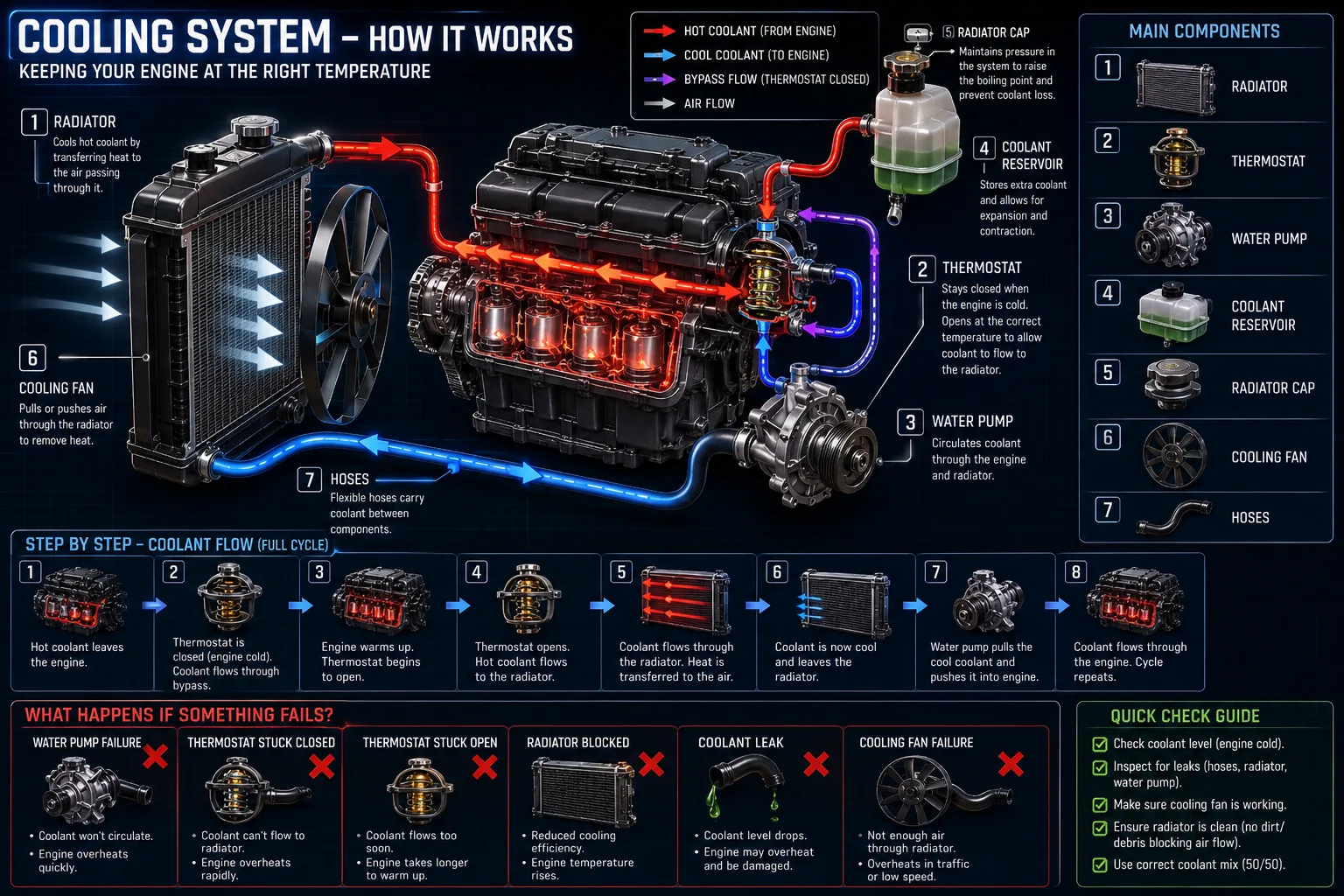
Your engine produces enormous amounts of heat burning fuel — heat that, left unchecked, would destroy it inside minutes. The cooling system is a sealed loop: coolant (an antifreeze-and-water mix, typically 50/50) is pumped around water jackets inside the engine block and cylinder head by the water pump, carries heat away to the radiator at the front of the car, where airflow and the cooling fan drop its temperature, and then back round again. The thermostat controls when flow begins — keeping the engine at its ideal operating temperature (roughly 85–95°C on most UK cars) rather than letting it run cold and inefficient. Coolant also passes through the heater matrix — a small radiator behind your dashboard that your cabin heating system runs through. It sits in an expansion tank to allow for thermal expansion. Any leak anywhere in that sealed loop — a split hose, a corroded radiator, a weeping water pump seal, a cracked thermostat housing — gradually empties the system. Because coolant is pressurised when hot (typically 15 psi), even a small crack can push coolant out faster than you'd expect, and pressure testing is the proper way to find it.
“SOSCarFix comes to you, finds the actual source, and sorts it before "small leak" becomes "engine transplant.”
Sound familiar?
So what's behind it?
What we do — at your door
We come to you — driveway, work car park, wherever the car is sitting being quietly dramatic — and run a proper cooling system diagnosis on the spot. That starts with a visual inspection for obvious external drips, staining and crusty coolant deposits, then a pressure test: we fit a pump to the expansion tank cap and pressurise the system to the cap's rated pressure (usually around 15 psi). A leak will show itself immediately; a slow one we give time to develop while we watch. We also check the coolant condition (colour, smell, contamination), test the cap's pressure-relief valve, and run a combustion gas sniff test at the expansion tank if there's any suspicion of a head gasket issue — because that needs a completely different conversation and a clear-eyed repair estimate before you commit to anything. Once we've found the source, we give you an itemised quote and, in the majority of cases, fix it the same visit.
What affects the price
Cost depends entirely on where the leak is coming from, which is why finding the source first is non-negotiable. A split coolant hose is at the cheap end — hose and coolant, straightforward labour. A thermostat housing or expansion tank replacement is a step up, though still usually reasonable. A radiator replacement varies significantly by car — some are accessible in an hour, others require half the front of the car coming off. A water pump often involves timing belt access and is priced accordingly. A heater matrix is labour-intensive (dashboard removal on most cars) and the bill reflects that. Head gasket failure is in a different category entirely — materials and labour for a full head gasket job represent a significant investment, and whether it's worth it depends on the car's value and overall condition, which we'll be honest with you about. We don't invent prices; we quote after we've actually found the problem.
Random knowledge you didn't ask for
Questions you're probably asking
Can I keep driving with a coolant leak?
It depends how fast it's leaking. A very slow seep with the level only dropping slightly over weeks is different from a hose that's weeping steadily. The rule is: never let the temperature gauge climb into the red. If it does, pull over and stop — continuing to drive an overheating engine risks warping the cylinder head or blowing the head gasket, which turns a £150 hose job into a £1,500 head gasket job. Top up, monitor, and get it looked at promptly.
What colour is coolant, and does the colour mean anything?
UK cars use various coolant colours — green, pink, orange, blue and yellow are all common, depending on the type (OAT, HOAT, silicate-based). The colour itself just tells you the formulation; what matters is that coolants shouldn't be mixed (they can react and form a gel that blocks passages). If your puddle is clear and odourless, it's more likely condensation from the air-con drain. Sweet-smelling and coloured means coolant.
My coolant level drops but I can't see any puddle — where is it going?
Three main possibilities: a very slow external leak that evaporates before it drips (pressure testing will find it), a heater matrix leak that drips inside the cabin onto the carpet rather than the ground, or — the one nobody wants — it's being burnt internally through a head gasket leak (watch for white exhaust smoke and check the oil filler cap for a brown, mayonnaise-like residue). We test for all three.
Is a coolant leak an MOT failure?
Yes. A significant coolant leak is an MOT failure — it falls under fluid leaks likely to cause environmental harm or be a safety hazard. Even a minor leak will get flagged as an advisory. Worth sorting before the test rather than having to rebook.
How long does a coolant leak repair take?
A hose replacement or thermostat housing is typically under an hour. A radiator replacement is usually one to two hours depending on the car. A water pump can be longer if it shares access with the timing belt. A heater matrix — honestly, most of a day, because it often involves removing significant dashboard. We give you a realistic time estimate when we quote.
Coolant Leak — sorted at your door
Stop procrastinating. Get a transparent quote and we'll come to you.