The Little Valve That Ruins Everything: Mobile Thermostat Replacement
Your engine thermostat is a valve roughly the size of a golf ball that your car's entire thermal management depends on. It sits between the engine and the radiator, stays closed while the engine warms up (so combustion heat builds quickly to the efficient operating range), then opens to let coolant flow through the radiator and shed the excess. That's it. That's the whole job. And yet when this palm-sized lump of wax and metal decides to give up — either stuck permanently shut or eternally open — the consequences are disproportionately annoying. A thermostat stuck closed gives you an overheating engine within minutes. Stuck open, and your engine never reaches proper temperature: sluggish warm-up, a heater that blows lukewarm at best, a MPG that quietly worsens while you wonder why you're filling up more often. SOSCarFix comes to your driveway and fixes it without you ever having to find a local garage, drop the car off, or explain yourself to a service advisor.
See our upfront pricingOverheating engine or stuck in the cold? A faulty thermostat is often to blame. SOSCarFix replaces it at your door, no garage required. Get a quote today.
How it actually works
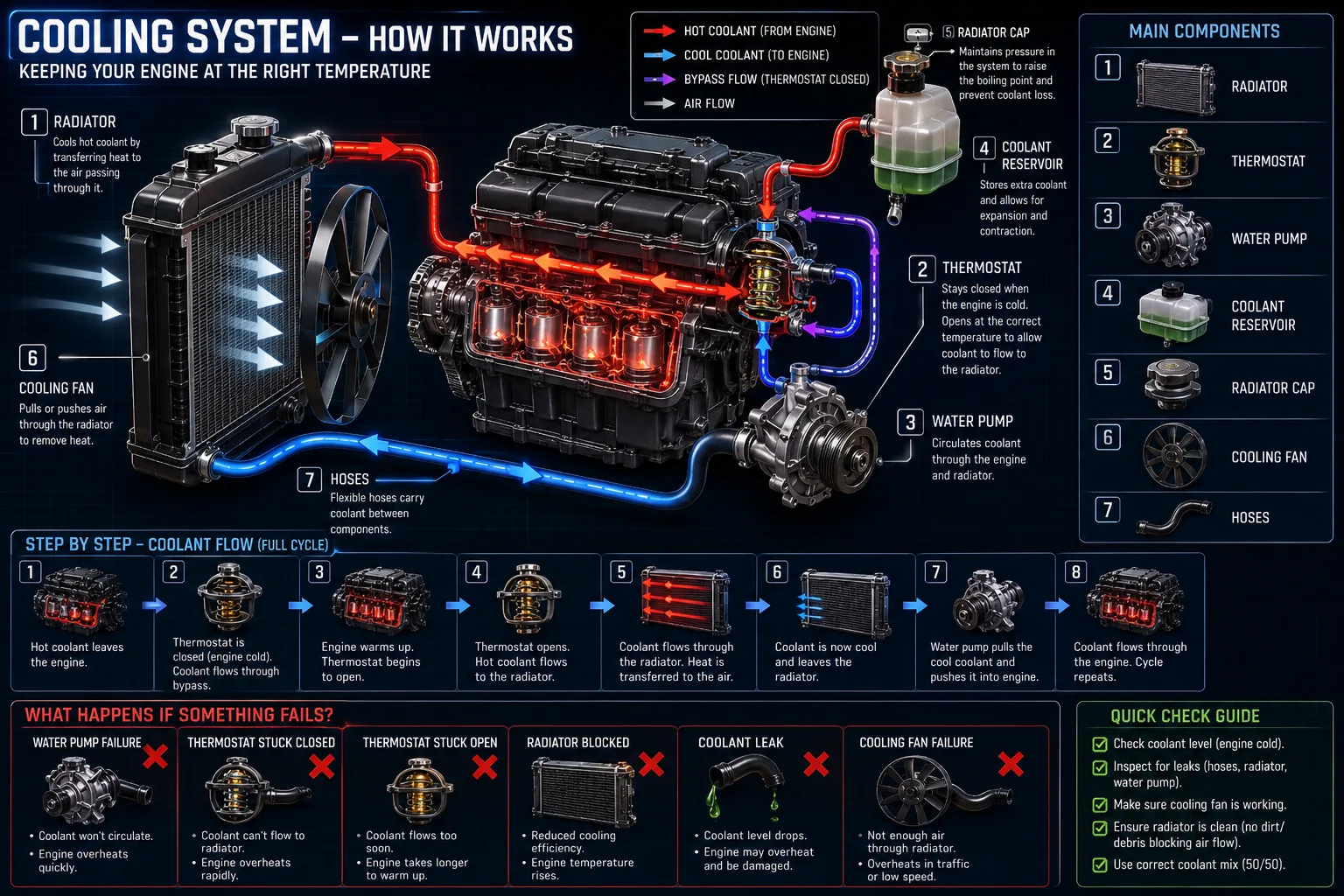
The thermostat lives in a housing — usually at the top of the engine where the top radiator hose connects, though on many modern engines it migrates to the bottom hose or is buried in a coolant manifold. Inside is a wax pellet that expands as it heats up, pushing the valve open against a spring. When the coolant hits roughly 80–95°C (depending on the car's calibrated opening temperature), the valve cracks open and lets hot coolant flow into the radiator, where it gives up its heat to the air before returning to the engine. Below that temperature, the valve stays shut and the coolant circulates only through a small bypass circuit, so the engine warms up quickly rather than sitting lukewarm forever. When the thermostat fails, two things can happen. If the wax element seizes in the closed position — common with age or corrosion — there is no route to the radiator, heat builds rapidly and the temperature gauge climbs toward the red. Drive far enough and you risk a blown head gasket, a cracked head or a warped block: all of which cost many multiples of a thermostat. The stuck-open failure is subtler: the engine never reaches its design temperature, the engine management runs a permanently enriched fuel mixture, oil takes longer to burn off condensation, fuel economy drops and your cabin heater turns into a politely warm fan. Replacing the thermostat means draining some coolant, swapping the housing and seal, refitting and bleeding the system of air — something a mobile mechanic can handle without a ramp or a garage.
“Your engine thermostat is a valve roughly the size of a golf ball that your car's entire thermal management depends on.”
Sound familiar?
So what's behind it?
What we do — at your door
We come to wherever the car is sitting — driveway, car park, office, roadside — and start by confirming the diagnosis before any parts are ordered. On most cars that means a quick fault code scan (a P0128 is almost a thermostat confession), watching the temperature gauge behaviour and feeling the radiator hose to see whether hot coolant is actually reaching it. Once we are confident it is the thermostat and not a water pump or blocked radiator we drain the relevant coolant, remove the thermostat housing, swap in a new OEM-spec thermostat with a fresh seal or O-ring, refit the housing and then bleed the cooling system properly — air locks are the enemy here and skipping the bleed is how you get a heater that still blows cold after the repair. We top up with the correct coolant type for your car (yes, the colours matter and no, they are not all interchangeable), run the engine to operating temperature on your driveway to confirm the thermostat is opening at the right point and the gauge settles where it should. No garage drop-off, no shuttle bus, no sitting in a waiting room that smells of instant coffee and tyre compound.
What affects the price
What you pay for a thermostat replacement in the UK depends on a few honest variables. The thermostat itself is typically inexpensive — it is the labour and access that shifts the price. On most mainstream cars (Ford, Vauxhall, VW Group, Renault, etc.) the thermostat housing is in a sensible location and the job is relatively straightforward. On some engines it is buried under the inlet manifold, sandwiched behind auxiliary components or integrated into a plastic coolant distribution manifold that costs significantly more to replace than a traditional unit. The housing material matters too: alloy housings corrode and sometimes cannot be reused, meaning the housing itself becomes a parts cost. Coolant type affects price — BMW, Mercedes and VAG cars often specify a specific OEM coolant that is considerably more expensive than generic antifreeze. And if there is evidence of further cooling system damage (a tired water pump, a radiator with restricted flow, a compromised head gasket from a previous overheat), those are separate conversations with separate costs that we will flag clearly before doing anything.
Random knowledge you didn't ask for
Questions you're probably asking
Can I drive with a stuck thermostat?
Depends which way it is stuck. Stuck open: yes, briefly, though you will suffer poor economy, a cold cabin and eventual engine wear from running too cool. Stuck closed: absolutely not. Your engine has no route to shed heat, the temperature climbs fast, and a blown head gasket or cracked head is a real outcome. If your gauge is heading toward the red, stop the car, let it cool and call us.
How do I know it is the thermostat and not something worse like the head gasket?
A few clues: if the top radiator hose is cold when the gauge reads hot, coolant is not circulating — that points to thermostat or water pump rather than head gasket. Head gasket failures usually show additional symptoms: white smoke from the exhaust, mayonnaise under the oil cap, coolant loss without visible leaks, or bubbles in the header tank. A fault code scan and a proper inspection separates them — we will tell you honestly what we find.
Why is my heater still blowing cold after the thermostat was replaced elsewhere?
Almost always an air lock. When you open the cooling system, air gets in, and if you do not bleed it properly, that air sits in the heater matrix — which is just a small radiator in your dashboard — and blocks hot coolant from flowing through it. The fix is a proper bleed of the system, not another thermostat. Some cars need the engine run with the heater on full blast and the bleed nipple cracked open — skip that step and you get exactly the symptom you are describing.
What coolant do you use? Does the type matter?
Yes, the type matters more than most garages will admit. Modern cars specify different coolant formulations — OAT (Organic Acid Technology), HOAT, Si-OAT — that are not interchangeable without flushing the system first. Mixing types can cause silicate precipitation, which looks like pink or brown sludge and blocks your radiator and heater matrix. We use the correct coolant type for your specific car as standard.
How long does a thermostat replacement take?
On a cooperative engine with a sensibly located thermostat, usually between 45 minutes and an hour and a half including the bleed and warm-up check. Engines where the thermostat is buried behind ancillaries, or where the housing is integrated into a larger coolant manifold, take longer. We confirm the expected time when we quote — no vague 'could be a few hours' from us.
What does fault code P0128 mean — coolant thermostat below regulating temperature?
P0128 means your ECU has clocked that coolant is not reaching its target operating temperature within the expected time. The overwhelmingly common real cause is a thermostat stuck open — coolant bleeds through to the radiator constantly, so the engine never properly warms up. Symptoms: temperature gauge sitting low, heater that never gets properly hot, and quietly worsening fuel economy. It is rarely anything sinister, but ignoring it means the engine runs rich longer than it should and wears faster. Get it diagnosed and, almost certainly, a new thermostat fitted.
Why is coolant leaking from my thermostat housing?
Because most modern thermostat housings are plastic, and plastic does not age gracefully. Thermal cycling — heating and cooling thousands of times over a car's life — makes the housing brittle and cracks it, or degrades the gasket or O-ring until it weeps. VAG, BMW and Renault engines are particularly notorious for this. You will usually see a seeping puddle of coolant underneath the housing rather than a dramatic gush, often with crusty dried deposits around the joint. Left alone it gets worse, the system loses pressure, and overheating follows. Worth sorting before it does.
The Little Valve That Ruins Everything — sorted at your door
Stop procrastinating. Get a transparent quote and we'll come to you.