The Little Tank That Couldn't: Coolant Expansion Tank Replacement
The coolant expansion tank is a humble translucent lump of plastic bolted into your engine bay, quietly doing an unglamorous but critical job. It buffers the cooling system as coolant expands when hot and contracts when cold, maintains the pressure that keeps your coolant from boiling at the wrong moment, and gives you the only visual dipstick you have on your coolant level. When it cracks, splits at the seam, or develops a cap that can no longer hold pressure, the cooling system slowly loses its mind — and your engine, which really does not enjoy overheating, starts counting down. SOSCarFix comes to you, diagnoses it properly, and fits a replacement before a cheap bit of plastic becomes a very expensive gasket.
See our upfront pricingCracked coolant tank, mystery puddles, or a cap that can't hold pressure? SOSCarFix replaces your expansion tank at your door. Get a quote.
How it actually works
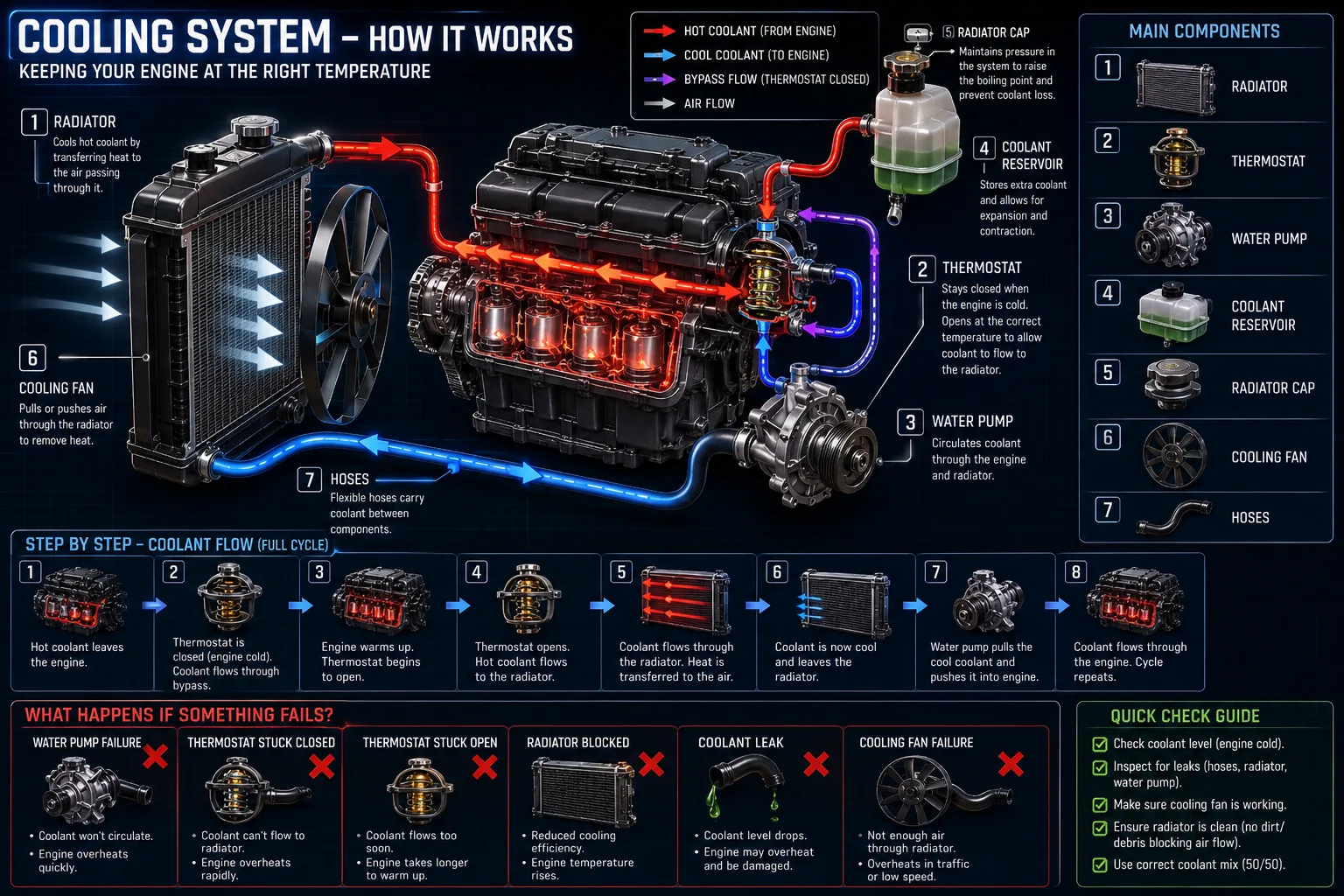
The cooling system runs under pressure — typically somewhere between 13 and 16 psi depending on the car. Pressure raises the boiling point of the coolant, which is why your system can safely operate at around 90–95°C without boiling. The expansion tank (also called the header tank or overflow bottle, depending on who made your car and when) sits in this pressurised circuit and serves two purposes. First, it accommodates the volume change as coolant heats up and expands — without it, the pressure would simply spike and blow a hose. Second, on most modern cars it is the primary reservoir: the radiator itself is fully sealed and there is nowhere else to top up from. The tank is sealed by a pressure cap — a spring-loaded valve that holds the system at the correct pressure and only releases once that threshold is exceeded. When the cap fails, it either vents too early (dropping system pressure, which drops the boiling point, which can cook the engine under load) or weeps constantly, letting coolant escape. The tank itself is polypropylene or nylon plastic that ages, becomes brittle, and can crack at the seams, the overflow stub, or the mounting brackets. Even a hairline crack that is invisible when cold will open up and weep coolant once the system pressurises at operating temperature. The puddle you find on the drive is the consequence; finding the crack is the diagnosis.
Sound familiar?
So what's behind it?
What we do — at your door
We come to your home, workplace or wherever the car is sitting. We do not start by reaching for a new tank — we start with a diagnosis, because coolant loss has several possible sources and fitting a new expansion tank while a hose is quietly weeping behind the alternator helps nobody. We pressure-test the cooling system with a hand pump and gauge to confirm the system holds the correct pressure, and identify exactly where it is not. We inspect the expansion tank, seams, the overflow stub and mounting points — visually and under pressure — and test the cap separately on a pressure tester to confirm it releases at the correct value and seals properly. On many cars, a £15 pressure cap is the entire fault. If the tank itself needs replacing, we drain the coolant, remove the old tank, fit a quality replacement, reconnect the hoses, refill with the correct OEM-specified coolant type (and the right concentration — not just tap water), bleed the system to remove air pockets, and confirm the system holds pressure at operating temperature before we leave. All of this on your drive, without you having to arrange a tow truck or sit in a waiting room.
What affects the price
The cost of a coolant expansion tank replacement in the UK varies considerably depending on the car. The tank itself ranges from under £20 for common European hatchbacks to over £100 for prestige or German premium vehicles — and the cap is often a separate part. Labour is the other variable: some tanks are bolted in with two screws and accessible in minutes; others are buried under intake trunking, coolant pipes and electrical looms. We will always quote the specific job for your car before starting. We also factor in the correct coolant: mixing types (e.g. OAT versus HOAT) is a common cause of cooling system damage, so we use the right fluid for the manufacturer's specification, not whatever is on offer at a trade counter.
Random knowledge you didn't ask for
Questions you're probably asking
Can I just keep topping up the coolant instead of replacing the tank?
You can keep topping it up for a while, but you are masking the problem rather than fixing it. A cooling system with a slow leak is gradually losing pressure too, which lowers the boiling point and increases the risk of overheating. It will also eventually leave you stranded — usually at the least convenient moment. Fixing the source is always cheaper than a recovery truck and a potential head gasket.
How do I know if it is the cap or the tank that is faulty?
That is exactly what we test for before ordering parts. The pressure cap is a cheap, testable component and is the cause of a surprising number of 'leaking tank' calls. We test the cap separately on a pressure gauge — if it releases below spec or won't hold, it gets replaced. If the tank itself is cracked or split, that is what we replace. We do not assume.
My coolant level is dropping but I cannot see any leak — where is it going?
If the loss is small and there is no puddle, the most likely culprit is a crack that only opens under pressure when the system is hot. Other possibilities include a weeping hose connection, a seeping radiator or (in the worst case) an internal head gasket leak pushing coolant into the combustion chamber. A cold-engine visual check will miss a pressure-dependent crack every time — which is why we pressure-test rather than just look.
Is it safe to drive to you with a coolant leak?
Depends on the rate of loss. A very slow seep might get you a few miles safely if you top up and monitor the temperature gauge carefully. But if the level is dropping fast, the temperature gauge is rising above normal, or there is any steam from the engine bay, do not drive it — call us and we will come to wherever the car is. Overheating even once can warp a cylinder head, which moves the repair bill from 'annoying' to 'genuinely painful'.
Does it matter what coolant I use to top up in the meantime?
Yes, significantly. Different manufacturers specify different coolant types — OAT (organic acid technology, usually pink or purple), HOAT (hybrid OAT, often blue or yellow), or older silicate-based green coolants. Mixing incompatible types causes the inhibitors to react, forming a sludge that blocks the radiator and damages the water pump seal. Always use the type specified in your handbook, diluted 50/50 with distilled water — not tap water, which adds limescale.
The Little Tank That Couldn't — sorted at your door
Stop procrastinating. Get a transparent quote and we'll come to you.