The Heater Matrix: When Your Car Decides the Heating Is Optional
Your heater matrix is the unsung component that turns engine coolant into a warm, misted-up-free cabin. It's basically a tiny radiator tucked behind your dashboard — and when it decides to give up, it does so with remarkable flair: sweet-smelling coolant vapour, a mysteriously damp front-passenger carpet, a windscreen that fogs the moment you breathe, and heating that's gone from 'warm embrace' to 'deeply disappointing'. SOSCarFix diagnoses it properly first — because a misting screen can be many things — and then, if the matrix really is gone, we do the hard yards to sort it, without you having to leave your driveway or book a courtesy car you'll spend two days waiting for.
See our upfront pricingNo heat, sweet smell, fogged windscreen or soggy carpet? Classic heater matrix. We diagnose first, then sort it at your door. Get a quote.
How it actually works
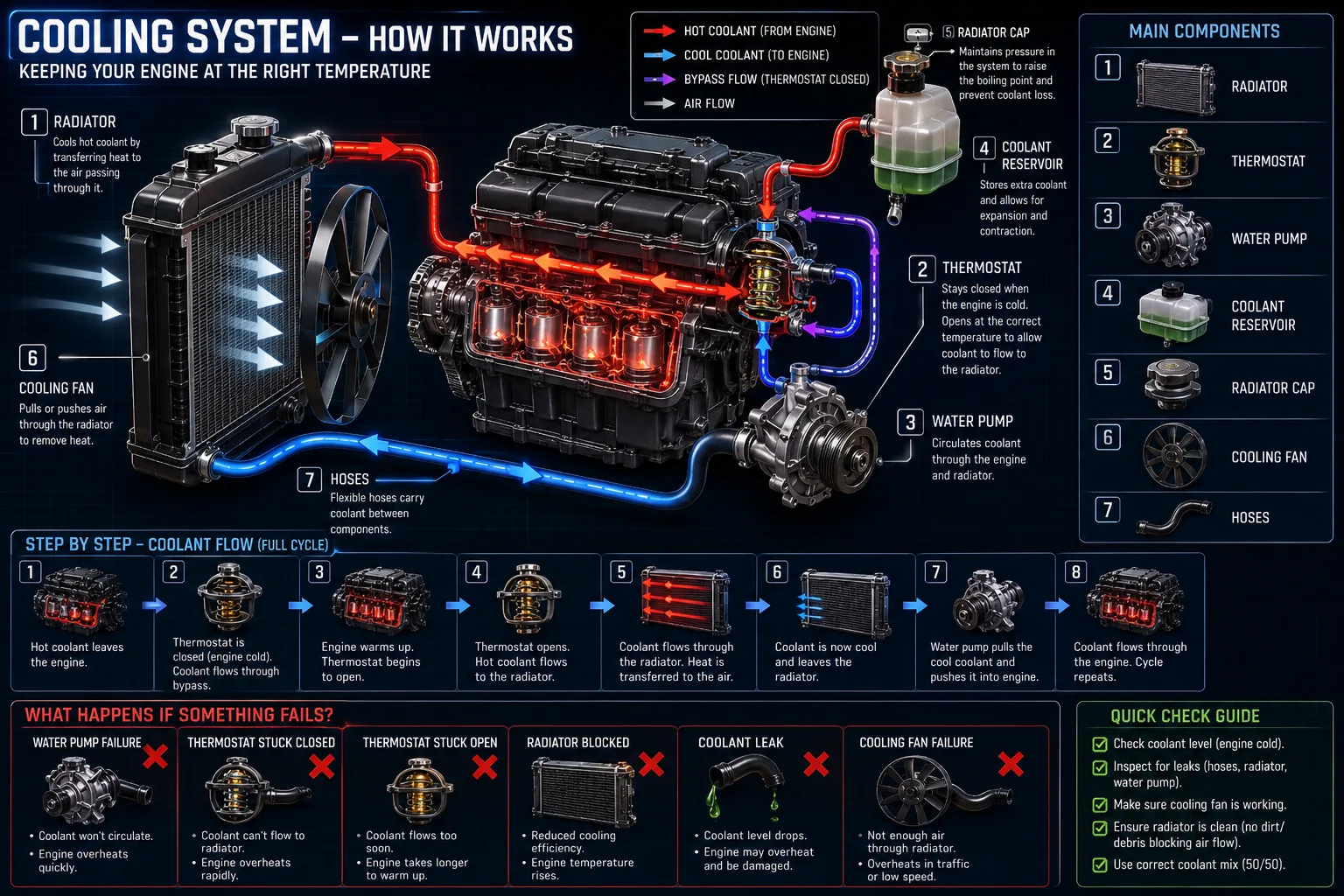
Your engine produces a colossal amount of heat — enough to destroy itself if not managed. The cooling system deals with this by circulating coolant (antifreeze/water mix) from the engine, through the radiator at the front, and back round again. But before the coolant returns, a branch of the system diverts a portion through the heater matrix: a small, densely-finned heat exchanger mounted behind the dashboard. A blower fan pushes cabin air over those fins, picks up the heat, and delivers it through the vents. That's your heating system — no gas, no resistance element, just borrowed engine heat. The temperature dial controls a valve regulating how much hot coolant flows through the matrix; the fan speed dial adjusts how hard the blower pushes. Simple in principle. Disastrous in location. The heater matrix lives deep inside the dashboard, which on most cars means an hour to two of coolant draining, dashboard stripping, matrix swapping, and reassembly before you get to switch the heating on again. Labour is the story here, not parts.
“Your heater matrix is the unsung component that turns engine coolant into a warm, misted-up-free cabin.”
Sound familiar?
So what's behind it?
What we do — at your door
We start with diagnosis, because 'no heat' and 'misting screen' have plenty of other explanations — a blocked heater control valve, an airlock in the cooling system, a failed blower motor, or a temperature sensor telling the ECU the engine is warmer than it is. We check coolant level and condition, feel the matrix hoses for temperature difference in and out, scan for fault codes if the car has climate control electronics, and look for the telltale sweet smell and damp carpet before declaring the matrix dead. If it's confirmed, we drain the cooling system, strip out the necessary dashboard sections to access the matrix (every car is different — some are two hours, some are closer to five), swap the unit, refit and reseal everything, refill with the correct coolant specification and bleed the system to clear airlocks. We then test heating at all settings before calling it done. All of this happens on your driveway, at your workplace, or wherever you park — no garage, no drop-off, no waiting.
What affects the price
Cost varies enormously by vehicle and is driven almost entirely by labour, not parts. The matrix itself is typically a modest part — the real cost is how long it takes to get to it. A Ford Focus or VW Golf might be a half-day job; a BMW 3 Series or Honda CR-V can take considerably longer; some MPVs and prestige models are notorious all-day dashboard-out affairs. Coolant type matters too — some modern engines specify OAT or HOAT coolant that costs more than generic green. Always get a vehicle-specific quote. We'll give you an honest labour estimate based on your exact make, model and year before we start anything.
Random knowledge you didn't ask for
Questions you're probably asking
My heater stopped working but there's no smell and no wet carpet — is it still the matrix?
Probably not. A heater matrix failure almost always involves coolant escaping somewhere — smell, damp carpet or coolant loss. A sudden loss of heat with no other symptoms is more likely a blocked or stuck heater control valve, an airlock after recent cooling system work, or a thermostat stuck open keeping the coolant too cold. We diagnose properly before assuming the worst.
Can I just bypass the heater matrix to stop the leak?
You can — it's a quick fix where both heater hoses are joined together with a connector, bypassing the matrix entirely. It stops the leak immediately and is sometimes used as a temporary measure. The downside: you lose all cabin heating and demisting, which in a UK winter is deeply grim, and it's technically a modification that could raise questions on an MOT if the vehicle was originally fitted with a working heater. We'd rather fix it properly.
How long does a heater matrix replacement actually take?
Honest answer: it depends heavily on the car. Small hatchbacks might be three to four hours. Older Land Rovers, BMWs and some MPVs can be five to seven hours or more — some require the entire dashboard to come out, which is a full-day job. We'll give you a vehicle-specific time estimate before booking. We won't start something we can't finish in a single visit.
Will coolant smell inside the car cause any harm?
Yes, potentially. Ethylene glycol vapour in a sealed cabin is not something to ignore — it's toxic if inhaled over time, and it's almost certainly fogging your windscreen too, which is a visibility and MOT concern. Drive with the windows cracked, sort it sooner rather than later, and don't let anyone convince you it's 'just condensation'.
The coolant reservoir keeps needing topping up but I can't see a leak anywhere outside — could it be the matrix?
Classic sign, yes. If coolant is disappearing without a puddle under the car, it's either burning in the engine (head gasket territory — check for white exhaust smoke) or escaping through the heater matrix into the cabin. Sometimes the cabin smell is subtle and the carpet damp is only under the mat. Lift the mat in the front passenger footwell — if it's wet, the matrix is the prime suspect.
The Heater Matrix — sorted at your door
Stop procrastinating. Get a transparent quote and we'll come to you.