Water Pump Replacement: The Unsung Hero Keeping Your Engine Off the Grill
Inside your engine sits a small impeller — a spinning disc of curved blades about the size of your fist — whose entire job is to keep coolant moving so the engine doesn't cook itself alive. It does this quietly, without complaint, every single second the engine is running. Nobody buys a car and thinks "brilliant, I love the impeller." Nobody names a car after the water pump. And yet, the moment that humble little spinner stops doing its thing, you've got an overheating engine, possibly warped cylinder heads, and a bill that makes grown adults sit down and reconsider their life choices. SOSCarFix replaces water pumps at your home, workplace, or wherever you've had the misfortune of breaking down — no garage, no tow truck, no drama.
See our upfront pricingYour water pump's tiny impeller is the only thing stopping your engine from turning into a very expensive bonfire. SOSCarFix replaces it at your door — usually with the cam belt, because going back in twice is nobody's idea of a good time.
How it actually works
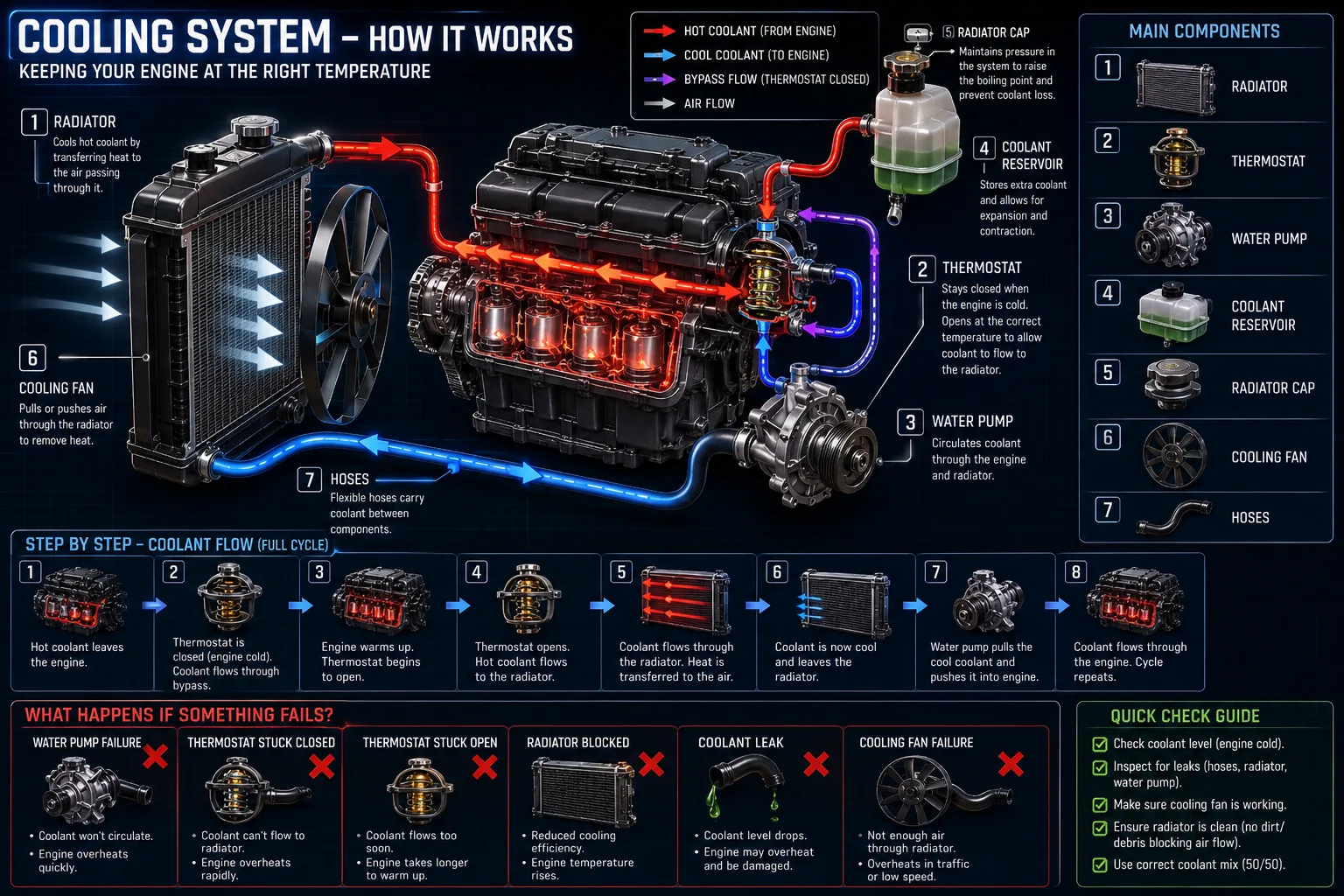
The water pump lives at the front of your engine and is driven either by the cam belt (timing belt) or the auxiliary belt — depending on your car. Inside is that impeller: a set of curved vanes that use centrifugal force to pull coolant in from the radiator and push it through the engine block, the cylinder head, and back out again. At motorway speeds, a healthy water pump circulates coolant through the engine up to 20 times per minute, shifting somewhere between 30 and 50 litres of coolant every 60 seconds. Your engine runs at around 90–95°C in normal operation — the water pump is what keeps "normal" from becoming "catastrophic". When the impeller cracks, corrodes, or the shaft bearing gives up, that circulation stops. The thermostat opens in a panic, the temperature gauge climbs somewhere it really shouldn't, and if you ignore it, the aluminium cylinder head warps like a cheap baking tray left on a hob. Here's the bit that matters for your wallet: on most modern cars, the water pump is tucked behind the cam belt covers and driven off the timing belt itself. Which means replacing the pump on its own, without touching the cam belt, is considered malpractice by anyone who knows what they're doing — and replacing it later means paying for all that labour twice. So we do both at once. Sensible, economical, the way it should be done.
“It does this quietly, without complaint, every single second the engine is running.”
Sound familiar?
So what's behind it?
What we do — at your door
We come to you — home, work, car park, layby — with the parts already sourced for your specific vehicle. On cam belt-driven applications, we replace the water pump and cam belt together as a kit, which is how every reputable mechanic approaches it: all that labour is already happening, and a new cam belt next to an old pump (or vice versa) is just a job waiting to go wrong again. We drain the coolant, strip back the cam belt covers, remove the old pump, clean the mating face properly, fit the new pump with a fresh gasket, refit and correctly tension the cam belt, and refill with fresh coolant at the right concentration. Then we run the engine up to temperature and check everything — no leaks, correct temperature, correct pressure. On auxiliary belt-driven applications (where the pump isn't behind the cam belt covers), the job is more straightforward, but no less thorough. We carry out a full cooling system inspection while we're in there, because there's no point fitting a new pump into a system full of old, degraded coolant and calling it done.
What affects the price
Several things determine what your water pump replacement will cost, and we quote specifically for your car rather than plucking figures from thin air. The main factors are: whether the pump is driven by the cam belt or the auxiliary belt (cam belt jobs involve significantly more labour because half the front of the engine comes apart); whether the cam belt, tensioners, and idler pulleys are being replaced at the same time (they almost always should be, and doing it all in one visit costs far less than two separate ones); the make, model, and engine of your vehicle, since parts prices vary enormously between a high-street hatchback and a prestige German saloon; the accessibility of the pump on your specific engine, because some manufacturers appear to have hidden it purely out of spite; and whether any additional cooling system work is needed, such as a fresh thermostat, new coolant hoses, or a flush of a system that's seen better days.
Random knowledge you didn't ask for
Questions you're probably asking
Does my water pump always need replacing with the cam belt?
On most modern engines where the pump is driven by the timing belt, yes — and any mechanic worth their socket set will insist on it. The labour to access the water pump is almost entirely shared with the cam belt job. If you decline and the pump fails six months later, you're paying that labour bill all over again. It's not upselling; it's arithmetic.
Can I drive if my water pump is failing?
Depends on how bad things are, but the honest answer is: not far, and not wisely. A weeping seal losing coolant slowly gives you some warning miles before disaster. A bearing that seizes suddenly can snap the cam belt, and if that happens on an interference engine — which most modern engines are — the valves meet the pistons at speed and neither party enjoys it. Don't gamble with it. Call us.
How long does a water pump replacement take?
A straightforward auxiliary belt-driven pump can be done in an hour or two. A cam belt and water pump replacement together typically takes two to four hours depending on the vehicle. We give you an honest estimate when we book the job — not a guess designed to get us through the door.
What coolant should go back in after the replacement?
The correct coolant for your vehicle, mixed to the right concentration for UK winters — which is not 'whatever was cheapest at the petrol station.' Different manufacturers specify different formulations (OAT, HOAT, silicate-based), and mixing the wrong types creates sludge that defeats the entire point of the exercise. We use the right stuff.
Water Pump Replacement — sorted at your door
Stop procrastinating. Get a transparent quote and we'll come to you.