Your Radiator Is Leaking: And Your Engine Is Quietly Auditioning for a Paperweight
The radiator is the unsung peacekeeper between your engine and catastrophic, wallet-destroying meltdown. Literally. Your engine produces enough heat to destroy itself several times over during a normal commute — the radiator is the only thing stopping that from happening. It takes boiling coolant from the engine, blasts air through a matrix of tiny channels, and sends it back cooler, ready to absorb more punishment. When the radiator starts failing — whether it's a hairline crack weeping coolant onto your driveway, a corroded core blocking flow, a stone-punctured front panel, or electrolysis silently eating it from the inside — the whole arrangement unravels fast. Overheating isn't a slow-burn problem you can nurse along; it's the prelude to a warped cylinder head, a blown head gasket, or a seized engine. SOSCarFix comes to your driveway, workplace or car park, diagnoses exactly what's wrong, and replaces the radiator on the spot — before you turn an annoying coolant leak into a catastrophically expensive engine rebuild.
See our upfront pricingLeaking radiator, overheating engine, or coolant puddles on the drive? SOSCarFix replaces radiators at your door — no garage faff. Get a quote today.
How it actually works
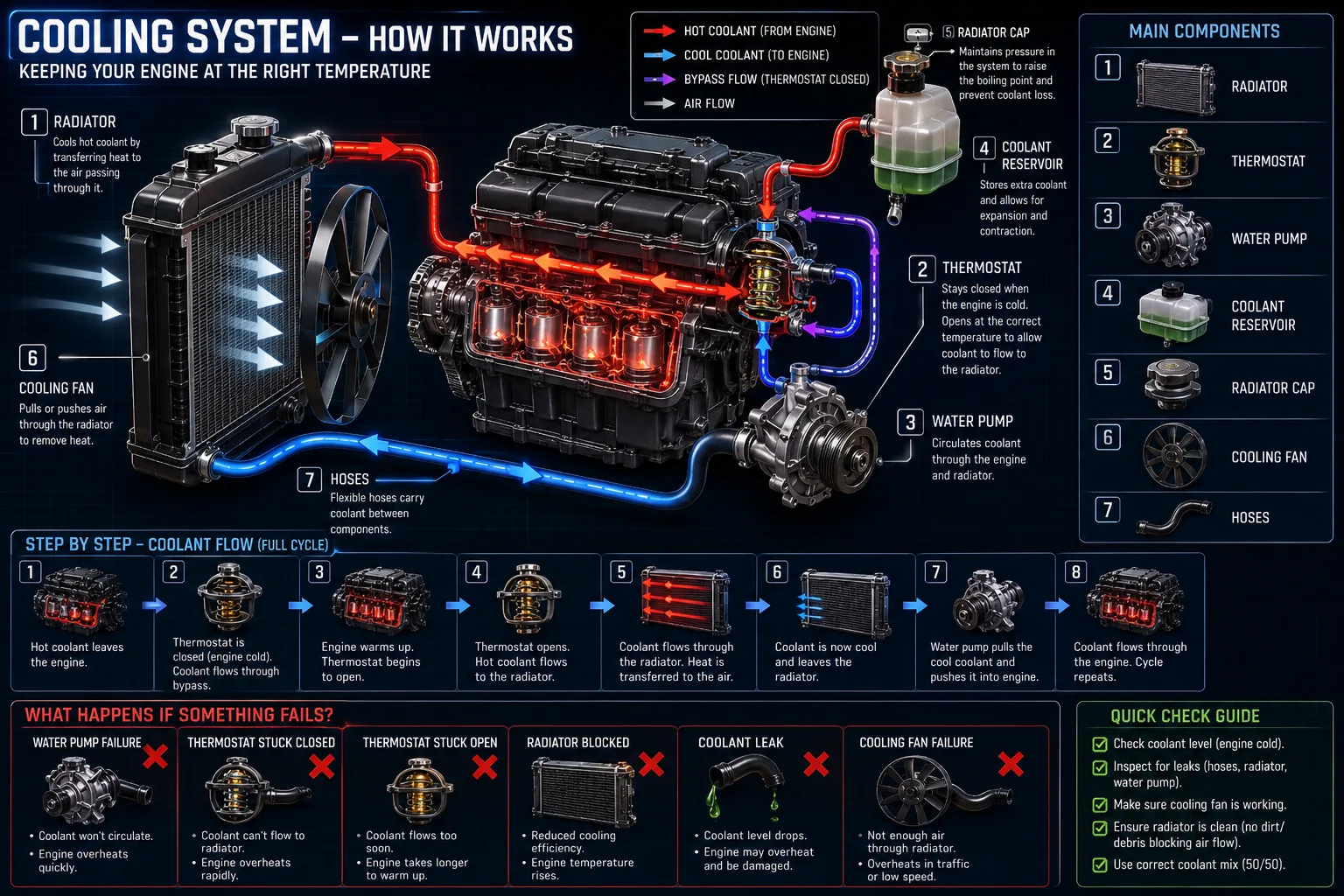
Your cooling system works like a central heating circuit, except instead of keeping a house warm it's keeping an engine from incinerating itself. The water pump circulates coolant — a mix of water and antifreeze — around passages cast into the engine block and cylinder head, where it absorbs heat. That hot coolant then travels through the top hose to the radiator, which sits at the front of the car directly in the airflow. The radiator itself is a heat exchanger: coolant flows through a dense grid of thin aluminium or plastic-and-aluminium tubes, and the fins between them transfer that heat to the air passing through. By the time the coolant reaches the bottom hose and heads back to the engine, it's lost enough heat to do the whole job again. A thermostat gates coolant flow until the engine reaches its correct operating temperature — typically around 88–95°C — and electric cooling fans kick in when you're stationary or moving slowly and there's not enough natural airflow. When the radiator is compromised — leaking externally, blocked internally with scale or corrosion products, or simply rotted through — the system loses either coolant volume or heat-transfer efficiency. Both outcomes end in overheating. The only fix is a new radiator.
“The radiator is the unsung peacekeeper between your engine and catastrophic, wallet-destroying meltdown.”
Sound familiar?
So what's behind it?
What we do — at your door
We turn up at your home, workplace, car park, or wherever the car has been parked up looking sorry for itself, and start with a proper diagnosis before anything gets unbolted. That means a visual inspection of the radiator core, tanks and connections, a pressure test of the cooling system to reveal leaks that aren't visible when cold, and a check of the coolant condition for signs of contamination, electrolysis damage, or exhausted inhibitors. If the radiator needs replacing — and we'll tell you honestly if something else is the actual culprit — we drain the system, remove the old radiator, fit a quality replacement (OE-specification or better, not the suspiciously cheap import that'll last eighteen months), refill with the correct coolant mix for your vehicle, bleed the system to purge air pockets, and run the engine up to temperature to confirm everything is behaving itself. We check the fans, the thermostat operation, and hose condition while we're at it, because finding a radiator leak and then discovering the top hose is about to go is nobody's idea of a good time. All done on your driveway — no towing, no waiting room, no courtesy car shuffle.
What affects the price
Radiator replacement cost in the UK depends on a handful of honest variables, none of which we'll dress up. The radiator itself varies considerably by vehicle — a straightforward hatchback radiator is a very different proposition to one from a large SUV, a car with an integrated automatic transmission oil cooler, or a vehicle where the manufacturer has helpfully buried the radiator behind the air conditioning condenser, a crash bar, and what appears to be spite. Labour time also varies: some radiators come out in under an hour with the bumper still attached; others require partial front-end dismantling, which is known in the trade as a 'go and make a cup of tea' job. Coolant type matters too — OAT, HOAT and IAT coolants are not interchangeable, and the correct one for your car isn't always the cheapest one on the shelf. If a pressure test reveals the radiator leak has been quietly contaminating your coolant with combustion gases (suggesting a head gasket issue), that changes the conversation entirely. We quote transparently before starting, so there are no invoice surprises at the end.
Random knowledge you didn't ask for
Questions you're probably asking
Can I drive with a leaking radiator to get home?
Depends how bad the leak is and how far home is. A small weep that's losing coolant slowly might get you a short distance if you keep a very close eye on the temperature gauge and pull over immediately if it climbs. A proper split or a fast leak? No. Running an engine low on coolant even briefly can warp a cylinder head or blow a head gasket, at which point you've turned a £400 radiator job into a repair bill that'll make you feel properly unwell.
How do I know if it's the radiator leaking or something else?
A pressure test is the definitive answer — we pressurise the cooling system cold and watch for the drop. Before that, the location of the leak helps: coolant dripping from the radiator itself or its end tanks points at the radiator. Coolant coming from a hose connection, the water pump, or the heater inlet pipes points elsewhere. Sweet smell plus puddle at the front of the car is classic radiator, but we'll always confirm before recommending the fix.
My car overheats but there's no visible coolant leak — could it still be the radiator?
Yes — an internally blocked radiator can cause overheating without losing a drop externally. The coolant is still in the system, it's just not being cooled efficiently because the passages are restricted with scale or corrosion debris. A cold-spot check across the front face of a warm radiator can reveal blocked sections. Could also be a stuck thermostat or a failing water pump — diagnosis tells us which, so we're not replacing the wrong thing.
What coolant should I use after a radiator replacement?
Whichever type the manufacturer specifies for your car, mixed to the correct concentration — usually 50/50 with water, though some manufacturers specify different ratios. OAT (organic acid technology) coolants are now common and are typically pink, red or purple; older cars may use IAT (blue or green). Mixing types neutralises the inhibitor packages in both, which is exactly as useful as it sounds. We refill with the correct coolant for your vehicle.
Is it worth repairing a radiator rather than replacing it?
Occasionally a cracked plastic header tank can be repaired with specialist adhesive or a new tank if the core itself is fine, but it's rarely the most reliable long-term fix. Aluminium radiators can be re-cored or brazed in some cases, but by the time you factor in the cost of specialist repair versus a new unit, a replacement radiator typically wins on price and certainly wins on confidence. We'll tell you honestly if repair is a sensible option for your particular situation.
Your Radiator Is Leaking — sorted at your door
Stop procrastinating. Get a transparent quote and we'll come to you.