Exhaust System Repair
AKA 'Loud Pipe Boys' — From embarrassing rattle to neighbour-annoying roar.
Loud exhaust? Rattling underneath? Failing emissions? We repair and replace exhausts, catalytic converters, and everything in between.
See our upfront pricingQuick Facts
What's This All About Then?
Your exhaust does three jobs: silences the engine, carries away toxic gases, and keeps emissions legal. When any part fails, you get noise complaints, failed MOTs, and possibly a car that runs like rubbish. From the manifold to the tailpipe, we handle exhaust repairs and replacements. Rusty sections, blown gaskets, failing catalytic converters, blocked DPFs, missing heat shields - if it's under the car and gas flows through it, we fix it. We can also upgrade your exhaust if 'quiet' isn't really your style.
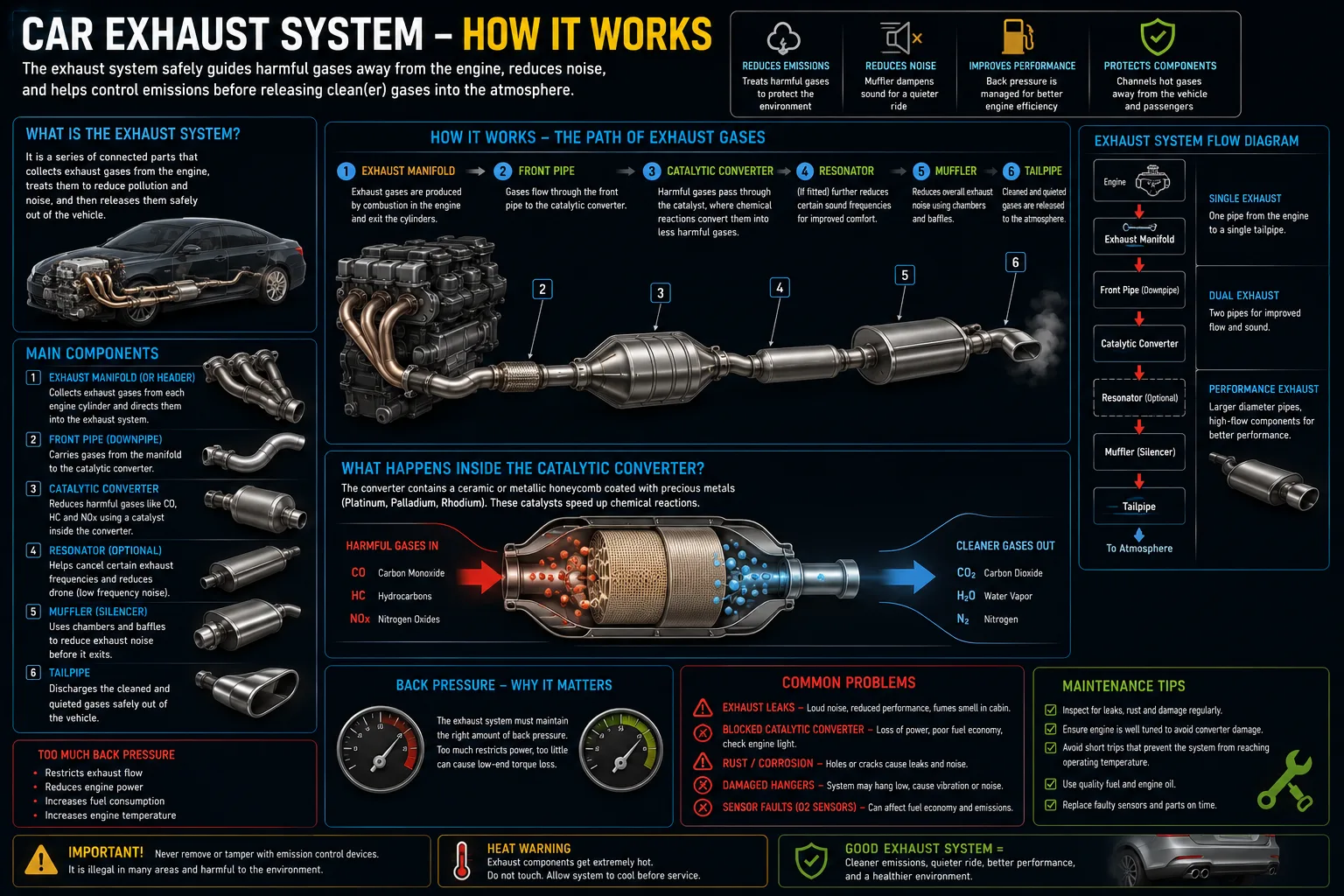
How it works
Exhaust gas leaves the engine through the manifold, then travels down a pipe through a series of clever bits. The catalytic converter uses precious-metal coatings to turn nasty gases — carbon monoxide, unburnt fuel, nitrogen oxides — into far less harmful ones. Diesels add a diesel particulate filter (DPF) that traps soot and periodically burns it off. Oxygen sensors along the way tell the engine's computer how well it's burning fuel, so it can fine-tune the mixture. Finally the silencer boxes and baffles cancel out sound before the gas exits the tailpipe. The whole system hangs from rubber mounts and is sealed at every joint. A leak anywhere upstream is both noisy and, near the sensors, can upset how the engine runs.
Warning signs to watch for
- •A loud droning or blowing that's worse when accelerating — a leak or blown joint somewhere in the system
- •A rattle underneath, especially over bumps — a broken mount or a loose internal baffle
- •A hissing or ticking near the engine — a leak at the manifold or a front joint
- •A sulphur or rotten-egg smell — often a failing catalytic converter
- •The engine warning light with poor running or weak power — a sensor or emissions fault
- •Visibly more smoke, or a diesel warning about the DPF — a blocked or failing particulate filter
Common causes
What we do
We locate the leak or fault — often audible, sometimes needing a fault-code read for sensor and emissions issues — and give you a straight, itemised quote. We replace corroded sections, silencers, mounts and gaskets, and sort blowing joints. For cat and DPF issues we advise on the proper fix. Legally we can only replace these with type-approved parts, never remove or gut them. All done on your driveway, no garage booking.
Exhaust System Repair — FAQs
My exhaust is blowing and loud — is it expensive?
Often not. A blowing exhaust is frequently just a corroded joint, a cracked silencer section or a snapped mount, and replacing that one part is a relatively cheap, quick job. It only gets pricey if the fault is in an emissions part like the catalytic converter. We'll pinpoint exactly where the leak is and quote you before doing anything, so there are no surprises.
Can you remove my DPF or cat to save money?
No — and no reputable mechanic will. Removing or hollowing out a catalytic converter or diesel particulate filter is illegal for road use in the UK, an automatic MOT failure, and can invalidate your insurance. It also means your car emits far more pollution. We'll always look at the proper fix: cleaning, forced regeneration where suitable, or replacing with a legal type-approved part.
Why does my DPF keep clogging up?
Usually because of the kind of driving the car does. A DPF cleans itself by getting hot and burning off trapped soot, which needs a decent run at sustained speed. Lots of short, stop-start trips never let it reach that temperature, so soot builds up. We can advise on regeneration, check for underlying faults, and suggest driving habits — like an occasional longer motorway run — to help keep it clear.
What You Actually Get
Common Exhaust System Repair Faults We Fix
Random Knowledge You Didn't Ask For
A catalytic converter reaches 400°C+ during normal operation. That's why cats get stolen - precious metals love heat.
Exhaust gases leave your engine at about 300°C. By the time they exit, it's about 50°C. Science!
Why Get Your Exhaust System Repair Done By Us?
We're Quick
Fast response, efficient work. No dragging things out.
We Come To You
Your driveway, your office, wherever. We travel.
We Guarantee It
If we mess up, we fix it. Simple as that.