Catalytic Converter Replacement
Somewhere under your car sits a box stuffed with platinum, palladium, and rhodium — metals so precious that thieves will slide under your vehicle with an angle grinder at 3am just to get at them. That same box is what stands between your car and an MOT failure, a fine, and the slow suffocation of your own engine. The catalytic converter: simultaneously one of the most valuable components on your vehicle and one of the most quietly abused. Feed it a sustained misfire and it turns into a thousand-pound paperweight. Leave it unguarded in the wrong postcode and it simply ceases to exist. When yours needs replacing — for whatever colourful reason that may be — SOSCarFix comes to you, tools in hand, no garage required.
See our upfront pricingYour cat's been nicked, melted by a misfire, or quietly given up the ghost. SOSCarFix replaces catalytic converters at your home or workplace — no garage, no drama, no rotten waiting room coffee. Get a quote today.
How it actually works
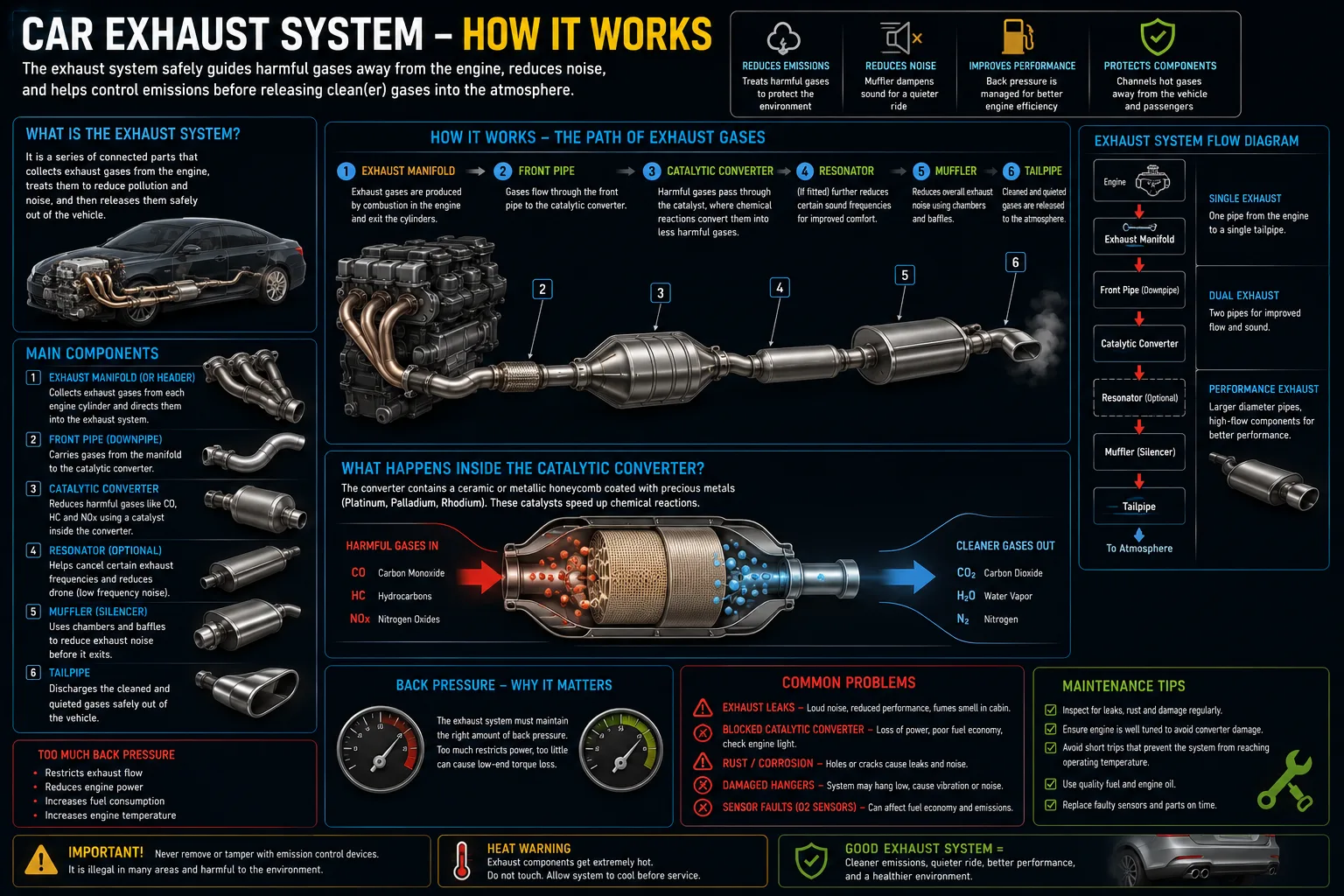
Your exhaust system produces three genuinely nasty gases: unburnt hydrocarbons, carbon monoxide, and nitrogen oxides. Left unchecked, that lot would make your car a rolling air-quality violation. The catalytic converter's job is to sort them out before they leave the tailpipe. Inside the steel canister is a ceramic honeycomb — an invention from Corning in 1971 that packs roughly a football pitch of surface area into something the size of a loaf of bread. That surface is coated in those precious metals: platinum and palladium handle the oxidation reactions, converting CO into CO2 and hydrocarbons into CO2 and water. Rhodium does the reduction work, stripping the oxygen off nitrogen oxides and releasing harmless nitrogen gas. All three reactions happen simultaneously, which is why modern units are called three-way catalytic converters. The catch: the converter needs to reach around 400°C to start working properly — mechanics call this "light-off temperature." Below that, it's basically ornamental. Above about 1,000°C — which is exactly what happens when a misfiring engine pumps raw unburnt fuel into the exhaust — the precious-metal-coated ceramic substrate starts to melt and collapse. A melted substrate means blocked exhaust flow, backpressure, power loss, and a chat with an MOT tester you'd rather not have. When SOSCarFix replaces your catalytic converter, we come to wherever your car is sitting, carry out a proper diagnosis first to make sure the underlying cause of failure is addressed (replace the cat without fixing the misfire that murdered it and you'll be back to square one), then fit the correct replacement unit for your vehicle. Job done, no tow truck required.
“The catalytic converter: simultaneously one of the most valuable components on your vehicle and one of the most quietly abused.”
Sound familiar?
So what's behind it?
What we do — at your door
We come to your driveway, your workplace car park, or wherever the car has ground to a halt. Before anything gets unbolted, we properly diagnose the situation — checking for misfires, scanning for fault codes, inspecting oxygen sensors — because a catalytic converter doesn't usually fail in isolation. Fit a new one without finding out why the old one died and you're just donating expensive parts to the same underlying problem. Once we're confident the root cause is either resolved or accounted for, we remove the failed unit, clear the fault codes, fit the correct replacement for your specific vehicle, and verify the repair. All without you having to arrange a recovery truck, beg a lift, or lose a day to a garage waiting room. We carry out the work at your location using professional equipment — the same job a garage would do, just without the inconvenience of having to go to one.
What affects the price
Several things determine what a catalytic converter replacement actually costs, and they vary considerably between vehicles. The converter unit itself is the main variable — a small hatchback's cat is a very different component (and a very different price) to the one fitted to a large SUV, a hybrid, or a performance car, where precious-metal loading tends to be higher. Labour time varies based on how accessible the unit is and whether surrounding components need to come off to get at it. If the failure was caused by a misfire, oil consumption, or another underlying issue, addressing that root cause adds to the scope. Oxygen sensors — upstream and downstream of the converter — often need replacing at the same time, either because they've been damaged by the same failure or because they're simply old enough to warrant it while everything is apart. We provide a full, itemised quote before any work starts, so there are no surprises.
Random knowledge you didn't ask for
Questions you're probably asking
My catalytic converter was stolen overnight — can I drive the car?
Technically the engine will run, but we'd strongly advise against it beyond the absolute minimum necessary. Without the converter, your exhaust noise will be considerable, your emissions will be illegal, you'll fail any roadside check, and your vehicle won't pass its MOT. There's also a chance the thieves have damaged surrounding exhaust components in the process. Get it inspected and replaced promptly — and check whether your insurance policy covers catalytic converter theft, because many comprehensive policies do.
Will fixing the catalytic converter clear my check engine light?
It depends entirely on why the light is on. If the fault code is a catalyst efficiency code caused by a degraded converter, then yes — fitting a new unit and clearing the codes should resolve it, provided the underlying engine is healthy. If the light was triggered by a misfire, an oxygen sensor failure, or an engine management issue, those need to be diagnosed and fixed separately. Replacing the converter without addressing what killed the old one is the automotive equivalent of painting over damp.
Does my car need a genuine OEM catalytic converter, or will an aftermarket one do?
For most everyday vehicles, a quality aftermarket unit that meets the correct emissions specification for your car will do the job perfectly well and is what the majority of independent garages fit as standard. Some manufacturers and some specific vehicles are more particular than others. When we quote for your car, we'll advise on the appropriate specification — the goal is a part that does what it's supposed to do and keeps you legal, not just the most expensive option on the shelf.
Can a failing catalytic converter damage other parts of my engine?
Yes, and this is worth taking seriously. A severely blocked converter creates significant exhaust backpressure, which forces the engine to work harder to expel gases. Over time this can affect performance, fuel economy, and place additional strain on exhaust valves. More immediately, if the substrate has collapsed and broken into fragments, those pieces can theoretically be drawn back towards the engine under certain conditions. A rattle from under the car isn't just annoying — it's worth getting looked at before it turns into a bigger problem.
Catalytic Converter Replacement — sorted at your door
Stop procrastinating. Get a transparent quote and we'll come to you.