Exhaust Repair & Replacement: We Come to You Before the Neighbours Come for You
Yesterday it was a sensible, slightly boring hatchback. This morning it pulled off the driveway sounding like it was headlining Download Festival. No warning. No gradual build-up. Just full Harley-Davidson energy from a 1.2-litre Vauxhall Corsa. The neighbours are watching. The dog's confused. You're confused. Welcome to the world of exhaust failure — where your entirely ordinary car decides, overnight, to develop serious personality. SOSCarFix mobile mechanics come straight to wherever you've parked up, diagnose exactly which part of your exhaust has gone rogue, and sort it — no garage, no tow truck, no drama. Well. Less drama.
See our upfront pricingYour sensible hatchback woke up sounding like a clapped-out motorbike? SOSCarFix mobile mechanics fix blowing exhausts, catalytic converters & more — we come to you, anywhere in the UK.
How it actually works
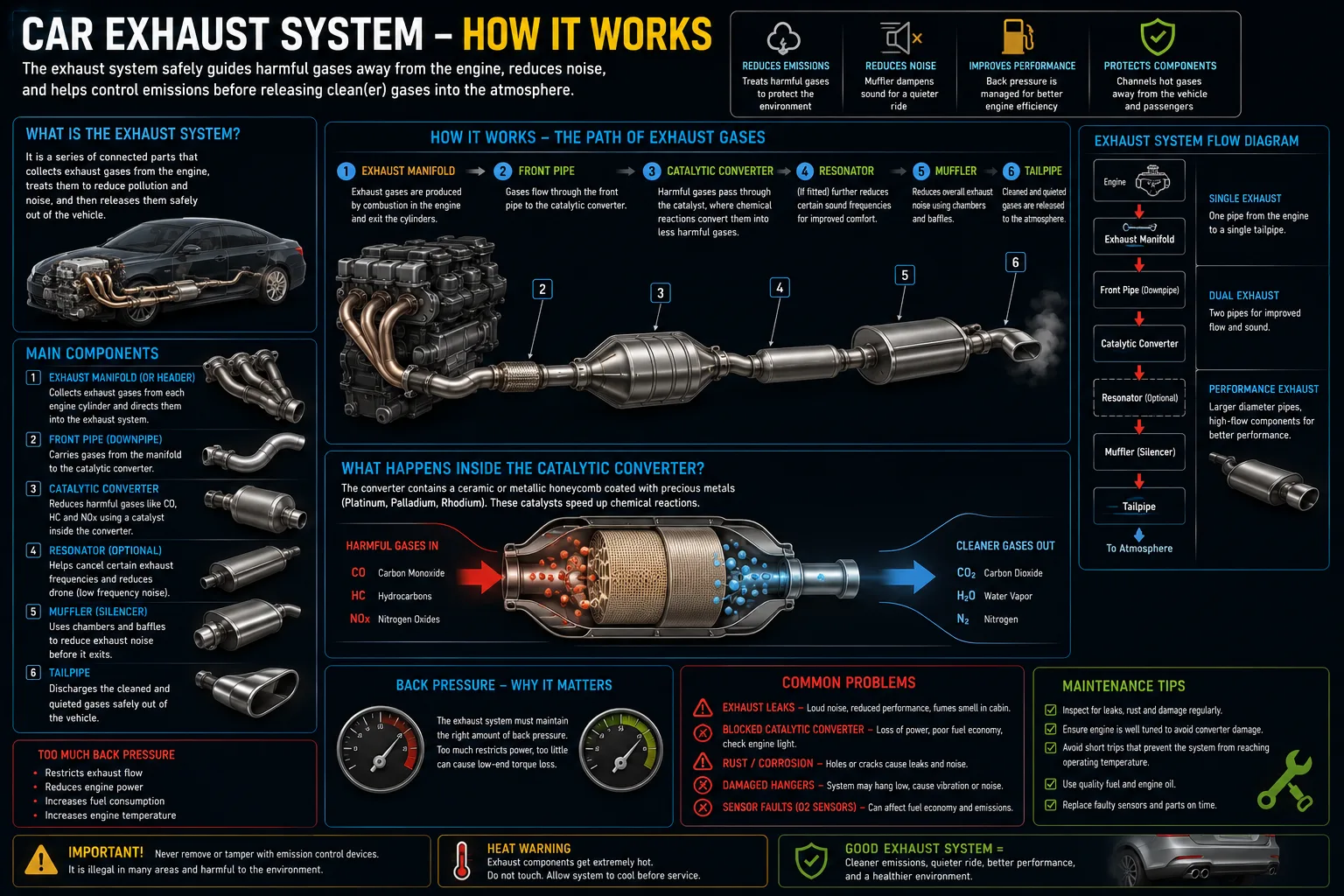
Your exhaust system is doing several jobs at once, which is ambitious for a collection of metal pipes bolted underneath a car that mostly sits in a supermarket car park. From the moment the engine fires, it routes the combustion gases away from the cylinders via the exhaust manifold, pushes them through the catalytic converter (which quietly converts the truly nasty stuff — carbon monoxide, hydrocarbons, nitrogen oxides — into less catastrophic emissions), through the mid-section pipework, then into the silencer box (back box), and finally out the tailpipe. Every joint, gasket, hanger bracket, and section of pipe along that journey is an opportunity for something to go wrong. Rust, heat cycling, road grime, the occasional pothole that the council swore they'd fix — it all takes its toll. When a joint blows, a pipe corrodes through, or a hanger snaps, the gases that were politely guided out the back suddenly start escaping wherever they fancy. That's the motorbike impression sorted. A SOSCarFix mechanic will trace the system from manifold to tailpipe, identify every weak point, and advise you on what genuinely needs replacing now versus what can wait. Then we fix it — right there, on your driveway, in a car park, or wherever you happen to be parked when the performance started.
“Welcome to the world of exhaust failure — where your entirely ordinary car decides, overnight, to develop serious personality.”
Sound familiar?
So what's behind it?
What we do — at your door
SOSCarFix mobile mechanics carry a comprehensive range of exhaust components and come to you — driveway, workplace car park, or the lay-by where you've sensibly pulled over rather than continuing to annoy an entire town. We'll do a full under-car inspection first, because 'it's just blowing a bit' often has a longer story attached to it once you get a proper look. We can weld, patch, or replace individual sections — manifold, flexi pipe, mid-section, back box, catalytic converter, heat shields, hangers — depending on what's actually failed rather than upselling you a full system when one section will do the job. Where a full replacement makes more sense (badly corroded systems where the next section will go in six months anyway), we'll tell you that honestly too. Everything is sourced to the correct spec for your vehicle, fitted properly, and we'll check emissions before we leave so there are no nasty MOT surprises.
What affects the price
Several things influence what an exhaust repair or replacement actually involves. The section at fault matters enormously — a back box is a very different job from a catalytic converter or an exhaust manifold gasket. The make and model affects parts availability and the time it takes to access the system; some cars were designed by people who clearly resented mechanics. Vehicle age and overall system condition matters too: if the surrounding pipework is heavily corroded, replacing one section cleanly can be more involved than it looks on paper. Whether a repair (weld, patch, new gasket) is appropriate versus a full section replacement depends on the extent and location of the damage — we assess this on inspection and give you a clear, honest quote before any work starts. No fixed prices published here because a genuine quote is always better than a number that doesn't apply to your actual car.
Random knowledge you didn't ask for
Questions you're probably asking
Is it safe to drive with a blowing exhaust?
Depends where it's blowing. A leaking back box is noisy and antisocial but not immediately dangerous. A leak from the manifold or anywhere forward of the catalytic converter can allow carbon monoxide into the cabin, which is not a risk worth taking. If you can smell fumes inside the car, stop driving it and call us. If it's just loud, get it looked at promptly — a minor blow has a habit of becoming a major one very quickly, and an excessively noisy exhaust is an MOT failure and a police pull-over waiting to happen.
Can you repair an exhaust or does it always need replacing?
Often a repair is perfectly appropriate — a new gasket, a welded section, or a replacement hanger can sort the problem cleanly. Where the damage is extensive, or the surrounding pipework is so corroded that it'll fail in the next few months anyway, replacement makes more sense and we'll tell you why. We don't replace things that don't need replacing, not least because we'd rather you called us for the next job with some trust intact.
Will a faulty exhaust fail my MOT?
Yes — an exhaust leak that allows gases to escape before the tailpipe is an automatic MOT failure. Excessive noise is also a failure. So is a catalytic converter that's not functioning properly, since emissions are tested against legal limits. If your exhaust is in doubt, getting it sorted before your MOT rather than hoping for the best is considerably cheaper than a retest.
My catalytic converter has been stolen. What now?
Unfortunately a very familiar conversation. Without a catalytic converter the car is loud, illegal to drive on the road, and will fail emissions instantly. We can supply and fit a replacement catalytic converter at your location. It's worth checking whether your insurance covers catalytic converter theft before booking — many comprehensive policies do, which makes the conversation with us considerably more cheerful.
Exhaust Repair & Replacement — sorted at your door
Stop procrastinating. Get a transparent quote and we'll come to you.