Lambda Sensor Replacement: Your Engine Is Flying Blind and It Shows
Your lambda sensor — also called an oxygen sensor, O2 sensor, or, if you're feeling technical at a dinner party, exhaust gas oxygen sensor — is the small but deeply opinionated component screwed into your exhaust that constantly measures how much oxygen is left in your exhaust gases. It reports back to the ECU roughly 50 times a second, which is more often than most people check their mirrors, and the ECU uses that data to trim the fuel mixture in real time. When the lambda sensor goes wrong, your engine stops getting accurate feedback and starts guessing. It's a bit like asking someone to cook a meal but removing all the tasting spoons and telling them to just crack on. The result? Poor fuel economy, lumpy running, a very cheerful engine management light, and a guaranteed failure on the emissions section of your MOT. SOSCarFix comes to you, diagnoses which sensor is actually at fault, and replaces it without you needing to set foot near a garage or a waiting room with three-year-old Top Gear magazines.
See our upfront pricingEngine management light on, MPG through the floor, failed emissions? Your lambda sensor's sulking. SOSCarFix replaces it at your door — get a quote.
How it actually works
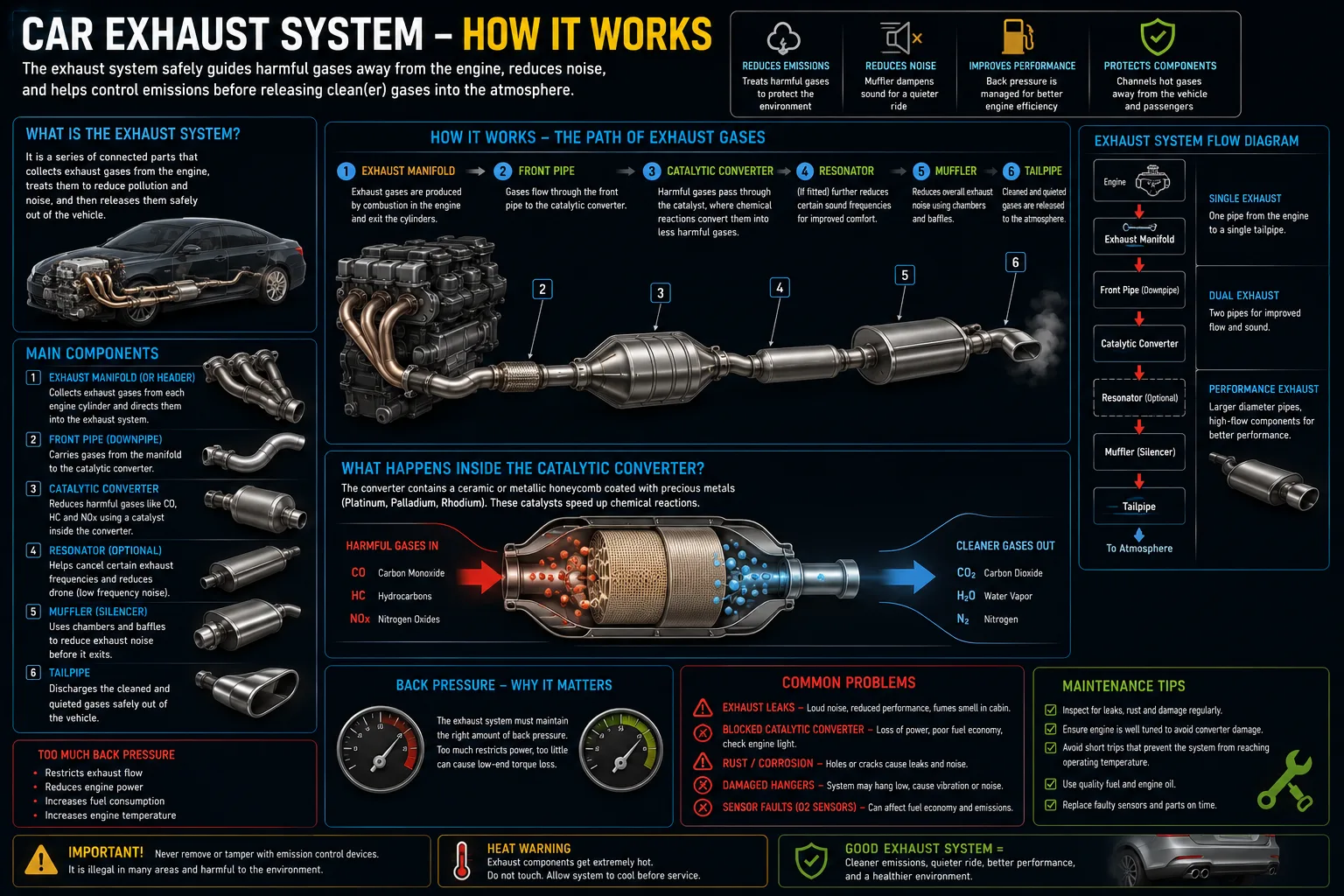
Modern petrol engines run in what's called closed-loop operation: they continuously adjust the air-to-fuel ratio based on feedback from the lambda sensor. The ideal ratio — roughly 14.7 parts air to 1 part fuel, known as stoichiometric, a word designed to win pub quizzes — is the sweet spot where combustion is efficient and the catalytic converter can do its job properly. A working lambda sensor voltage oscillates between roughly 0.1V (lean, too much air) and 0.9V (rich, too much fuel) as the engine hunts either side of that sweet spot. The ECU watches this oscillation and makes constant micro-adjustments to the injectors. There are typically two lambda sensors on a modern car: one upstream, fitted before the catalytic converter in the exhaust manifold area, and one downstream, fitted after the cat. The upstream sensor does the heavy fuel-trimming work. The downstream sensor is more of a quality-control monitor — it checks the catalytic converter is actually converting. When either goes slow, lazy, or completely silent, the ECU either logs a fault code (triggering the engine management light) or, worse, defaults to a fixed fuelling map that was calibrated for a sensor that was actually functional. Either way, you're burning money. SOSCarFix reads the fault codes, tests sensor response live, and confirms exactly which sensor is the culprit before ordering a single part.
“It's a bit like asking someone to cook a meal but removing all the tasting spoons and telling them to just crack on.”
Sound familiar?
So what's behind it?
What we do — at your door
When you book with SOSCarFix, a mobile mechanic arrives at your house, driveway, office car park, or wherever the car has quietly staged its protest, with a professional OBD diagnostic tool and the appropriate lambda sensor for your specific vehicle — because lambda sensors are not a one-size-fits-all commodity, and the difference between an upstream wideband sensor on a modern direct-injection engine and a narrowband downstream sensor on something older is not trivial. We plug in, read the live data, check the voltage oscillation pattern, confirm the fault codes, and make sure we're actually replacing the sensor that's at fault rather than guessing. The old sensor gets unthreaded — often with a combination of penetrating fluid and patience, because exhaust threads that have been baking at several hundred degrees for a decade tend to have opinions — and the new one goes in torqued correctly, with the wiring loom routed away from anything hot. We clear the codes, take the car for a short drive cycle to let the ECU re-learn, and confirm the sensor is reporting correctly before we leave. No garage, no recovery truck, no waiting room. Just a fixed car where you left it.
What affects the price
Lambda sensor replacement cost in the UK varies more than you might expect, and the main drivers are sensor type, vehicle, and location on the exhaust. A standard narrowband sensor for a common hatchback is significantly cheaper than a wideband sensor for a newer turbocharged engine — the latter can be many times the price of the former, partly because wideband sensors do considerably more sophisticated work and partly because the aftermarket supply chain hasn't caught up on some applications. OEM sensors from the vehicle manufacturer's parts network cost more than quality aftermarket equivalents from brands like Bosch, Denso, or NGK, who actually supply the OEMs in the first place, so aftermarket isn't always a compromise. Upstream sensors on turbocharged engines are sometimes awkward to access and can add time to the job. Corroded threads occasionally require extraction — a separate skilled operation if the sensor has sheared. As a rough steer, a straightforward single-sensor replacement on a common vehicle tends to sit in the range of the sensor cost plus an hour's labour, but pricing for your specific vehicle and sensor position is best confirmed with a quote rather than a guess.
Random knowledge you didn't ask for
Questions you're probably asking
Will my car pass its MOT with a faulty lambda sensor?
Almost certainly not, no. The MOT emissions test directly measures the byproducts of combustion — hydrocarbons, carbon monoxide, carbon dioxide — and a fuelling system that's operating without accurate lambda feedback tends to produce results outside the legal limits. Beyond that, a stored fault code related to the lambda sensor can trigger a minor or major defect depending on the tester's assessment. Sort the sensor before the test, not after the failure.
Can I drive with the engine management light on because of a lambda sensor fault?
Technically yes, practically it's a false economy. In limp-home or open-loop mode, your engine is burning fuel inefficiently — you'll notice worse MPG pretty quickly. More concerning is the long-term effect: running rich accelerates catalytic converter damage, and a replacement cat costs several times what a sensor does. The management light is the car politely requesting your attention before things get expensive. It's worth listening.
How do I know if it's the upstream or downstream sensor that's failed?
You need a diagnostic scan with live data, not just a generic code reader that spits out a code number. The fault code will usually indicate which sensor bank and position is implicated — P0130, for example, points to the upstream sensor on bank 1. But a good mobile mechanic will also look at the live voltage waveform to confirm actual sensor behaviour before ordering anything, because codes tell you where to look, not always exactly what to replace.
Are aftermarket lambda sensors as good as OEM?
From quality brands — Bosch, Denso, NGK — generally yes, because those companies manufacture lambda sensors for vehicle makers in the first place. The cheap unbranded sensors flooding certain online marketplaces are a different matter entirely; quality control is opaque and failure rates can be disappointingly high. SOSCarFix uses reputable aftermarket parts that carry a warranty, so you're not gambling on something that might fail inside six months.
My car has two lambda sensors — do I need to replace both at the same time?
Not automatically. The upstream and downstream sensors serve different functions and often fail at different times. If diagnostics confirm one specific sensor is at fault, replacing that one is the correct approach. Some mechanics will suggest replacing both simultaneously on high-mileage vehicles on the basis that if one has given up the other probably isn't far behind — there's a logic to that, and it saves a second labour charge — but it's a suggestion, not a necessity, and a decent mechanic will give you the honest assessment rather than the upsell.
Lambda Sensor Replacement — sorted at your door
Stop procrastinating. Get a transparent quote and we'll come to you.