That Annoying Rattle Under Your Car: The Heat Shield (Probably) Done It
There is a very specific kind of automotive misery that goes like this: you sit at traffic lights, engine just ticking over, and somewhere beneath you a tinny, buzzing rattle rattles away like a very small, very persistent maraca. You rev slightly — it stops. You ease off — it returns. You turn the radio up. The rattle turns up too. Nine times out of ten the culprit is a heat shield: a thin steel plate bolted around the exhaust to stop the 400°C pipework from setting your carpets or your fuel tank on fire. It corrodes, its brackets rot, and it vibrates at exactly the frequency your sanity can't tolerate. SOSCarFix comes to you, gets underneath for a proper look, and sorts it before you pull out every wire in your radio trying to find the fault.
See our upfront pricingThat tinny buzz under your car at idle? Probably a loose heat shield — usually a cheap fix. SOSCarFix diagnoses it on your driveway. Get a quote.
How it actually works
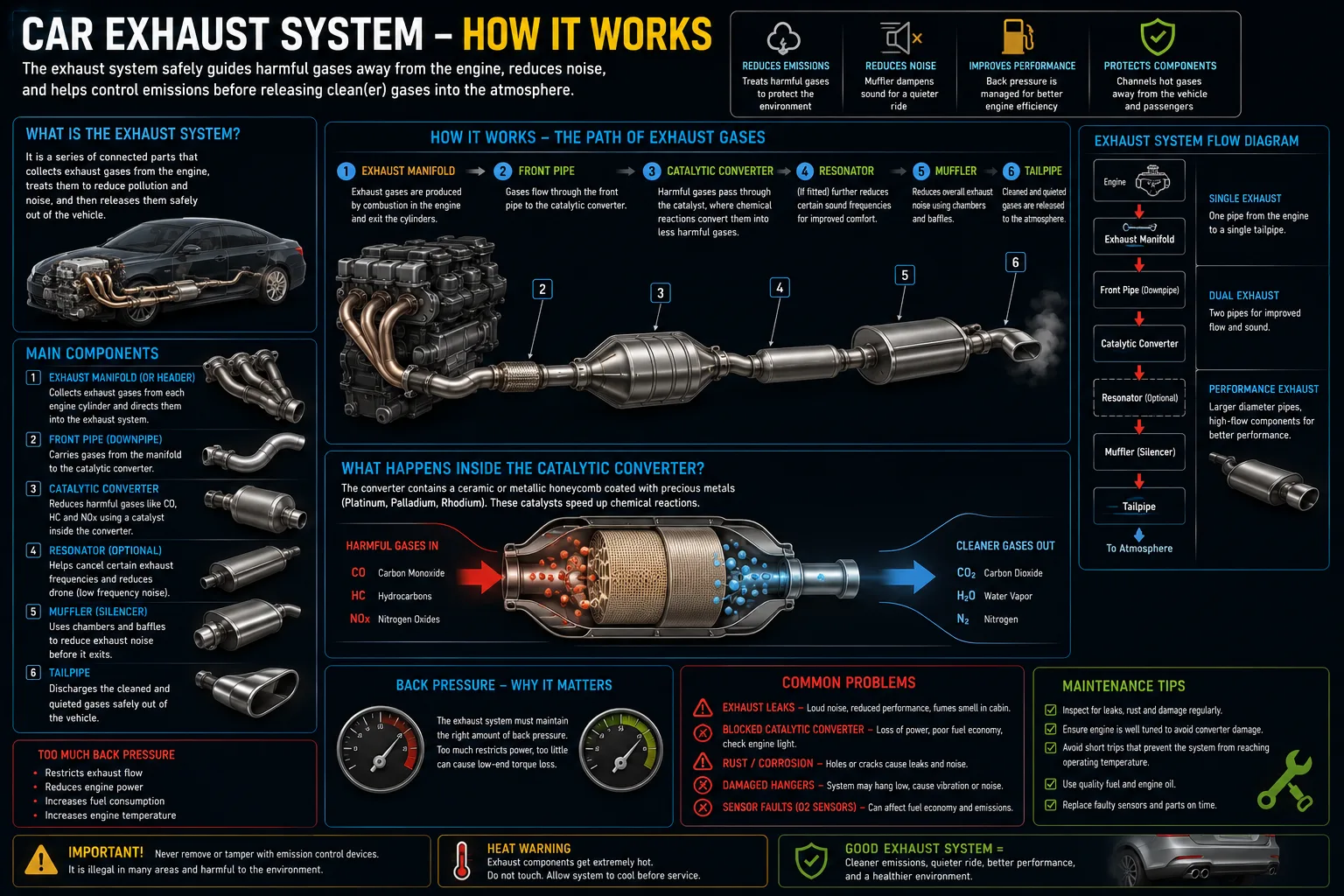
Your exhaust system runs at serious temperatures — the catalytic converter alone can hit 600°C under load. Heat shields are thin pressed-steel covers bolted around the most intense sections: typically the cat, the downpipe, and sometimes along the floor near the fuel tank or spare wheel. They deflect radiant heat away from flammable bits and stop the driver's footwell becoming a slow cooker. The brackets and fixings holding these shields on are mild steel in a filthy, salt-sprayed, thermally-cycling environment — which is a polite way of saying they rot. Once a fixing fails, the shield doesn't fall off immediately (there are usually several); instead it hangs loose and vibrates against the exhaust pipe or floor pan. That vibration resonates at specific engine frequencies — which is why it's worst at idle (around 700–900 rpm) and disappears when revs rise. Alongside the shield, perished rubber exhaust mounts let the whole system move too freely, causing clunks and booming resonances. And occasionally the rattle is from inside the catalytic converter itself — the internal ceramic substrate breaking up, which is a different and more serious fix.
“It corrodes, its brackets rot, and it vibrates at exactly the frequency your sanity can't tolerate.”
Sound familiar?
So what's behind it?
What we do — at your door
We come to you — driveway, office car park, or the layby you've been sitting in Googling 'rattle under car' — and get a proper look while the engine is running. Diagnosing a rattle from inside a garage with the car on a ramp in silence is a mug's game; we listen with the car live, feel the system for movement, and prod the shields and mounts to pinpoint which component is actually loose. If it's a heat shield bracket we'll refit, clamp or weld depending on what's left of the fixing; some shields can be tacked back with a repair clamp without replacing the whole thing. Perished exhaust mounts are a quick swap. Flexi pipes we can replace on-site. A failed cat substrate is a bigger job and we'll be honest with you about whether repair or replacement makes more sense for your car's age and value. We don't guess — we test, diagnose, then quote before anything comes off.
What affects the price
Cost depends entirely on what we find: a refitted and clamped heat shield is at the cheaper end of the exhaust repair spectrum; a new rubber mount hanger is similarly modest. A replacement flexi pipe varies by car make and fitting complexity. A new catalytic converter is a significantly larger cost — original equipment (OE) vs. aftermarket vs. a pattern part makes a big difference to price, and we'll tell you the honest pros and cons of each. Labour is charged at our mobile rate; because we come to you there is no recovery fee, no courtesy car rigmarole, and no hourly garage sitting-around charge. Getting an accurate quote is straightforward once we know what the car is and whether it's the shield or the cat — so give us the details when you book.
Random knowledge you didn't ask for
Questions you're probably asking
Is it safe to drive with a rattling heat shield?
A loose heat shield is usually not an immediate safety emergency — the exhaust is still doing its job. But the shield is there for a reason: it stops the hot exhaust from setting fire to fuel lines, carpets or the spare wheel above it. Driving with it flopping around is fine short-term, but don't leave it forever. If the rattle turns out to be a broken cat substrate or a failing flexi pipe, those can get worse quickly and could put you through an MOT failure.
Will a rattling heat shield cause an MOT failure?
It can. An MOT tester can fail a car for a heat shield that is missing entirely or is so loose it poses a risk of contacting other components or the road. A shield that's present but slightly loose is a grey area — some testers will flag it as an advisory. A broken catalytic converter (detected by emissions test or by being obviously perished on the ramp) is a definite failure.
Why does the rattle only happen at idle and not when I accelerate?
This is the classic heat shield tell. At idle the engine produces a specific low-frequency vibration. A loose shield resonates at that frequency — like a tuning fork — and buzzes away. When you accelerate, the frequency changes and the shield moves out of resonance, so the noise stops. It is not your imagination and it is not going away on its own.
Could the rattle be something more serious than the heat shield?
Yes — that's exactly why we diagnose before quoting. A broken catalytic converter substrate rattles from inside the can and can be mistaken for an external shield. A cracked exhaust manifold produces a rhythmic ticking at idle. A perished flexi pipe drones. All are diagnosable with the car running and someone underneath having a proper look, which is what we do.
Can you fix a heat shield without replacing the whole exhaust section?
Usually yes. If the shield bracket has rotted but the shield itself is intact, we can often refit it using a repair clamp or by welding a new tab — much cheaper than a new section. If the shield itself is too corroded to hold a repair, a replacement shield is typically a separate, reasonably priced part. We'll tell you what's actually needed rather than upselling you a new back box you don't need.
That Annoying Rattle Under Your Car — sorted at your door
Stop procrastinating. Get a transparent quote and we'll come to you.