Your Exhaust Is Blowing: And No, Ignoring That Noise Is Not a Personality
There's a certain kind of driver who decides the droning, rasping, embarrassing noise coming from under their car is simply part of the vehicle's character now. A feature, not a bug. Perhaps it adds gravitas. Perhaps it announces their arrival in a way that commands respect. It does not. What it actually does is signal a hole, a blown gasket, a corroded section, or a flexi pipe that gave up somewhere around the last pothole — and it means your exhaust system is venting hot, toxic gases into places they absolutely should not be. A blowing exhaust is also an immediate MOT failure. It's not a quirk; it's a ticking timer. SOSCarFix comes to your driveway, car park, or the layby you've been skulking in, diagnoses exactly where it's blowing from, and fixes it without you ever setting foot in a waiting room with a sad vending machine and a Jeremy Kyle rerun.
See our upfront pricingBlowing exhaust droning like a foghorn? Hole, blown gasket, snapped flexi, hanging section — SOSCarFix fixes it at your door. Get a quote.
How it actually works
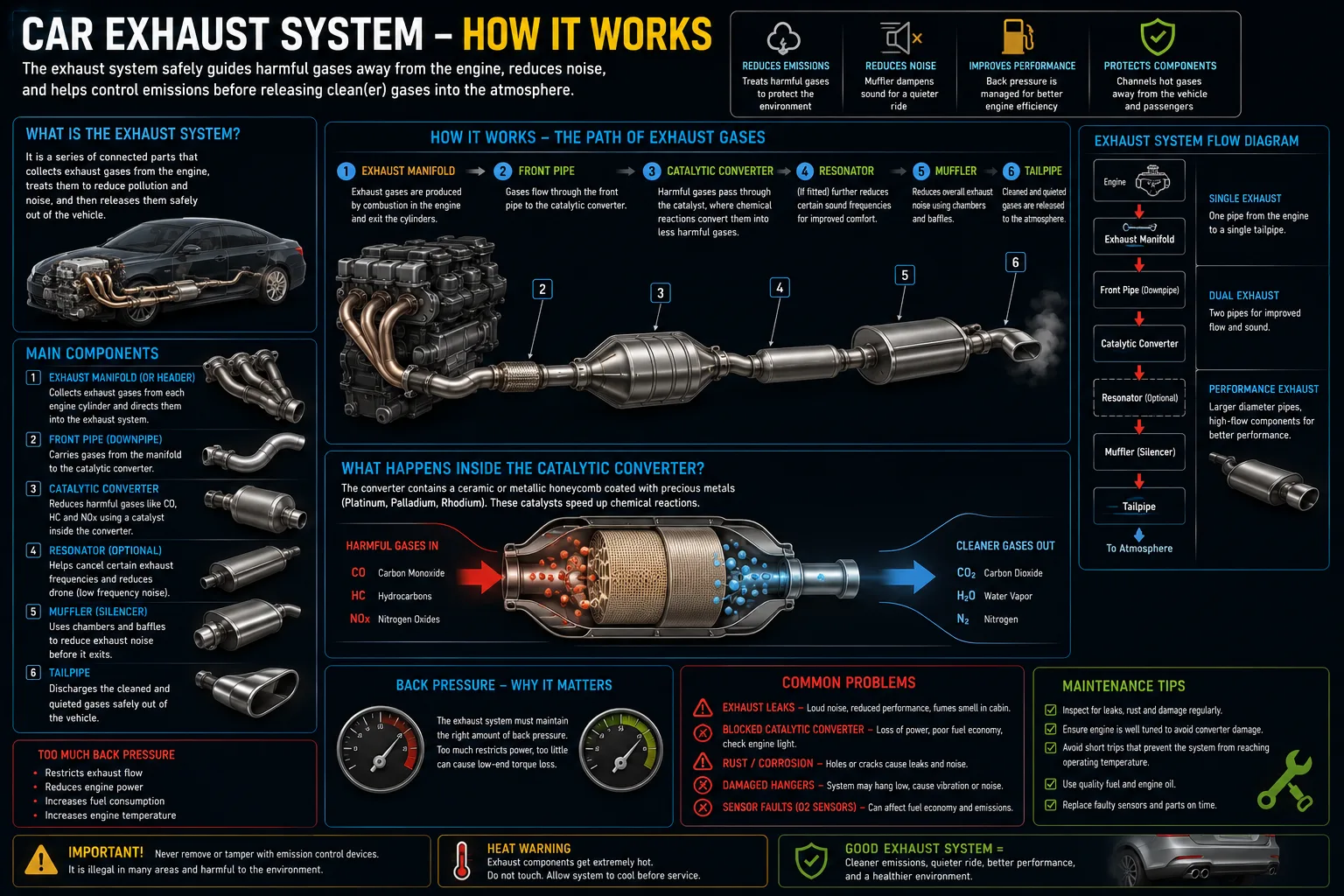
Your exhaust system runs from the engine's exhaust manifold, through a flexi pipe (on most modern cars), past the catalytic converter, into a mid-section, and finally to the rear silencer or back box. Every joint in that chain is a potential failure point — gaskets compress and blow, clamps rust and slip, pipes corrode from the outside in and the inside out simultaneously thanks to condensed acid from combustion gases. The rasping, droning, or blowing noise you're hearing is exhaust gas escaping somewhere it shouldn't, and the location matters enormously for what the fix involves. A blown manifold gasket is a sharp, ticking, sometimes metallic sound that gets faster as the engine revs — it's near the engine and can be genuinely awkward to access depending on your car. A hole or corroded section further back in the mid-pipe or silencer typically produces the more classic low-pitched drone that oscillates with engine load. A broken or split flexi pipe — that corrugated bellows section just after the manifold — will give you a hissing or rasping exhaust note and is one of the more common failures on higher-mileage cars, particularly after years of absorbing the engine's torque and vibration so the rest of the system doesn't have to. Identifying which part has failed before quoting or ordering parts is the only sensible approach. That's what we do first.
“Perhaps it announces their arrival in a way that commands respect.”
Sound familiar?
So what's behind it?
What we do — at your door
We come to you — driveway, car park, roadside, wherever the car currently is — and we don't start by assuming you need the most expensive option on the shelf. The first job is getting under the car and finding exactly where it's blowing: manifold gasket, flexi pipe, mid-section, back box, clamp joint, or hanger failure. A lot of exhaust noise diagnoses go wrong because someone assumes back box when it's actually a gasket, or assumes full replacement when a single corroded section with a decent clamp or a flexi pipe repair would sort it. We assess the rest of the system at the same time, because fitting a new flexi onto a mid-pipe that's six months from disintegrating is a favour to nobody. We'll tell you honestly what needs doing now and what can wait — and then we fix it, at your location, with the parts on the van or ordered for a return visit, without routing you through a chain exhaust centre that sells you a lifetime guarantee on a system your car will outlast anyway.
What affects the price
What you'll pay for exhaust work in the UK depends on several things working against each other simultaneously. The part itself varies enormously: a flexi pipe for a popular hatchback might be a modest outlay, while a stainless manifold section for something European and temperamental is a different conversation entirely. Labour time is shaped by access — a rear silencer on a simple car can be swapped in under an hour; a manifold gasket on a transversely-mounted engine crammed into a modern engine bay can eat a morning. The decision between section repair and full system replacement is the biggest cost fork: we'll always tell you honestly which one the car actually needs rather than defaulting to the option with the better margin. Stainless steel sections cost more upfront but corrode dramatically more slowly than mild steel, which is worth factoring in if you're planning to keep the car. Labour rates for a mobile mechanic are typically lower than a main dealer or fast-fit chain because we don't have a forecourt, a waiting area, or a franchise fee to amortise across every job.
Random knowledge you didn't ask for
Questions you're probably asking
Will a blowing exhaust fail an MOT?
Yes, without hesitation. An MOT tester will fail the car for a blowing exhaust anywhere in the system — leaking manifold gasket, holed silencer, corroded mid-section, fractured flexi. They're also looking at the exhaust mountings and hangers, so a section that's secure but badly corroded, or hanging at an angle, can also pick up a failure. The good news is it's a definable, fixable fault, not the existential kind.
Can you just patch a hole in an exhaust rather than replacing the section?
Sometimes, honestly yes — exhaust paste and bandage repair kits exist and a small hole in an otherwise sound section on a car you're keeping for six more months is a legitimate call. But a section that's corroded through in one place is usually corroded through in several, and a patch on fragile metal tends to create a new hole nearby within a few months. We'll tell you the honest answer for your specific car rather than defaulting to the expensive one or the cheap-and-cheerful one.
How do I know if it's the flexi pipe or the manifold gasket making the noise?
Roughly: a manifold gasket tends to produce a ticking or chuffing sound, audible from the engine bay, that increases in frequency with revs. A flexi pipe failure is more typically a raspy, hissing, or droning note from further back under the car. But they genuinely do overlap and the only reliable diagnosis is getting under the car with the engine running and finding where the gas is actually escaping from — which is what we do before anything else.
Is a blowing exhaust actually dangerous, or is it just annoying and an MOT problem?
Both, with emphasis on the dangerous if it's near the front of the car. A leak at the manifold or anywhere in the first half of the system can route carbon monoxide towards the cabin — slowly, subtly, and without the obvious smell that a petrol leak gives you. Rear leaks are less acutely dangerous but still not fine. The noise and the MOT failure are the obvious problems; the gas routing concern is the one worth taking seriously.
My exhaust is hanging off but not obviously blowing — do I need to do anything urgently?
Yes, fairly urgently. A section hanging from one mount is a scrape-on-a-speed-bump away from separating entirely, which is both an immediate MOT failure and the kind of event where your exhaust introduces itself to the tarmac at speed. A loose or broken hanger is often a cheap repair on its own — but left alone it puts mechanical stress on the pipe joints and the section will start blowing shortly anyway.
Your Exhaust Is Blowing — sorted at your door
Stop procrastinating. Get a transparent quote and we'll come to you.