Timing Belt & Chain Service
AKA 'The Expensive Rubber Band' — Skip this service, buy a new engine. Your choice.
Timing belt due? Chain rattling on startup? This is the service you don't skip unless you enjoy buying new engines.
See our upfront pricingQuick Facts
What's This All About Then?
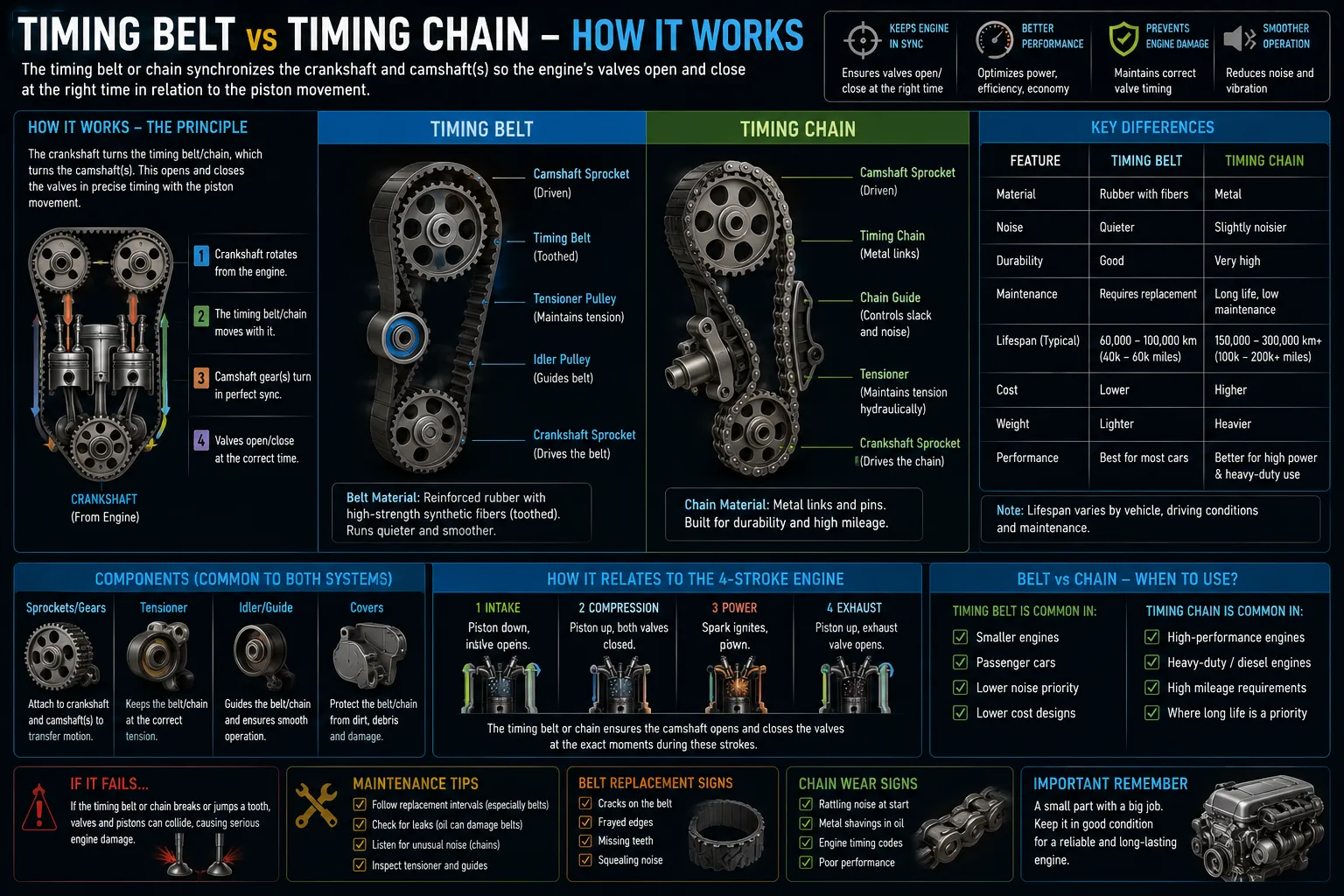
The timing belt or chain keeps your engine's valves and pistons dancing in perfect synchronisation. When a timing belt snaps, valves meet pistons, and your engine becomes modern art (expensive, twisted metal modern art). Timing chains last longer but stretch over time, causing rattling and eventually skipping. Neither failure mode is cheap. The good news: replacing them on time is WAY cheaper than replacing an engine. We do timing belt and chain replacements at your location, including water pump (often driven by the same belt), tensioners, guides, and all the bits that should be changed at the same time.
How it works
Your engine has two halves that must stay perfectly synchronised: the crankshaft down below (driven by the pistons) and the camshaft(s) up top (which open and close the valves). The timing belt or chain links them so the valves open and close at exactly the right moment relative to each piston. Get that timing wrong by even a fraction and the engine won't run — or worse. Most engines today are 'interference' designs, meaning the valves and pistons share the same space at different times; the belt is the only thing keeping them apart. A belt is rubber-toothed and wears out on a schedule; a chain is metal and usually lasts longer, but chains can still stretch and their tensioners and guides can fail.
Warning signs to watch for
- •A rattling or chattering noise from the front of the engine — a stretched chain or failing tensioner
- •A high-pitched belt squeal or whirring — a worn or perishing timing belt
- •The engine light on with camshaft/crankshaft correlation codes — the timing has drifted
- •Rough running, misfires or difficulty starting — timing that's slipped a tooth
- •Visible cracks, fraying or shiny glazing on an inspected belt — the rubber is failing
- •A ticking that worsens with revs on a chain engine — worn guides or a slack chain
Common causes
What we do
First we identify whether your engine has a belt or a chain and check it against the manufacturer's exact interval — guesswork here is dangerous. For a belt service we replace the belt, tensioner, idlers and usually the water pump together (it's driven by the same belt on many engines, so doing it once is smart). It's precise, careful work, done properly at your home or workplace so you're not without the car for days.
Timing Belt & Chain Service — FAQs
Does my car have a timing belt or a timing chain?
It depends entirely on your make, model and engine — some manufacturers use belts, others chains, and some the same model changed over the years. Chains generally last longer but aren't maintenance-free. We'll check your exact engine against the manufacturer's data and tell you which you have and when it's genuinely due.
What actually happens if my timing belt snaps?
On most modern engines — 'interference' designs — a snapped belt lets the valves and pistons collide at speed, bending valves and sometimes wrecking the head or pistons. Repair costs can rival the car's value. That's exactly why replacing it on schedule, before it fails, is so much cheaper than the alternative.
Should I replace the water pump at the same time?
Usually yes. On many engines the timing belt also drives the water pump, so the mechanic is already right there. Fitting a new pump then costs mostly just the part, whereas a pump failure later means paying the whole belt labour again. We'll advise based on your specific engine layout.
What You Actually Get
Common Timing Belt & Chain Service Faults We Fix
Random Knowledge You Didn't Ask For
Timing belt replacement intervals range from 40,000 to 100,000 miles. Check your manual. Seriously.
A snapped timing belt at 3,000 RPM means pistons hitting valves 1,500 times per minute. Ouch.
Why Get Your Timing Belt & Chain Service Done By Us?
We're Quick
Fast response, efficient work. No dragging things out.
We Come To You
Your driveway, your office, wherever. We travel.
We Guarantee It
If we mess up, we fix it. Simple as that.
Ready for Timing Belt & Chain Service?
That thing's not going to fix itself. We've checked.