Timing Belt Replacement: The Cheap Rubber Band Holding Your Engine Together
Somewhere inside your engine, a toothed rubber band about as thick as your thumb is the only thing preventing a mechanical catastrophe of genuinely impressive proportions. It synchronises your crankshaft and camshaft — keeping the valves and pistons on speaking terms rather than in a violent, engine-destroying argument. That band is your timing belt. It costs very little relative to what it protects. Ignore the replacement interval and the bill stops being small very quickly indeed. We replace cam belts at your driveway, your workplace, wherever — no garage required, no disruption, no drama.
See our upfront pricingYour timing belt is a rubber band stopping your engine from destroying itself. Miss the replacement interval and the valves meet the pistons — expensively. SOSCarFix replaces cam belts at your door, anywhere in the UK.
How it actually works
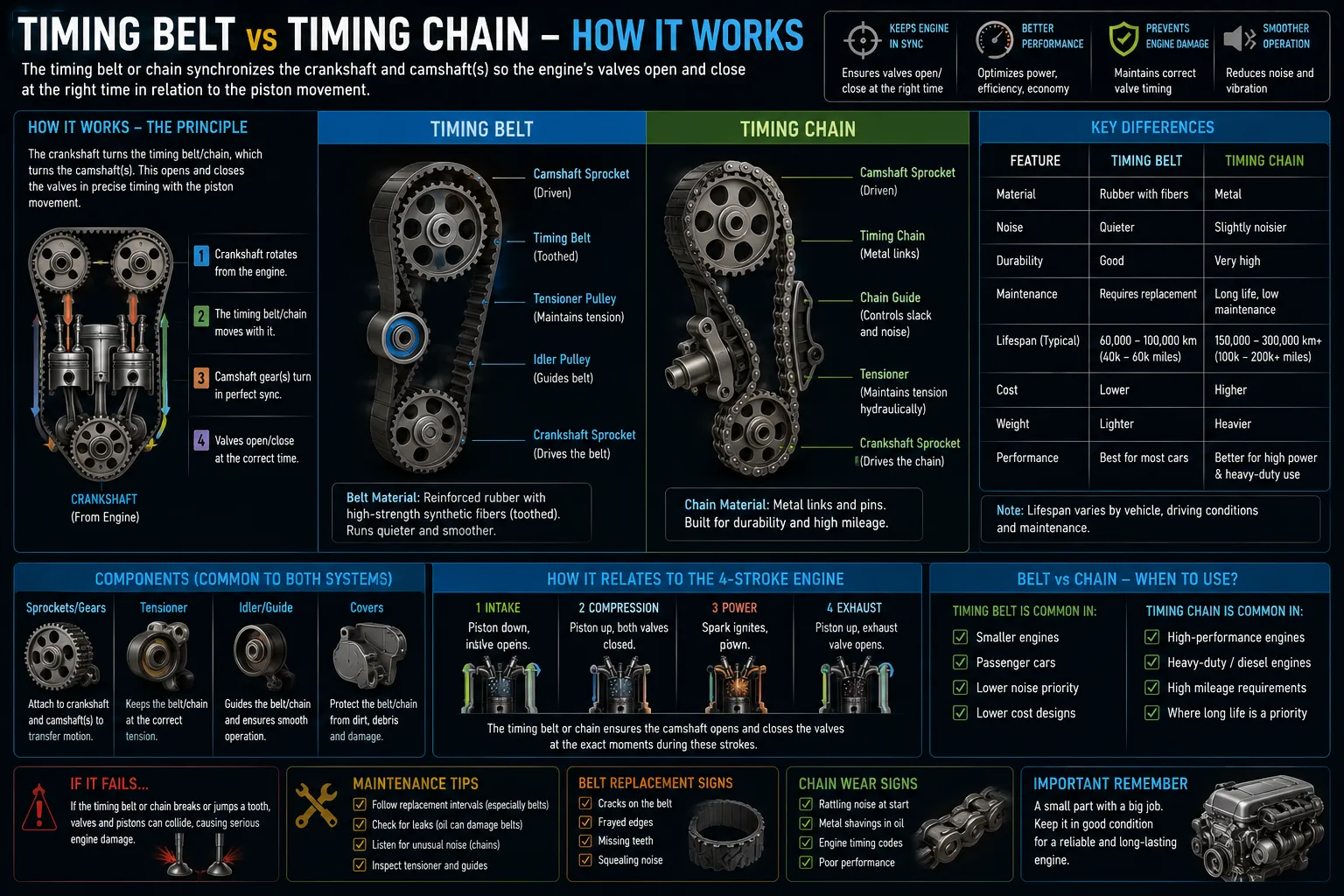
Your engine is basically a very precise sequence of explosions. Fuel goes in, spark fires, gases push the piston down, exhaust goes out. For that to work, the valves — which let fuel in and exhaust out — need to open and close at exactly the right moment. Too early, too late, or not at all, and the whole sequence falls apart. The timing belt is what keeps it all coordinated. It runs between the crankshaft (bottom of the engine, driven by the pistons) and the camshaft (top, which operates the valves), and the toothed inner face locks them in perfect synchronisation — like a bicycle chain, but with considerably higher stakes if it snaps. On most modern engines — interference engines — the pistons and valves actually share the same physical space at different points in the cycle. They're carefully choreographed never to be in the same place at the same time. The timing belt is the choreographer. When it goes — whether it snaps outright or slips a tooth — the pistons and valves collide. Bent valves, cracked pistons, destroyed cylinder head. An engine that was fine one second and scrap metal the next. Most manufacturers spec a replacement interval somewhere between 60,000 and 100,000 miles, or every 5 to 8 years — whichever comes first. The 'whichever comes first' bit catches a lot of people out. Rubber degrades whether you're driving it or not. A belt on a low-mileage car that's sat through eight British winters is not a healthy belt. On many engines, the water pump is driven off the timing belt. If it fails, it can take the belt with it. This is why we replace both at the same time — the labour to get back there is the same either way, and doubling up now is a fraction of the cost of doing it twice.
“We replace cam belts at your driveway, your workplace, wherever — no garage required, no disruption, no drama.”
Sound familiar?
So what's behind it?
What we do — at your door
We come to you — driveway, car park, office, wherever the car happens to be sitting — and carry out the full timing belt replacement job on-site. That means the belt itself, the tensioner and idler pulleys from the kit (never just the belt alone — the pulleys are the same age and they will betray you), and the water pump where it's driven off the belt. We check the cam and crank seals for weeping while we're in there, because finding a leaking seal after the job is done and the cover is back on is the sort of thing that makes mechanics quietly furious. The job is done properly, torqued to spec, timed correctly and tested before we leave. We'll tell you the manufacturer's next recommended interval so you're not guessing in three years' time. No upselling, no vague advice, no 'while we had it in we noticed seventeen other things' — just the job done right, at your door.
What affects the price
The price of a timing belt job varies quite a bit, and here is why. Engine layout is the biggest factor — a belt buried behind auxiliaries on a transversely mounted engine in a small engine bay takes significantly longer to access than one on a straightforward inline engine with room to work. Access time is labour time, and labour time is cost. The make and model drives parts cost; timing belt kits for a common Ford or Vauxhall are a fraction of the price of an equivalent kit for a higher-end European car. Whether the water pump is driven off the belt is relevant — if it is, replacing it at the same time is the sensible move and adds to the job cost, but far less than it would cost to come back and do it separately later. Your location affects the overall quote too. Get in touch for a bespoke price — we'll need the make, model, year, and engine size, and we'll give you a straight answer.
Random knowledge you didn't ask for
Questions you're probably asking
How do I know when my timing belt is due for replacement?
Check your vehicle handbook — it will list both a mileage and an age interval. The rule is whichever comes first. If you don't have the handbook, tell us your make, model, year, and engine size and we'll look it up. If you've bought a used car and have no service history proving the belt has been changed, treat it as due regardless of the displayed mileage.
Can I drive with a worn timing belt?
If you have reason to suspect the belt is past its interval or showing symptoms, the honest answer is: not really, no. There is no 'a bit longer' with a timing belt. It either holds or it doesn't, and the difference between those two outcomes is an engine rebuild versus a part swap. The risk-to-reward calculation here is not complicated.
Do you have to replace the water pump at the same time?
On engines where the water pump is driven by the timing belt — which is a large number of common UK cars — yes, we strongly recommend it. The pump is the same age as the belt. Getting back inside that engine if the pump fails six months later means paying the full labour cost a second time. Doing both together is always the better call financially and mechanically.
Is a timing belt the same as a timing chain?
No — and it matters. A timing chain is metal, runs in oil, and is generally designed to last the life of the engine (though they do wear and stretch, and rattling on startup is a warning sign). A timing belt is rubber, runs dry, and has a defined replacement interval. Not all cars have a belt — some use a chain. We'll tell you which yours has and whether any attention is needed.
How often should the cambelt / timing belt be changed?
Most manufacturers specify every 60,000–100,000 miles or every 5–8 years — whichever comes first. That second part is the one people miss. Rubber degrades whether the car is moving or sitting on a driveway through three British winters. A low-mileage car with an eight-year-old belt is not a safe car. Check your handbook for the exact interval; if you don't know when it was last done, treat it as overdue. The cost of replacement is trivial compared to a bent-valve engine rebuild.
Timing Belt Replacement — sorted at your door
Stop procrastinating. Get a transparent quote and we'll come to you.