The Chain That Rules Them All: Why a Stretched Timing Chain Deserves Your Immediate Attention
Somewhere inside your engine, a metal chain — roughly the same concept as a bicycle chain, though considerably less forgiving if you neglect it — is synchronising your crankshaft and camshaft with precision that would make a Swiss watchmaker weep with envy. It is doing this thousands of times per minute, every minute you drive, for what the manufacturer cheerfully describes as the "lifetime of the engine." That lifetime, it turns out, is not always as long as advertised, especially if your oil changes have been more... aspirational than actual. A worn timing chain doesn't announce its retirement gracefully. It rattles, it stretches, it throws diagnostic codes, and if you leave it long enough, it introduces your valves to your pistons in a meeting nobody survives. SOSCarFix comes to you — no garage waiting room, no upsell theatre — and sorts it before your engine becomes an expensive paperweight.
See our upfront pricingRattling timing chain on cold starts? Stretched chain, worn tensioner or cam correlation codes? SOSCarFix diagnoses and replaces it at your door. Get a quote.
How it actually works
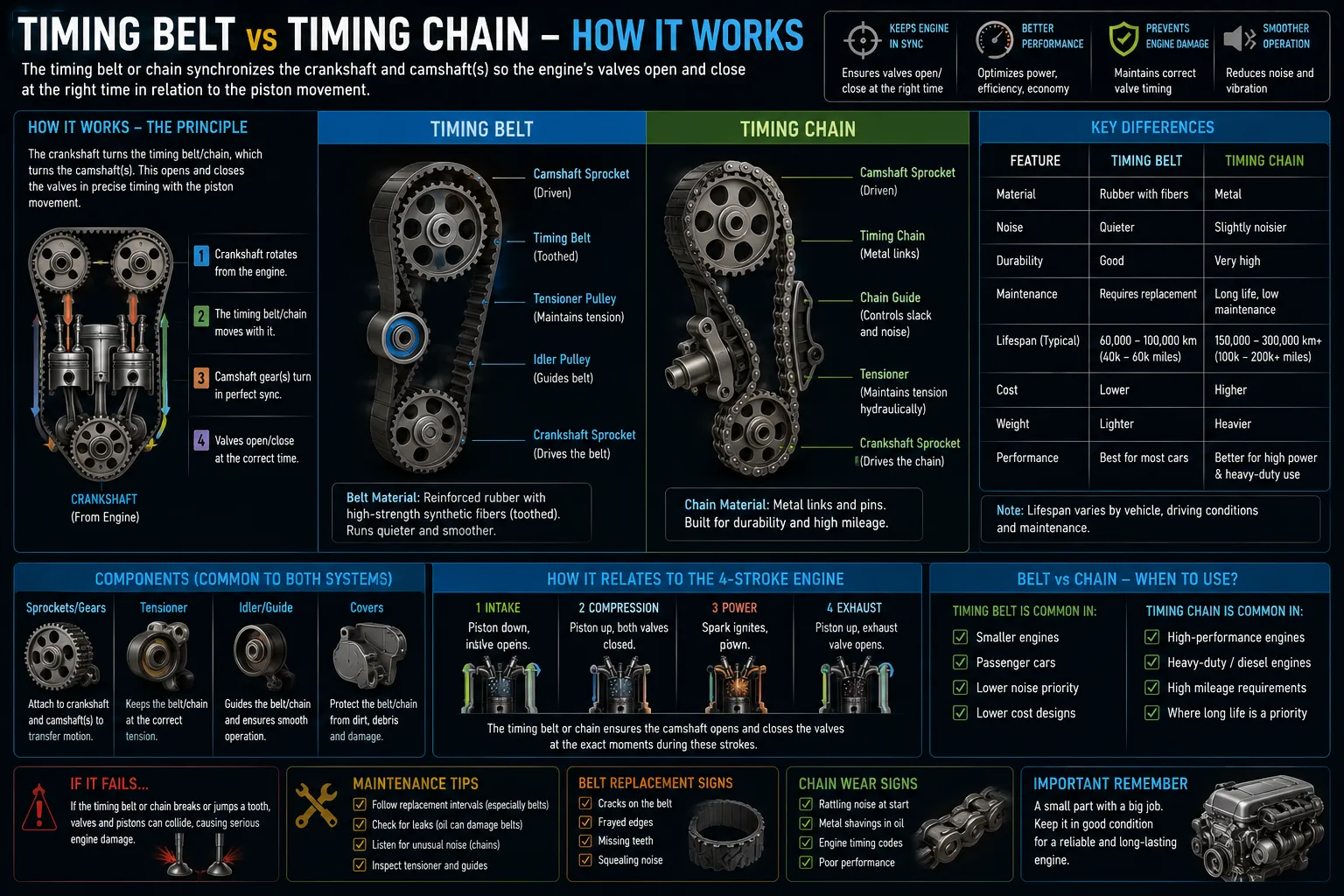
The timing chain lives inside your engine, bathed in oil, connecting the crankshaft at the bottom to one or more camshafts at the top. Its sole job is keeping these two (or more) shafts in perfect rotational sync so that your valves open and close at exactly the right moment relative to your pistons. Get it wrong by even a few degrees — as happens when a chain stretches — and you've got cam-to-crank correlation errors, rough running, and potentially valves arriving in a cylinder at the exact moment a piston is also trying to be there. On interference engines (which is most modern engines, because efficiency), that's a total engine failure waiting to happen. Unlike a timing belt, a chain is lubricated by the engine's own oil supply, which is why the two most common killers are low oil level and infrequent oil changes. Sludged, degraded oil starves the tensioner — a small hydraulic or mechanical device that keeps slack out of the chain — and once the tensioner gives up, the chain starts slapping around like a wet rope. Guides (the plastic rails the chain runs along) wear down too, and shed fragments into your oil. A full timing chain kit replacement typically involves the chain itself, tensioner, guides, and often the cam and crank sprockets, because doing half the job twice costs more than doing it properly once.
“" That lifetime, it turns out, is not always as long as advertised, especially if your oil changes have been more.”
Sound familiar?
So what's behind it?
What we do — at your door
SOSCarFix sends a qualified mobile mechanic to wherever you've parked the problem — your driveway, your work car park, or the layby where the rattle finally convinced you to call someone. We start with a proper OBD scan and a cold-start listen to confirm it's actually the timing chain and not a tensioner in isolation or some other noise impersonating a chain problem, because throwing parts at symptoms is how garages charge double. Timing chain work is substantial — it's inside the engine, requires draining oil and often removing ancillaries to access the front cover — and we'll give you an honest assessment of whether this is a roadside job or whether we need to get the car to a workshop bay. We don't dress it up either way. If it needs doing, we tell you what the kit involves (chain, tensioner, guides, sprockets as appropriate), source quality parts, and get it done without the three-day wait and courtesy car faff. One call, one visit, one fixed engine.
What affects the price
Timing chain replacement in the UK is not cheap, and anyone quoting you a suspiciously low number is almost certainly leaving out something important — like the tensioner, the guides, or their labour time. Cost is driven by a handful of honest variables: engine complexity (a simple single-cam chain on a three-cylinder is a different job to a twin-cam V6 with variable valve timing on both banks); whether the job requires removal of ancillary components like the water pump, alternator or power steering pump to access the timing cover; the quality of the kit used (OE-specification or OEM-equivalent parts cost more than pattern parts and are worth it on a job you don't want to repeat); and the labour time, which on some engines runs to eight hours or more because the chain is buried behind everything. Parts alone for a full kit — chain, tensioner, guides, sprockets — can range significantly depending on the engine. Labour on top reflects genuine time on the vehicle. We give you a transparent breakdown before we touch anything.
Random knowledge you didn't ask for
Questions you're probably asking
How is a timing chain different from a timing belt, and does it matter?
Yes, significantly. A timing belt is a rubber-toothed belt that runs dry, outside the engine, and has a defined service interval — typically 60,000–100,000 miles or 5–10 years. A timing chain is metal, runs inside the engine in oil, and is marketed as lasting the engine's lifetime. That's true when serviced properly. The practical difference is that belts fail on a schedule you can plan for; chains fail on a schedule dictated by how conscientiously you've changed your oil.
Can I keep driving with a timing chain rattle?
You can. People do. It tends not to end well. A cold-start rattle that clears quickly suggests the tensioner is still just about managing, but it's telling you the chain is slack enough to be a problem at low oil pressure. Every cold start is a gamble. On an interference engine — which yours probably is — a chain that skips teeth or snaps doesn't give you a gentle warning. It gives you bent valves, a dead engine, and a recovery truck. 'How long can I leave it' is the wrong question. 'How much does a new engine cost' is the right one.
My mechanic mentioned replacing the timing chain 'kit' — what does that mean exactly?
A timing chain kit is the sensible approach to not doing this job twice. It typically includes the chain itself, the tensioner (which is often why the chain is rattling in the first place), the plastic timing chain guides (which wear and can shatter), and the cam and crank sprockets. Replacing just the chain while leaving a worn tensioner is technically possible and professionally embarrassing. Any competent mechanic doing the job properly will quote you for the full kit.
Will a timing chain replacement fix my cam-to-crank correlation fault codes?
In most cases, yes — P0016-type codes are the ECU detecting that the relationship between camshaft and crankshaft position has drifted beyond tolerance, which is textbook stretched-chain territory. However, variable valve timing solenoids (VVT solenoids) can also cause similar codes if they're clogged with sludge or failed electrically. A proper diagnosis before the job confirms the cause. We scan before we quote, not after.
Is timing chain replacement something a mobile mechanic can actually do?
Often, yes — but it depends on the engine. Some timing chains are accessible enough that a well-equipped mobile mechanic can do the job on your driveway with the right tools: engine support, timing locking tools specific to the vehicle, and a flat, clean working area. Other engines — particularly where the timing chain is at the rear of the engine or buried behind the gearbox — need a proper workshop lift. We'll tell you honestly which category yours falls into before we schedule anything.
Why is my engine rattling when I first start it up in the morning?
That cold-start rattle is the timing chain tensioner struggling to build oil pressure before it quietens down — and it's telling you the chain has stretched. Ignore it and you're gambling with your engine: a slack chain can jump a tooth, wreck your valve timing, and turn a £400 fix into a £2,000 engine rebuild. The rattle gets worse over time, not better. Get a mobile mechanic to listen to it properly before you've driven another thousand miles.
The Chain That Rules Them All — sorted at your door
Stop procrastinating. Get a transparent quote and we'll come to you.