Track Rod Ends: The Steering Part That Fails Quietly — Until Your MOT Doesn't
Track rod ends are the small ball-jointed connectors that sit at the outer end of your steering rack and physically push and pull your front wheels left and right when you turn the wheel. They're not glamorous. They don't have a warning light. They just quietly wear out — usually over years of absorbing every pothole, kerb clip and rutted B-road Britain can throw at them — until your steering starts going vague, your tyres wear in a baffling feathered pattern, or your MOT inspector finds play in them and writes it down in red. SOSCarFix comes to you, replaces the worn end (or both, if that's what's needed), then sends you straight to a tracking alignment to make sure your wheels are actually pointing the same direction again.
See our upfront pricingKnocking on turns, vague steering or a mystery MOT fail? Worn track rod ends, sorted on your driveway. Get a quote from SOSCarFix today.
How it actually works
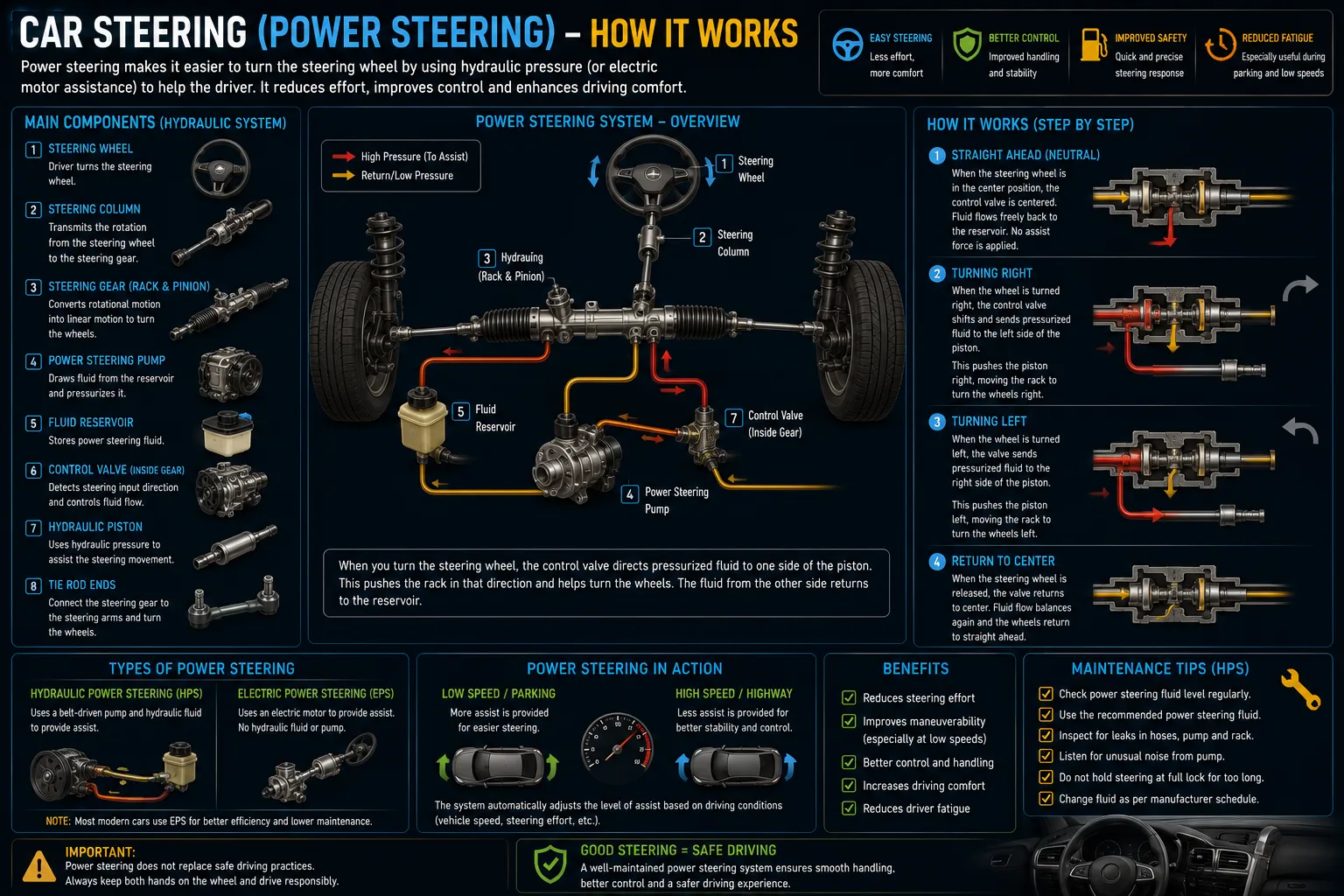
Your steering rack converts the rotation of your steering wheel into a side-to-side pushing motion. But the rack itself terminates roughly in the middle of the car. To connect that motion to your actual wheels, you need track rods — long metal rods that run outward from each end of the rack. At the outer tip of each track rod sits the track rod end: a ball-and-socket joint, enclosed in a rubber boot, packed with grease. That ball joint lets your wheel turn through its full lock-to-lock range while still transmitting the push-and-pull steering force. The inner end of the track rod connects to the rack via a similar inner ball joint (sometimes called a rack end), and the outer track rod end threads onto the track rod itself — which is how alignment adjusters set the toe angle of your wheels. Over time and mileage, the grease depletes, the rubber boot perishes and splits (often letting in water and grit), and the ball socket wears loose. When enough play develops, you lose precision in the steering, the wheel can knock under load, and the toe geometry goes off — which means your tyres start scrubbing against themselves on every straight line you drive. It's slow, insidious, and expensive in tyre wear before anything more dramatic happens.
“They don't have a warning light.”
Sound familiar?
So what's behind it?
What we do — at your door
We come to you — driveway, car park, or wherever the car happens to be sitting — and start with a proper inspection before anything gets quoted or ordered. With the wheel in the air we check for play in the joint by gripping the tyre and loading it in the plane the joint works in (not just waggling it, which tells you very little), inspect the boot condition, check the inner joints too so we're not replacing one end and leaving a failing inner to ruin your alignment again in three months, and look at general rack and suspension condition while we're there. If the track rod end needs replacing we remove it, measure the thread position carefully so the new end goes back to the same approximate setting (reducing how far out your alignment will be), fit the replacement, torque it correctly and lock it. We're honest about the one thing we can't do at the roadside: set final wheel alignment — that needs a laser or camera alignment rig. We'll tell you which local alignment centre to use, or if you're already booked at one, we can often time the replacement to happen beforehand.
What affects the price
Track rod end replacement in the UK typically falls somewhere in the range of parts plus an hour or so of labour — but the honest answer is that the spread is wide and depends on several things. The part cost varies significantly between a budget pattern part and an OEM or OEM-equivalent component; for most everyday cars the genuine or OE-quality equivalent is the right choice, because a cheap joint that develops play again in 18 months costs you the alignment fee twice. Some vehicles — certain German cars especially — have inner track rod ends (rack ends) that are a separate, fiddlier job and cost more in parts. Corrosion can add time if the lock nut is seized or the threads are damaged. And then there is the alignment itself, which is a separate cost at a specialist alignment centre but is not optional after this repair — driving away without resetting the toe means your new part is destroying your tyres from the first mile. We'll quote the replacement clearly before starting; we don't hide the alignment requirement.
Random knowledge you didn't ask for
Questions you're probably asking
Can I drive with a worn track rod end?
For a short while, possibly — but the risk scales with how worn it is. Minor play causes vague steering and tyre wear; severe play means the geometry can shift unpredictably under load, and in the worst case a completely failed joint allows the wheel to steer itself. An MOT fail on a track rod end is an immediate fail for good reason. Get it looked at promptly rather than treating it as a 'whenever' job.
Do I need to replace both track rod ends at the same time?
Not always — unlike brake pads, track rod ends don't have to be done in axle pairs. However, if one is genuinely worn and the car has covered significant mileage, the other is often not far behind. We'll check both and tell you honestly whether the second one warrants replacement now or can wait. Doing both in one visit does save you one alignment fee, which is worth factoring in.
Why do I need wheel alignment after a track rod end replacement?
Because the track rod end threads determine the toe angle of your front wheel — how much the wheel points inward or outward relative to straight ahead. Removing and refitting the joint, even carefully, almost certainly changes the toe slightly. Incorrect toe wears tyres very fast and can make the car pull to one side. Alignment isn't optional; it's the second half of the job.
How long does track rod end replacement take?
On a typical car where corrosion isn't a battle, an hour or less for one side — a bit more if both ends need doing or if the lock nut is seized. We'll give you a realistic time when we quote. The alignment afterwards is a separate appointment at a tracking centre and usually takes 30–45 minutes.
What's the difference between a track rod end and a tie rod end?
Nothing — same part, different names. Track rod end is the standard British term; tie rod end is the American equivalent. If you've searched for either and landed here, you're in the right place. Some UK workshops use both interchangeably, which is confusing but harmless.
Track Rod Ends — sorted at your door
Stop procrastinating. Get a transparent quote and we'll come to you.