That Clunk When You Turn: Why Your Steering Is Making Noises (And What's Actually Broken)
A clunk when you turn the steering wheel is one of those noises that starts off quietly comedic — like your car is doing a little percussion riff every time you leave the driveway — and becomes steadily less funny as you realise something structural is moving when it really shouldn't be. The cruel joke of steering noises is that four completely different components can all sound like "a clunk from the front." A worn CV joint clicking on full lock, a perished strut top mount thumping on every steering input, a loose track rod end with its ball joint giving up the ghost, or a tired steering column coupling all produce suspiciously similar noises. Finding which one is the problem — without guessing — is the job. That's what we do, on your driveway, with the tools to tell them apart.
See our upfront pricingThat clunk when you turn the wheel? Not normal. CV joints, top mounts, track rods — we diagnose it on your driveway. No garage. Get a quote.
How it actually works
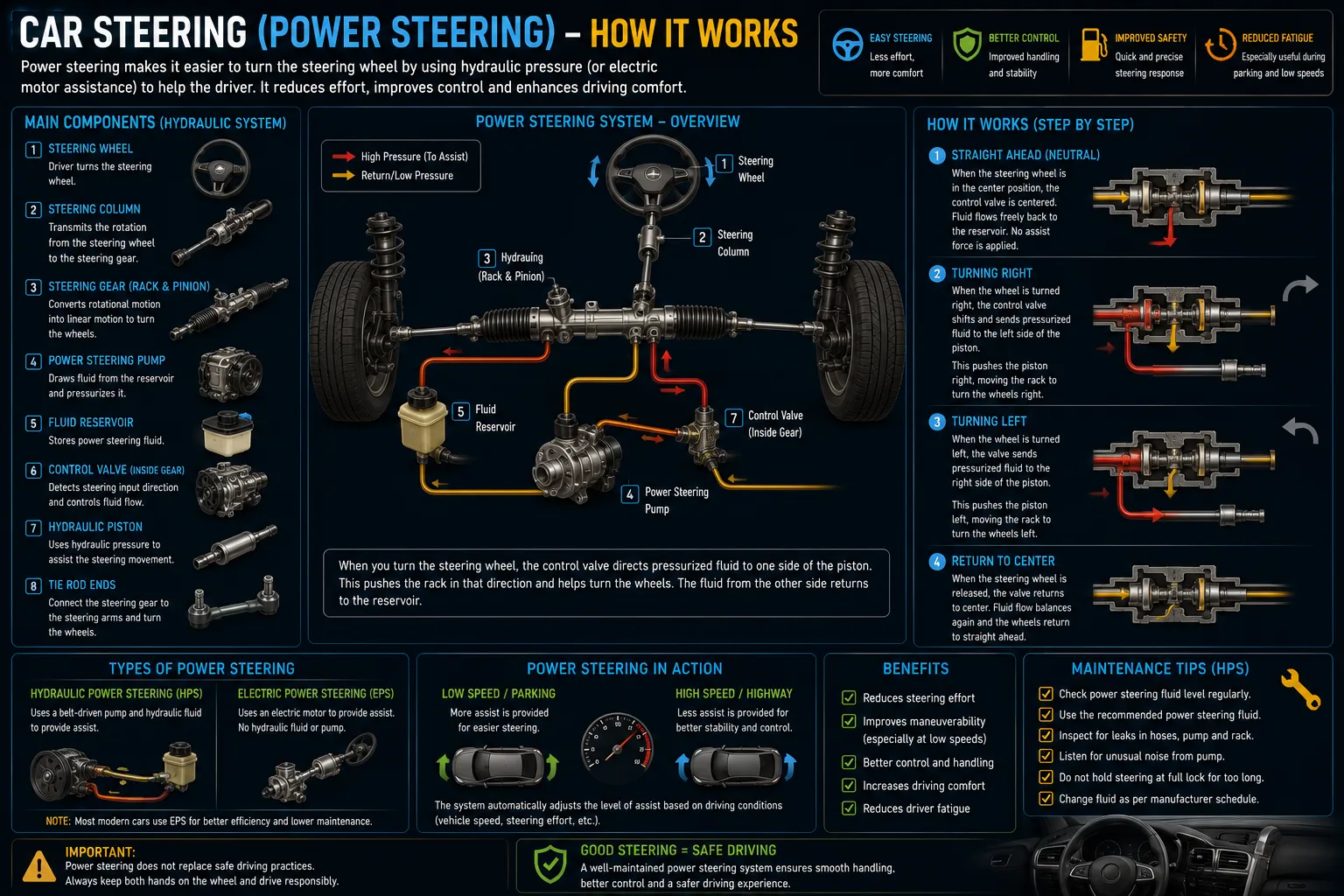
Your steering and front suspension are a mechanical conspiracy of parts all trying to achieve one thing: turning the wheels whilst keeping everything controlled and quiet. When you turn the steering wheel, that rotation passes down the steering column through one or two universal joints (UJs) in the coupling, into the steering rack, which pushes and pulls on the track rods — which in turn push the wheel hubs to turn the wheels. The whole corner of the car pivots around the strut, which sits in a top mount bearing bolted to the inner wing. And driving the wheels through all that steering motion are the driveshafts — fitted with CV (constant velocity) joints that allow the shaft to flex with suspension travel and steering lock whilst still spinning smoothly. Every one of those components is a moving joint. Every moving joint has a wear limit. The CV joint inner or outer — usually the outer, which takes the biggest angle on full lock — works by ball bearings running in grooves packed with grease, sealed by a rubber gaiter. When the gaiter tears, the grease escapes and grit gets in, and the joint's days are numbered. Strut top mounts are a bearing combined with a rubber isolating bush; they wear and crack. Track rod ends and ball joints are steel ball-and-socket joints — packed with grease under a dust seal — and they develop play. Steering column UJ couplings are small cross-shaped joints or flexible rubber disc couplings that can corrode or crack. The noise tells you something; the test tells you which.
“The cruel joke of steering noises is that four completely different components can all sound like "a clunk from the front.”
Sound familiar?
So what's behind it?
What we do — at your door
We come to you — driveway, car park, or wherever the car is sitting — and start with a proper physical inspection rather than a listen and a shrug. We check the CV gaiters for splits and grease flinging, rotate the driveshafts by hand to feel for roughness in the joints, grab the wheel at 12 and 6 and at 9 and 3 to test for track rod end and ball joint play, push and pull the strut to feel the top mount, and where needed take the car on a slow turn at full lock to confirm the clicking pattern. The steering column coupling gets checked too — it's often overlooked because it's up inside the cabin end of the shaft. Once we've identified the actual fault (not assumed it), we give you a clear quote before touching anything. CV joints, track rod ends, ball joints, top mounts and column couplings can all be replaced on-site. Driveshaft assemblies too, where access allows. We recheck for play after replacement and confirm the noise is gone. Track rod end replacement affects the tracking (the angle your front wheels point), so we advise a geometry check afterwards — one of those jobs that prevents tyre wear from eating your wallet over the next 12 months.
What affects the price
Cost varies significantly depending on which component is at fault. A CV gaiter replacement (if caught before joint damage) is the cheapest outcome. Replacing an outer CV joint — or more commonly a complete driveshaft assembly where it's more economical than sourcing just the joint — costs more, and prices vary by make and whether an OE, OEM-equivalent or pattern part is used. Track rod ends and ball joints sit in the mid-range; top mounts similarly. Steering column couplings vary from affordable standard UJs to more expensive OE rubber disc units on some makes. Labour times differ: a top mount on most hatchbacks is reasonably accessible; a pressed-in ball joint on certain cars requires specialist tools. Diagnostic time is always honest and quoted upfront. We use quality parts — not the cheapest pattern units that bring you back in six months.
Random knowledge you didn't ask for
Questions you're probably asking
How do I tell if it's a CV joint or a ball joint making the noise?
The classic tell for an outer CV joint is clicking or clunking specifically on full steering lock under load — pulling away slowly in a tight circle reproduces it reliably. Ball joint noise tends to be more of a knock over bumps and through mid-range steering rather than exclusively on full lock. There's overlap though, which is why we test both physically rather than just listening — live testing with the suspension unloaded versus loaded and the wheel at different angles is what separates them definitively.
Is a clunking CV joint an MOT failure?
A split gaiter on its own is an MOT advisory (or a minor deficiency under the current system). But if the CV joint itself has developed play or is visibly failing, or if the gaiter has been split long enough that grease has been flung and contamination is obvious, it becomes a major defect and a failure. An MOT tester will check both. If you've got an advisory from a previous MOT it's worth getting it looked at before your next one — 'advisory' has a way of becoming 'fail' inside 12 months.
Can you replace just the CV gaiter, or do you have to replace the whole driveshaft?
If the gaiter is caught early — torn but the joint inside is still smooth with no play or contamination — replacing the gaiter and repacking the joint with fresh grease is a legitimate repair. If the joint has been running dry and gritty for a while, or if there's any roughness or play in the joint itself, the joint (or the whole driveshaft assembly) needs replacing. We check the joint condition before recommending which route to take.
My car clunks when I turn but only in cold weather — does that matter?
Cold makes everything worse: rubber stiffens, lubricants thicken and clearances in worn joints temporarily tighten up and then knock. A noise that disappears when everything warms up isn't 'fine' — it's the same underlying wear, just more dramatic when cold. Worth getting it diagnosed before it becomes noise in all conditions and considerably more expensive.
Will a clunking steering component affect my MOT?
Yes, potentially — and directly. Play in track rod ends and ball joints is checked on the MOT brake/suspension check (either on a pit or a ramp), and any detectable play that exceeds the standard fails as a dangerous or major defect. Strut top mount play is checked similarly. A clunk alone isn't the test — play is — but if there's enough play to clunk there's usually enough play to fail. We can check everything before you book your MOT.
That Clunk When You Turn — sorted at your door
Stop procrastinating. Get a transparent quote and we'll come to you.