Power Steering Repair — When Your Steering Wheel Starts Doing CrossFit Without You
You hop in the car, go to pull out of a parking space, and suddenly realise you've been quietly relying on something you've never once thought about. Your steering wheel, previously content to glide with a couple of fingers, now requires the full commitment of both arms, a clenched jaw, and a mild identity crisis. Welcome to power steering failure — the automotive equivalent of the gym demanding you put in the work whether you wanted to or not. The good news: it's fixable. The better news: you don't have to drive it to a garage. We come to you.
See our upfront pricingPower steering gone stiff as a gym session you didn't sign up for? SOSCarFix mobile mechanics diagnose and repair power steering faults across the UK — we come to you.
How it actually works
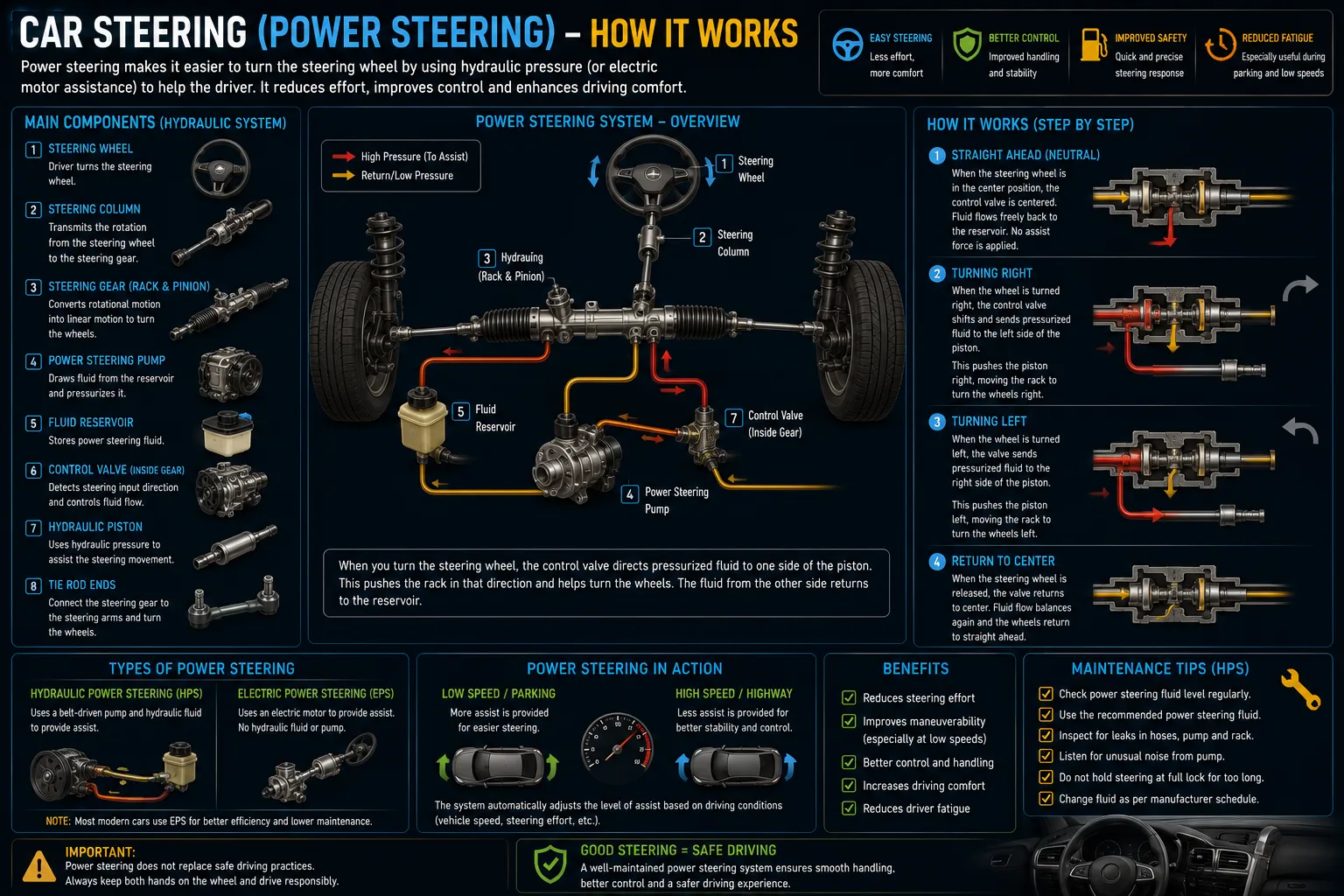
Your car's power steering system exists for one reason: to stop turning into a full-body workout every time you want to go left. There are two main flavours. Hydraulic power steering uses a belt-driven pump to push fluid under pressure through a rack-and-pinion or recirculating ball system — that pressure does the heavy lifting so your arms don't have to. Electric power steering (EPS), which most cars built in the last decade or so use, ditches the pump and fluid entirely in favour of an electric motor mounted on the steering column or rack, with sensors reading exactly how hard you're trying to turn and applying just the right amount of assist. Both systems are impressively clever. Both have their own specific ways of going wrong. A hydraulic system's Achilles heel is typically the fluid and pump; an EPS system's weak point tends to be sensors, the control module, or the motor itself. Either way, when they fail, you feel it immediately — and your arms feel it even more immediately.
“The better news: you don't have to drive it to a garage.”
Sound familiar?
So what's behind it?
What we do — at your door
We diagnose first — always. Power steering faults can be mechanical, hydraulic, or electronic, and throwing parts at it without knowing which is a good way to spend money on the wrong answer. Our mobile mechanics carry diagnostic equipment to read fault codes from EPS control units, check fluid pressure on hydraulic systems, and inspect the full steering setup including pump, rack, hoses, sensors, and belts. Once we know what's actually failed, we fix it — at your home, your workplace, wherever the car happens to be sitting. That might mean topping up and tracing a fluid leak, replacing a power steering pump, renewing worn hoses and seals, swapping a faulty EPS motor or control module, or replacing the rack entirely if it's given up the ghost. We'll always tell you what needs doing now, what can wait, and what's just someone trying to upsell you.
What affects the price
The cost of a power steering repair varies quite a bit depending on which type of system your car has, what's actually failed, and the make and model involved. A simple fluid top-up after a slow hose leak is obviously a very different job to replacing an electric power steering rack on a modern executive car. Key factors that affect the price: whether you have hydraulic or electric power steering (EPS parts tend to cost more); whether it's a pump, rack, sensor, motor, or control module at fault; the parts availability for your specific vehicle; and labour time, which varies significantly depending on how buried the components are. We provide bespoke quotes once we know exactly what's wrong — because an honest price after a proper diagnosis is always better than a ballpark figure that bears no resemblance to your actual bill.
Random knowledge you didn't ask for
Questions you're probably asking
Is it safe to drive with power steering failure?
Technically, yes — the car will still steer, because power steering assists rather than replaces the mechanical connection between your wheel and the road. Practically, it depends. At motorway speeds the steering won't feel dramatically different because less assist is needed anyway. At low speeds, parking lots, and junctions you'll need considerably more effort. If there's a hydraulic fluid leak involved, you also risk damaging the pump if it runs dry. Our strong advice: get it looked at promptly. Driving cautiously to get it fixed is fine; ignoring it indefinitely is not.
My power steering only plays up when it's cold — does it warm up and go away?
This is extremely common with hydraulic systems and it's usually down to the fluid being more viscous when cold, making the pump work harder at start-up. It can also mean low fluid levels or a pump that's on its way out but hasn't fully given up yet. The fact it improves when warm doesn't mean everything is fine — it usually means the problem is early enough to catch before it gets expensive and leaves you stuck.
My car has electric power steering and the EPS light came on. What does that mean?
It means the system has detected a fault and turned the power assistance off as a precaution — which is why the steering will suddenly feel noticeably heavier. It could be a torque sensor issue, a problem with the EPS motor or its control module, a wiring fault, or in some cases something as simple as a battery health issue affecting the system's power supply. It needs a proper diagnostic read rather than a guess. We can plug in, read the codes, and tell you exactly what's upset it.
Can a power steering rack be repaired, or does it always need replacing?
It depends on what's wrong with it. Minor seal failures inside the rack can sometimes be repaired rather than replaced, and a specialist remanufactured rack is often a cost-effective alternative to a brand new OEM unit. If the rack has developed mechanical wear — sloppy feel, knocking, or play in the steering — replacement is usually the right call. We'll always look at the realistic repair options for your specific car rather than defaulting to the most expensive answer.
EPS warning light came on after a jump-start or flat battery — why, and do I need a repair?
Because electric power steering is run by its own control module, and that module hates voltage spikes and brownouts about as much as your laptop hates being yanked from the wall mid-update. A flat battery, a poorly connected jump pack, or even just a very lazy starter motor can corrupt the module's memory or trip a protective fault. Sometimes the light clears itself once the battery is properly charged and the car has been restarted cleanly. If it stays on — or keeps coming back — the module has logged a real fault code that needs reading. It might be a genuine EPS fault the flat battery simply exposed rather than caused, which is the less fun scenario but better caught now than mid-roundabout.
Power steering fluid leak — should I be worried about red or amber fluid under the car and heavy steering?
Yes, and here's how to read what you're looking at. Fresh power steering fluid is typically red or pink; aged fluid turns amber to light brown — both are entirely normal colours for this system, so the shade tells you how old the leak is, not how catastrophic it is. The heavy steering is the bigger story: it means the reservoir is running low and the pump is being starved, which accelerates wear. Topping up buys you a short reprieve, but the leak still needs finding and fixing — rack seals, pump shaft seal, and the high-pressure hose are the usual suspects. Get it traced before the pump decides it's had enough.
groaning noise when turning the wheel at full lock
That groaning at full lock is almost always your power steering pump complaining — either the fluid level is low (check the reservoir under the bonnet, it's a quick win), or the pump itself is on its way out. On high-mileage cars, worn rack-end bushes or a tired rack can produce the same noise. It won't fix itself, and ignoring it usually ends in a seized rack or a failed pump. Get it looked at before it becomes a full steering replacement job.
How often should power steering fluid be changed?
Most manufacturers say every 2–3 years or around 30,000 miles — but a depressing number say nothing at all, which is why most people never change it and then wonder why the rack is weeping fluid at 80,000 miles. Power steering fluid degrades over time: it absorbs moisture, loses its protective properties, and starts to eat rubber seals from the inside out. Check the colour — clean fluid is red or clear; brown, foamy, or milky means it is overdue. If yours looks like old gravy, get it flushed and the level checked properly rather than just topped up and ignored.
Power Steering Repair — sorted at your door
Stop procrastinating. Get a transparent quote and we'll come to you.