Your Steering Pump Is Giving Up: And Your Arms Are the First to Know
There's a specific kind of grief that sets in when you try to pull out of a car park and the steering wheel feels like it's been welded to a ship's anchor. Your car previously required one finger and mild intention to turn; now it's demanding both arms, your core, and possibly a motivational speech. That's your power steering pump having a quiet, wheezy breakdown — and unlike a lot of car problems that you can pretend aren't happening for a few weeks, a dying PAS pump has a way of making itself very difficult to ignore. Groaning when you turn. Fluid weeping onto the driveway. The distinct whine of a system running dry. SOSCarFix diagnoses and replaces power steering pumps at your location — driveway, car park, or roadside — no garage required, no bus home, no drama.
See our upfront pricingStiff, groaning steering that feels like arm day at the gym? Your PAS pump is dying. SOSCarFix comes to you and sorts it. Get a quote.
How it actually works
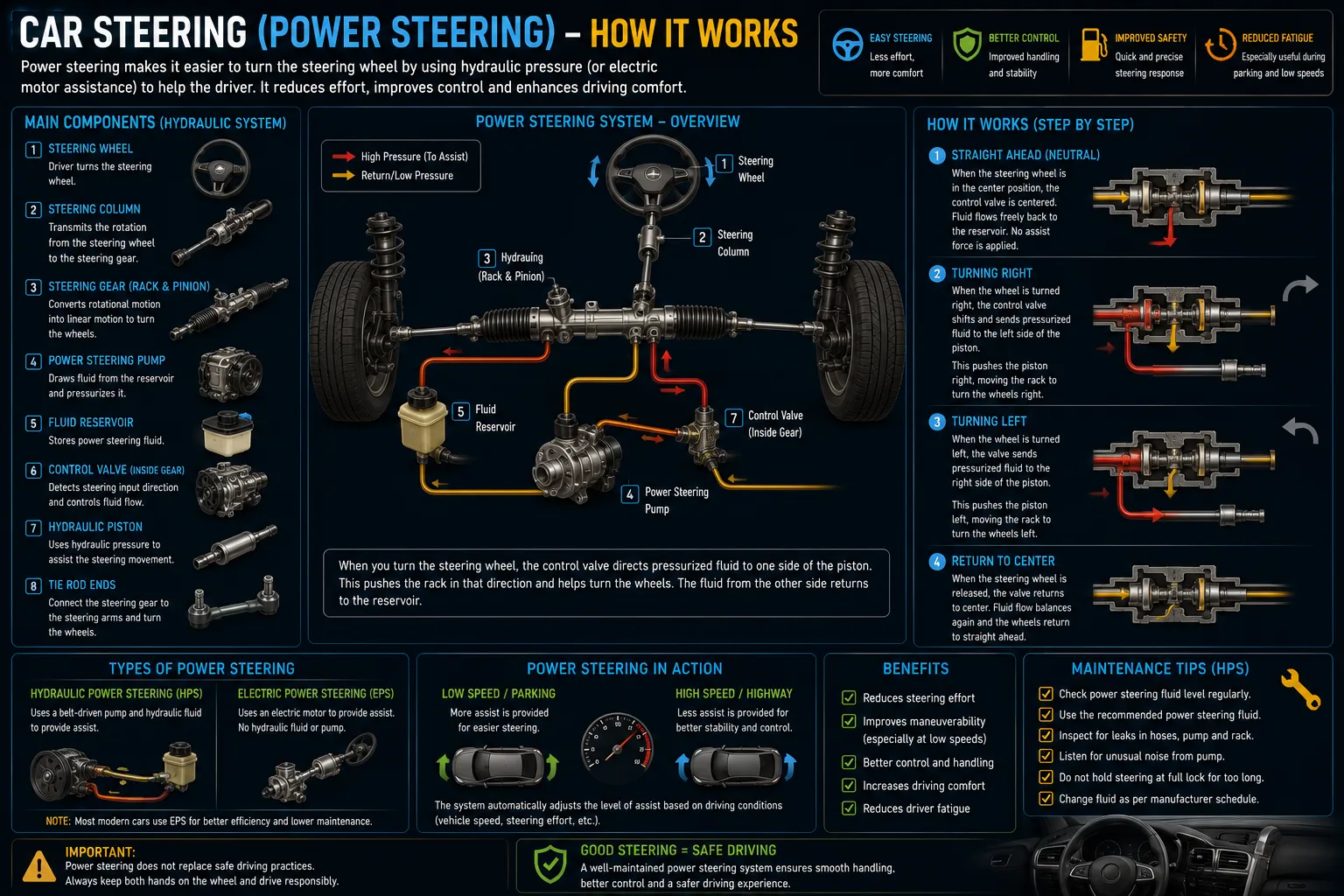
On a traditional hydraulic power steering system, the pump is the workhorse. Belt-driven off the crankshaft, it continuously pressurises power steering fluid and pushes it through a rack-and-pinion or steering box setup, multiplying your steering input so that a gentle nudge of the wheel translates into meaningful movement at the road. The moment you start the engine, the pump is already working. It works harder when you're turning at low speed — parking, manoeuvring, pulling into Tesco — and barely at all at motorway speeds. That duty cycle eventually takes its toll on the internal vanes, seals, and bearings inside the pump body. Seals crack. Bearings wear. Fluid escapes or gets contaminated. Pressure drops. You start to notice. Electric power steering (EPAS) is a different animal entirely — no fluid, no belt, no pump in the traditional sense. Instead, an electric motor assists the rack directly, governed by a control module. Faults here are usually sensor or motor failures rather than fluid and seals, and diagnosis requires live data from a scan tool rather than a dipstick and a suspicious puddle. Either way, SOSCarFix carries the diagnostic kit and the parts knowledge to tell you which system you have and exactly what's let go.
“The distinct whine of a system running dry.”
Sound familiar?
So what's behind it?
What we do — at your door
We come to you — your driveway before work, the office car park at lunch, a layby if things have gone properly wrong — and start with an honest diagnosis before anyone orders anything. On hydraulic systems that means checking fluid level and condition, inspecting for leaks at the pump, hoses, and rack, testing belt tension and condition, and where necessary using pressure testing equipment to confirm the pump is the actual culprit rather than a leaking hose making it look guilty. On electric systems, we plug in and pull live data — torque sensor readings, motor current, fault codes — because EPAS faults that aren't diagnosed properly lead to expensive parts being replaced in the wrong order. Once we know what's actually failed, we fit a quality replacement pump (or the correct EPAS component), flush and refill the hydraulic system with the correct fluid specification, refit and tension any associated belts, and bleed the system properly so there's no residual air causing the frothy nightmare you started with. You get your steering back. We pack up and leave. No one has to take a bus anywhere.
What affects the price
Power steering pump replacement cost in the UK varies considerably and anyone quoting a flat price without knowing your car is guessing — or hoping. The main variables are the car itself: a pump for a high-volume Ford Focus or Vauxhall Astra costs a fraction of one for a BMW, Mercedes, or anything with a German badge and an attitude. Whether you need a hydraulic pump, just a new drive belt, or an EPAS motor and control module are three very different jobs with very different parts bills. Age and accessibility matter too — on some engines the pump is a twenty-minute job in plain sight; on others it's buried behind ancillaries that need removing first, which adds labour time even for a mobile mechanic working efficiently. Fluid flush and refill is typically included in a proper job but worth confirming. If the power steering rack itself is also leaking or worn, that's a separate and larger repair that will affect overall cost. The honest answer is: get a quote based on your actual registration, not a number that turns out not to apply to your car.
Random knowledge you didn't ask for
Questions you're probably asking
Can I drive with a failing power steering pump?
Technically yes — power steering is assistance, not a legal requirement, and older cars managed without it entirely. But a pump that's failing rather than fully failed can be unpredictable: you might get intermittent assistance, which is arguably worse than none at all because your arms aren't calibrated for the variation. If the pump has seized or the belt has snapped, driving becomes genuinely hard work, particularly at low speed. Sort it promptly rather than finding out how your upper body copes on a multi-storey car park ramp.
How do I know if it's the pump or something else causing heavy steering?
Heavy steering on a hydraulic system can be the pump, a low fluid level, a leaking hose dropping pressure, a binding steering rack, or a worn drive belt — they can all produce similar symptoms. On an electric system the pump is irrelevant, and faults usually show as a warning light alongside the effort increase. This is exactly why diagnosis before parts ordering is worth doing: replacing a pump on a car that actually has a leaking high-pressure hose is an expensive way to not fix the problem.
How long does a power steering pump replacement take?
On most common UK cars — your Fords, Vauxhalls, Volkswagens, and the like — a straightforward hydraulic pump swap with a flush and refill typically takes one to two hours. Cars with tight engine bays or where ancillaries need to come off to access the pump take longer. Electric power steering motor or sensor replacement varies more widely depending on where the component is mounted. We'll give you a realistic time estimate when we know what car we're working on.
What happens if I just keep topping up the power steering fluid?
If the fluid level is dropping because of a leak, topping it up buys time but does nothing about the underlying leak — and a system that's losing fluid is ingesting air to replace it, which causes the aeration and foaming that accelerates pump wear. You're essentially funding a slow-motion pump failure with each top-up. Find the leak, fix the leak, then assess whether the pump has already been damaged by running low. Fluid disappearing from a sealed system is never just a quirk.
My car has electric power steering and the warning light is on. Is that the same job?
Different system entirely, but the outcome — heavy, unassisted steering — can feel similar. EPAS faults are typically electrical: a failed torque sensor, a faulty motor, a software issue in the EPAS control module, or a wiring problem. They need live diagnostic data to pinpoint, not a pressure gauge. We carry scan tools that read EPAS-specific fault codes on most common UK vehicles, so we can tell you what's actually wrong before suggesting any parts. Don't let anyone guess at an EPAS fault — guessing gets expensive quickly.
Your Steering Pump Is Giving Up — sorted at your door
Stop procrastinating. Get a transparent quote and we'll come to you.