Your Steering Rack Is Plotting Against You: Symptoms, Causes, and Why You Shouldn't Ignore That Clunk
The steering rack is the unassuming mechanical translator between your hands and your front wheels. You turn the wheel, the rack converts that rotational input into the lateral push-and-pull that actually points your tyres. Simple, elegant, and — like most things that work brilliantly for 80,000 miles — utterly unglamorous until it stops working. At which point it becomes the most important component in the car. A worn rack develops play, so the steering feels vague and wobbly, like the car is making suggestions rather than taking orders. A leaking rack weeps power-assisted steering fluid until either the pump starves and the steering goes heavy as a barge, or it marks its territory all over your driveway. Either way, it ends with a MOT advisory, a knocking noise that makes passengers clutch the door handle, or both. SOSCarFix comes to you — no appointment at a garage needed, no tow truck drama — and sorts it on your driveway.
See our upfront pricingKnocking, wandering, or leaking steering rack? SOSCarFix diagnoses and replaces it on your driveway. No tow truck, no faff. Get a quote today.
How it actually works
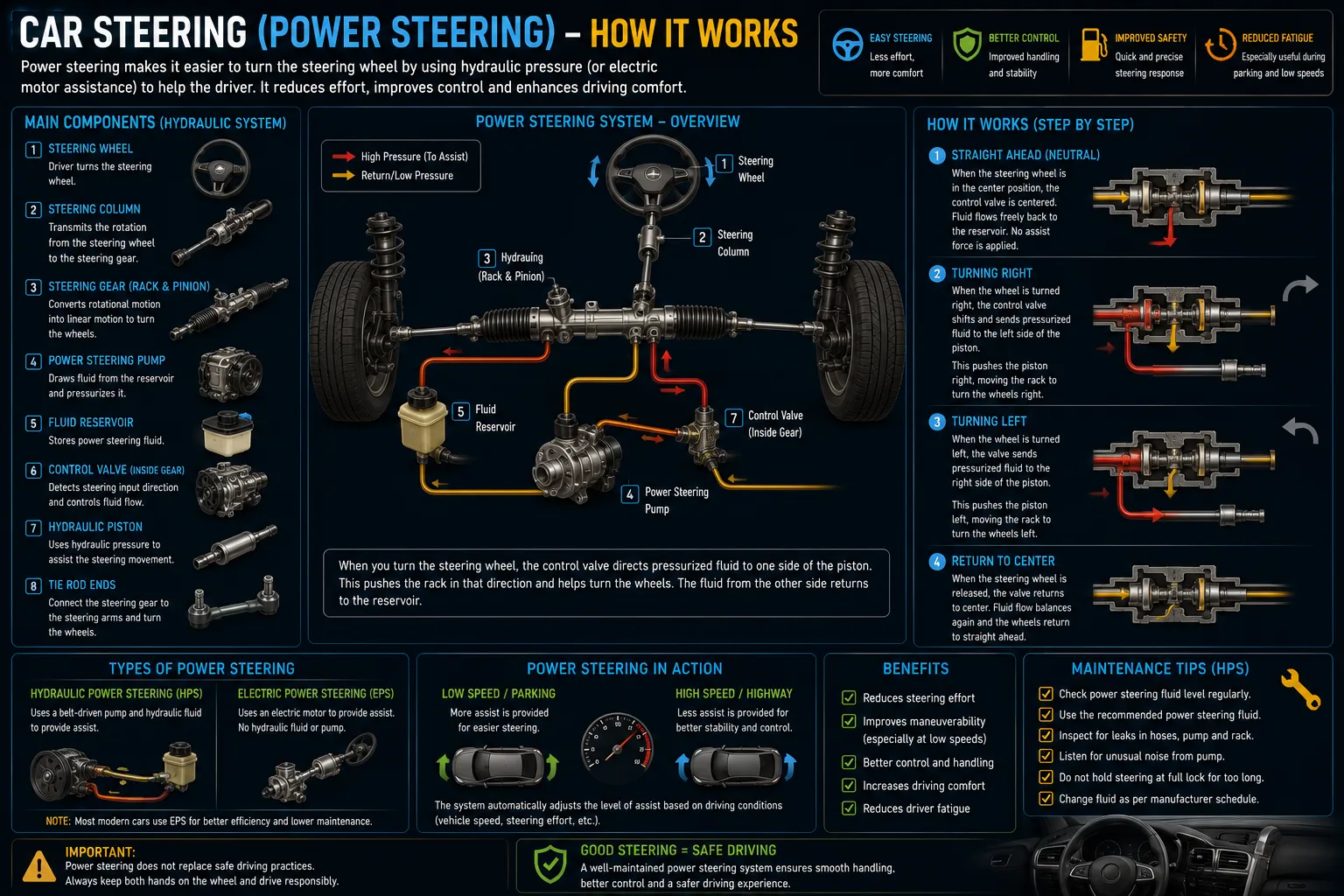
The rack and pinion is a beautifully direct piece of engineering. A toothed pinion gear sits on the base of your steering column; it meshes with a long toothed bar — the rack — that runs horizontally across the front of the car. Turn the wheel, the pinion rotates, the rack slides left or right, and tie rods at each end push or pull the front wheels into the turn. On most modern cars, a power-assisted steering system (either hydraulic PAS or electric EPAS) does the heavy lifting so you're not wrestling the car into every junction. Hydraulic systems use a pump driven by the engine belt to push pressurised fluid through the rack, providing assistance proportional to your speed. That fluid lives in a reservoir, travels through high-pressure hoses, and flows through seals inside the rack body. Those seals are the weak link — over time, heat cycling and mileage harden them, they crack, and the fluid starts finding creative exit routes. Electric racks skip the hydraulic system entirely, using a motor on the column or rack to provide assistance, which is simpler but not entirely immune to failure — worn internal components and play in the mechanism are still very much on the cards. Replacement means removing the old rack completely, fitting a new or remanufactured unit, realigning the tie rod ends, and — critically — getting the wheel alignment reset, because a new rack that isn't aligned will eat your tyres for breakfast.
“A worn rack develops play, so the steering feels vague and wobbly, like the car is making suggestions rather than taking orders.”
Sound familiar?
So what's behind it?
What we do — at your door
SOSCarFix comes to wherever your car currently is — your driveway, your office car park, the layby where the steering got dramatically worse — and carries out a proper diagnosis before anyone starts unbolting things. We'll check for play in the rack, inspect the gaiters for splits, look for fluid leaks, and assess the rack mounting bushes, because there's no point fitting a new rack if the cause was actually a collapsed bush that costs a fraction of the price. If a full rack replacement is what's needed, we carry remanufactured and new-old-stock racks for common UK vehicles, fit the unit on-site, reset the steering geometry as needed, and have you back on the road without the car ever needing to see the inside of a garage. No courtesy car negotiations, no waiting rooms with nine-month-old magazines, no mysterious additional work discovered after drop-off.
What affects the price
Steering rack replacement in the UK varies considerably and honestly, it's not a cheap job under any circumstances — so anyone quoting you a suspiciously low figure deserves your scepticism. The rack itself ranges enormously depending on whether it's a budget remanufactured unit, a quality remanufactured unit, or a new genuine-spec part — and that difference matters for longevity, particularly on higher-mileage cars. The labour time depends heavily on the vehicle: some racks are accessed relatively cleanly; others require dropping the subframe, which is a multi-hour exercise in mechanical patience. Electric rack replacements often include coding or adaptation work to match the new unit to the car's ECU, adding time and cost. PAS fluid, new rack gaiters, and fresh tie rod end locknuts are consumables typically replaced at the same time. Wheel alignment following rack replacement is non-negotiable — that's an additional charge but not an optional one, because misaligned steering on a brand-new rack will ruin your tyres faster than you'd believe.
Random knowledge you didn't ask for
Questions you're probably asking
How do I know if it's the steering rack or something else causing the clunking?
A worn rack typically produces a knock or clunk that you feel through the steering wheel specifically when cornering or hitting bumps, often accompanied by vague or imprecise steering. A clunk that's more structural or happens over bumps in a straight line might be a drop link, strut top bearing, or anti-roll bar bush. The distinction matters because a drop link is dramatically cheaper than a rack. A proper diagnosis checks all of these before committing to the big-ticket repair.
Can I top up the power steering fluid and buy myself more time?
Topping up PAS fluid when the level drops is sensible short-term management, but it doesn't fix the leak — it just delays the consequences. If the rack is weeping steadily, the underlying seal failure is progressing whether you top up or not. Driving on a chronically low PAS system stresses the pump, which is a considerably more expensive part than the rack. Top it up, yes, but treat it as time borrowed rather than problem solved.
Does a new steering rack need a wheel alignment immediately?
Yes, non-negotiably. The tie rods at each end of the rack determine your wheel alignment — specifically your front toe setting. Even if you're meticulous about threading them back to the exact same position, there will be variation. A rack fitted without a subsequent alignment will wear your front tyres unevenly and potentially create handling that feels odd in ways that are hard to diagnose. The alignment is part of the job, not an optional upsell.
Will a worn steering rack cause an MOT failure?
Yes, it can. MOT testers check for excessive play in the steering rack by grabbing the rack and feeling for movement beyond acceptable limits. They also check the gaiters — a split gaiter exposing the rack internals is a MOT failure item in its own right. Significant PAS fluid leaks can also fail the test. An advisory means the tester noted it but it wasn't yet beyond limits; a failure means it is.
Can an electric power steering rack be replaced the same way as a hydraulic one?
The physical replacement process is broadly similar — remove old unit, fit new unit, check tie rod positions, align wheels — but electric racks add a software step. The new rack or the steering torque sensor often needs coding to the vehicle, which requires a diagnostic interface capable of working with that specific make and model. It's not a job that works with a basic code reader. Factor that into any quote, and be cautious of anyone who doesn't mention it.
Your Steering Rack Is Plotting Against You — sorted at your door
Stop procrastinating. Get a transparent quote and we'll come to you.