Your Car's Got Opinions About Lanes: Why It's Pulling to One Side and What to Do About It
Your car has one job on a straight road: go straight. If it's quietly veering left or right like it has somewhere better to be, something is wrong — the steering wheel shouldn't need a constant hand correction just to stay in your lane. The frustrating part is that pulling to one side is a symptom, not a single fault. It could be something trivially cheap (a tyre at the wrong pressure) or it could be a seized brake caliper quietly cooking one corner of your car, or worn suspension geometry that will eat through a new set of tyres in twenty thousand miles. The point is, they all feel roughly the same from the driver's seat. SOSCarFix comes to you — driveway, car park, workplace — and actually works out which one it is before quoting you anything.
See our upfront pricingCar drifting left or right? Could be tracking, tyres, a seized caliper or worn suspension. We diagnose it at your door — no garage faff. Get a quote.
How it actually works
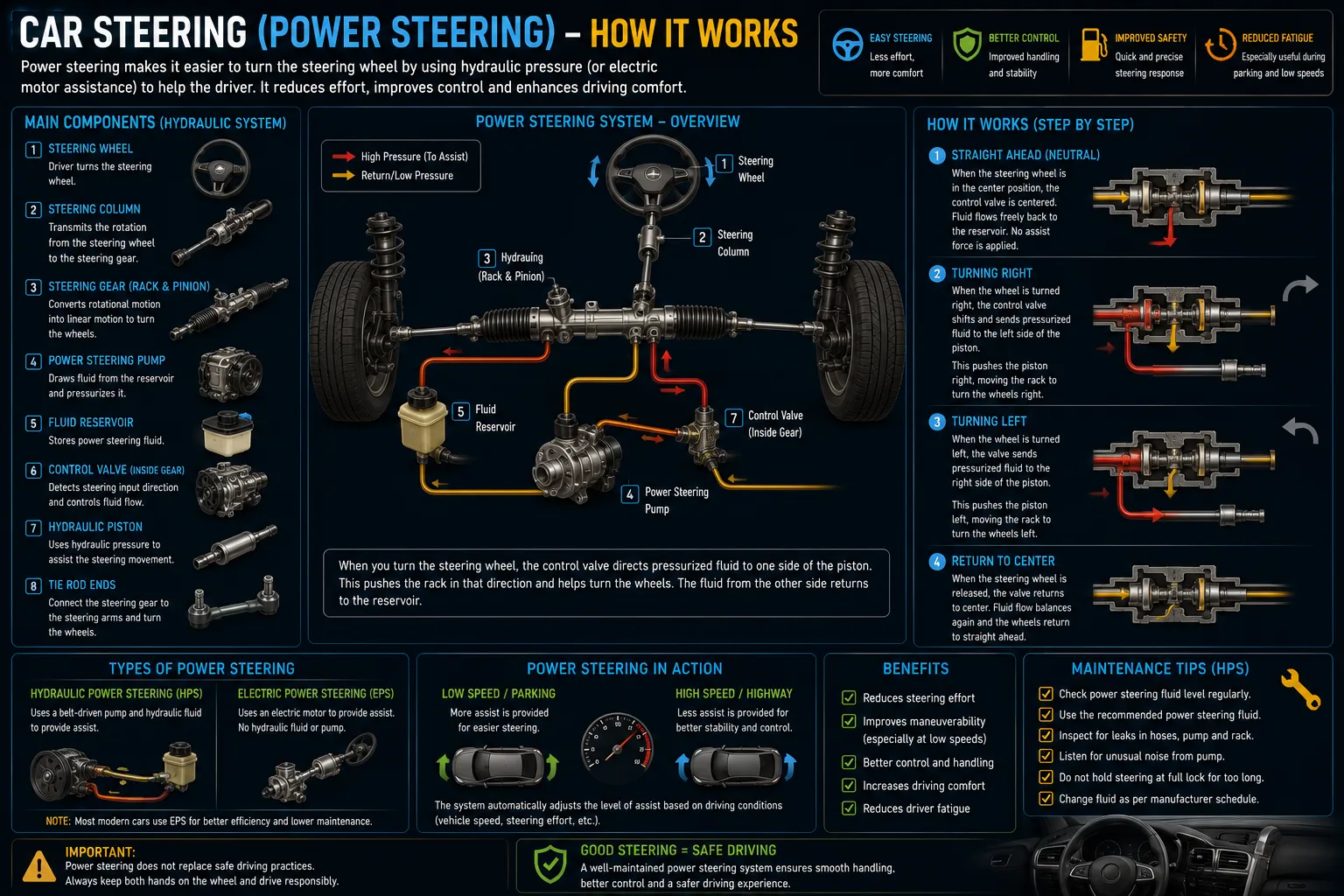
Your car stays on a straight line because several systems are in agreement. The wheels are set at precise geometry angles — camber (tilt in or out from vertical), toe (whether they point slightly in or out, like pigeon-toed versus splayed), and caster (the angle of the steering axis) — and when those angles are correct and matched left-to-right, the car tracks straight. Mess up any of them and the car steers itself toward the offending corner. Your tyres have to carry equal loads at equal pressures, otherwise the higher-pressure tyre generates more lateral force and drags the car toward it. Your brake calipers squeeze the disc and then — critically — let go. If a caliper piston or slide pin seizes and doesn't release fully, that wheel carries constant braking drag, which also pulls the car sideways (and heats the disc up, which you might smell). Your steering and suspension geometry can also change if a component wears or is bent by a pothole — control arm bushes, a ball joint, even a bent wheel can shift the angles enough to cause a pull. Road camber is real too: most UK roads slope toward the kerb for drainage, which creates a mild leftward pull. That's background noise. If you're fighting the wheel, it isn't just the road.
“SOSCarFix comes to you — driveway, car park, workplace — and actually works out which one it is before quoting you anything.”
Sound familiar?
So what's behind it?
What we do — at your door
We come to you — driveway, work car park, or wherever the car lives — and work through this methodically rather than just sending you for a four-wheel alignment and hoping for the best. First we check tyre pressures cold and inspect for obvious damage or sidewall bulges. We inspect each brake caliper for free movement: we check if the slide pins move, if the piston retracts, and we feel the wheel and disc temperature after a short test drive to spot a dragging corner. We check the steering and suspension with the vehicle loaded: ball joints, tie rod ends, control arm bushes, and wheel bearings for play and wear. If the geometry is the suspected cause we use our laser alignment equipment to measure actual camber, toe and caster values and compare them to manufacturer spec. We read the live data and clear any related fault codes. Then we give you a clear, itemised quote for what actually needs doing — not a list of everything we could possibly replace.
What affects the price
Cost depends entirely on what the diagnosis finds, which is rather the point of diagnosing first. A wheel alignment (four-wheel tracking) is typically one of the more affordable fixes. Tyre pressure correction costs you nothing. A seized brake caliper could mean freeing the slide pins and lubricating (cheap), or replacing the caliper itself (more involved, plus a new pad set on that axle). Worn bushes, ball joints or tie rod ends vary in cost by car — a common family hatch is straightforward; something with independent multi-link rear suspension has more components to inspect and replace. If the pull is caused by badly worn tyres with uneven tread patterns, they'll need replacing regardless of what else we do. We'll always tell you which fix is the actual cause and which is just consequential damage — so you're not throwing money at parts the car doesn't need.
Random knowledge you didn't ask for
Questions you're probably asking
How do I tell if it's the alignment or a seized caliper causing the pull?
Pull under braking is the big clue — if the car pulls mainly or much harder when you press the brake pedal, a sticking caliper is the likely culprit. Pull on a straight road regardless of braking points more toward alignment or tyres. A hot wheel after a normal drive is almost always a dragging caliper. We check both on the visit — they're not mutually exclusive.
Can wrong tyre pressures really cause the car to pull?
Yes, meaningfully so. A significant pressure difference side-to-side — say one tyre low after a slow puncture — changes the tyre's effective rolling radius and stiffness. Always check cold pressures first. If pressures are correct and equal and the car still pulls, you're looking elsewhere. It's also the first thing to rule out before spending money on alignment.
My car pulls to the left — is that just the road camber?
UK roads do slope left for drainage, so a very mild leftward drift on an unmarked road is background noise. But if you're actively fighting the wheel, it's not the road. A simple test: find a quiet, level car park and check whether it still pulls there. If it does, it's the car, not the tarmac.
Will a wheel alignment fix it if I've got worn suspension bushes?
Not reliably — and that's an expensive trap. If bushes or ball joints are worn, the geometry shifts dynamically as you drive, so a static alignment reading is only accurate at one moment. The alignment itself may be spot-on on the ramp and wrong again the moment the car moves. Worn components need to be replaced first, then the geometry is set correctly once everything is solid.
Is it safe to drive with the car pulling to one side?
Mildly, for a short while, if it's nothing more than tracking or tyres — but you'll wear through rubber asymmetrically and potentially fail an MOT on tyre condition. If there's a brake caliper involved, the risk is higher: a severely dragging caliper can overheat to the point of brake fade on that corner, and it's eating your disc and pad all the time. Don't leave either one long.
Your Car's Got Opinions About Lanes — sorted at your door
Stop procrastinating. Get a transparent quote and we'll come to you.