Your DPF Is Crying for Help: Diagnosing P2002, P2463, P244A and P244B Before Your Wallet Does
The P2002 family of fault codes is what your car's engine management stores when it's had enough of your five-mile school-run and daily traffic-jam diet. These codes — P2002, P2463, P244A and P244B — all point to the diesel particulate filter: either it's choked with soot that hasn't been burned off (regeneration failure), it's reading the wrong pressure across it (sensor issue), or the filter itself is cracked or poisoned beyond salvation. The critical thing to understand is that a code is the start of the investigation, not the answer. We read live data — actual soot load percentage, differential pressure, exhaust temperatures, regen attempts — before recommending anything. Because the cure for a blocked DPF and the cure for a failed differential-pressure sensor are very, very different, and getting them mixed up is a gift to the parts industry, not to you.
See our upfront pricingDPF fault codes P2002, P2463, P244A or P244B on your dash? We diagnose the real cause at your home or work — no garage, no guesswork. Get a quote.
How it actually works
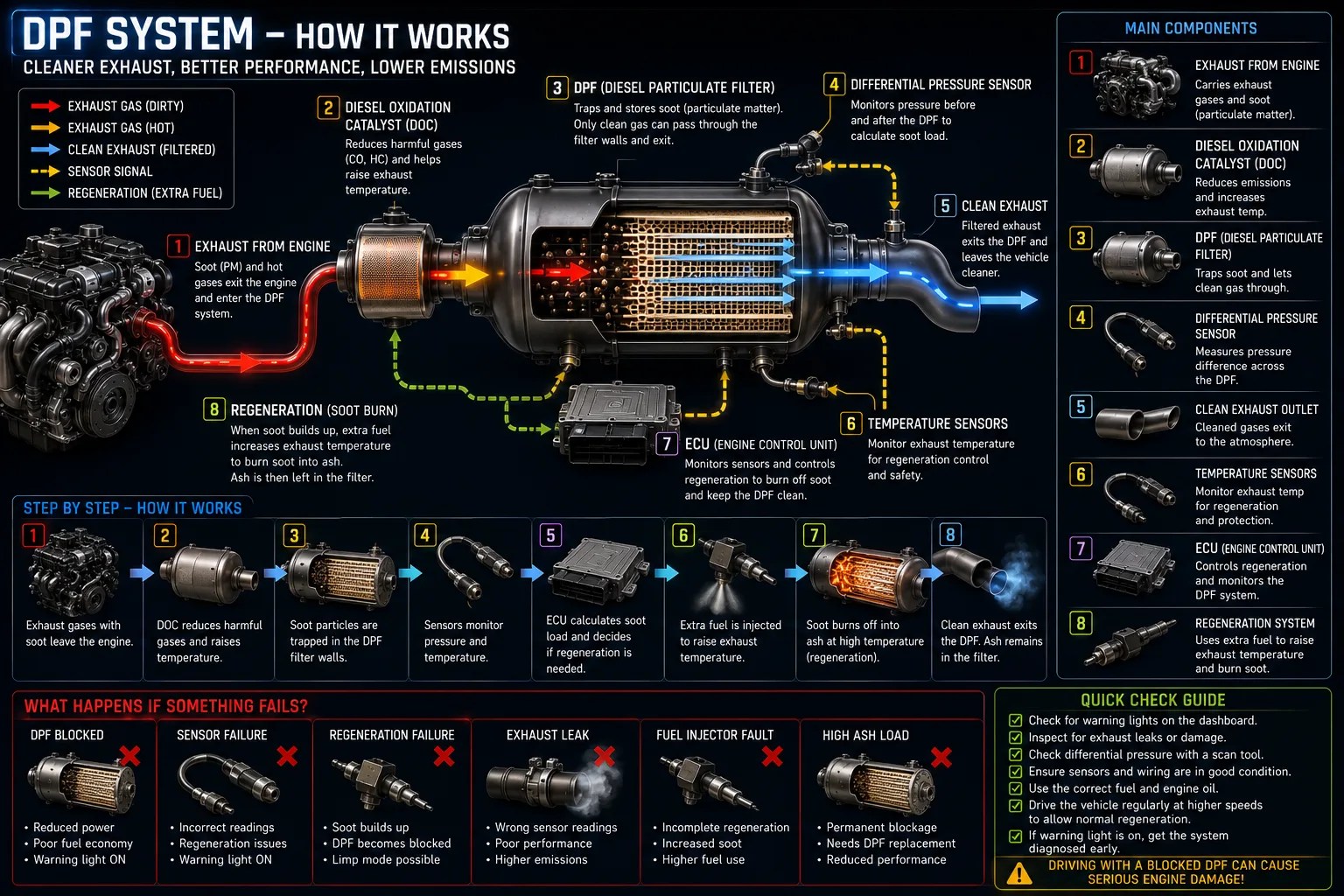
Your diesel engine burns fuel in a controlled fireball, but combustion is never perfectly clean. Tiny soot particles — the stuff that used to billow visibly from every lorry on a B-road in the 1990s — are produced constantly. The diesel particulate filter sits in the exhaust system downstream of the turbo and upstream of the catalytic converter, trapping those particles in a honeycomb ceramic substrate. Over time the filter fills up. The car knows this via two pressure sensors — one upstream, one downstream — that measure the differential pressure across the filter: more soot, more restriction, higher pressure reading. When the filter reaches roughly 45% soot load, the engine management triggers a passive regeneration: exhaust temperatures during normal motorway driving are high enough (above around 300°C) to oxidise the soot into CO₂ and water, cleaning the filter without you noticing. When passive regen fails — because the car never gets hot enough on short, slow trips — the ECU tries active regeneration: it retards injection timing and may inject a small post-injection fuel shot to raise exhaust temperature above 550–600°C, burning the soot off more aggressively. When even active regen repeatedly fails, or when the filter is so loaded it can't regen safely, you get the P2002 family lighting up — and often, limp mode shortly after.
“The critical thing to understand is that a code is the start of the investigation, not the answer.”
Sound familiar?
So what's behind it?
What we do — at your door
We come to you — driveway, car park, roadside — with proper diagnostic kit, not a cheap code reader from a well-known online auction site. We read the live data: current soot load percentage (not just the stored code), differential pressure across the filter both at idle and at a rev range, exhaust temperature sensor readings upstream and downstream, the number of active regen attempts the car has made and whether they completed, and whether the pressure sensor and its impulse pipes are reading cleanly. We also check EGR function, glow plug status and oil specification. From that, we tell you honestly what you've got: a filter that needs a forced regen (which we can initiate with the diagnostic tool and a safe road test), a pressure sensor or its pipes that need cleaning or replacing, an underlying cause (EGR, glow plugs, wrong oil) that needs fixing before any regen will stick, or a filter that is genuinely blocked beyond regen and needs either a professional clean or replacement. We quote clearly, in advance, and we don't sell you a new filter when your sensor pipes are blocked with gunk.
What affects the price
Cost varies enormously depending on what's actually wrong — which is why diagnosis first matters. A blocked differential pressure sensor pipe, cleaned or replaced, is a modest job. A forced regeneration (tool-initiated, with road test and monitoring) is similarly reasonable. Replacing a faulty differential pressure sensor itself is mid-range. Cleaning a DPF professionally (either an additive-and-regen cycle or off-car ultrasonic/thermal cleaning) is more expensive but far cheaper than a new filter. A new OEM or quality aftermarket DPF for a typical UK diesel (e.g. a Ford Focus, VW Golf, Vauxhall Astra) runs into several hundred pounds for parts alone. Labour on top. Then there's addressing root causes — EGR valve, injectors, glow plugs — each with their own cost. This is exactly why throwing a new filter at a code without diagnosing the cause is expensive and usually temporary; the root problem destroys the new filter too.
Random knowledge you didn't ask for
Questions you're probably asking
Can I just clear the fault code and drive to sort it out?
You can clear the code, but unless the underlying problem is fixed — whether that's a driving pattern, a blocked sensor pipe, a faulty EGR or a genuinely loaded filter — it will return, often with the soot load higher. Repeatedly failing regens can eventually reach a point where the filter is too loaded to regen safely, at which point you need professional cleaning or replacement. Clearing and ignoring is a deteriorating strategy.
Is P2002 the same problem as P2463, P244A and P244B?
They're related but not identical. P2002 and P2463 typically indicate DPF efficiency below threshold or excessive soot accumulation — the filter isn't getting clean. P244A and P244B relate specifically to the differential pressure across the filter being too high or too low relative to expected values. In practice, all four can appear together, and all four demand live data rather than assumption — a high differential pressure could be a genuinely loaded filter or a failed pressure sensor.
My garage wants to replace the DPF. Is that actually necessary?
Sometimes yes, sometimes absolutely not. A filter blocked because the differential pressure sensor was reading incorrectly doesn't need replacing — the sensor does. A filter blocked due to short-trip driving that hasn't been forced-regenned yet might clean up perfectly well. A filter cracked, oil-soaked from a turbo seal failure, or ash-poisoned from years of wrong oil is a different matter. We read the live data and tell you which situation you're in before recommending anything.
What happens if I ignore the DPF warning light?
The soot load keeps rising. At a certain threshold, the engine goes into limp mode to protect the filter from a catastrophic regen that could crack it or cause an exhaust fire. Beyond that, you're looking at a filter that can no longer be regenerated at all — and needs cleaning or replacement. What might have been a forced regen and an easy sensor clean becomes a several-hundred-pound filter job. Ignoring it is a financially creative choice.
Can a mobile mechanic actually fix a DPF fault, or do I need a garage?
For diagnosis, forced regeneration, sensor replacement, pressure pipe cleaning and fixing underlying causes (EGR, glow plugs, injectors), yes — all of that can be done at your location. If the filter genuinely needs off-car professional cleaning, that goes to a specialist, but we handle everything around it. The only thing we can't do at your address is off-car ultrasonic cleaning, and that's the minority of cases.
Your DPF Is Crying for Help — sorted at your door
Stop procrastinating. Get a transparent quote and we'll come to you.