DPF Cleaning & Regeneration — Your Filter Is Sulking Because You Never Take It Anywhere Nice
Diesel particulate filters are, in principle, a brilliant idea: a ceramic honeycomb that catches the soot your engine produces before it disappears into somebody's lungs. The snag is that they need heat — serious, sustained, motorway-speed heat — to burn that soot off and reset themselves. Think of a border collie: wonderful creature, genuinely useful, but pen it in a small garden for six months of school-run loops and Tesco car park manoeuvres and it will absolutely lose the plot. Your DPF is that dog. Town driving is the small garden. And right now, yours has probably eaten the sofa. SOSCarFix comes to you — wherever you and your sulking diesel are parked — with the diagnostic kit and the forced regeneration equipment to sort it out without you having to trailer it to a garage.
See our upfront pricingYour DPF is blocked because your diesel never gets a proper run out. SOSCarFix sorts DPF cleaning and forced regeneration at your door, no garage required.
How it actually works
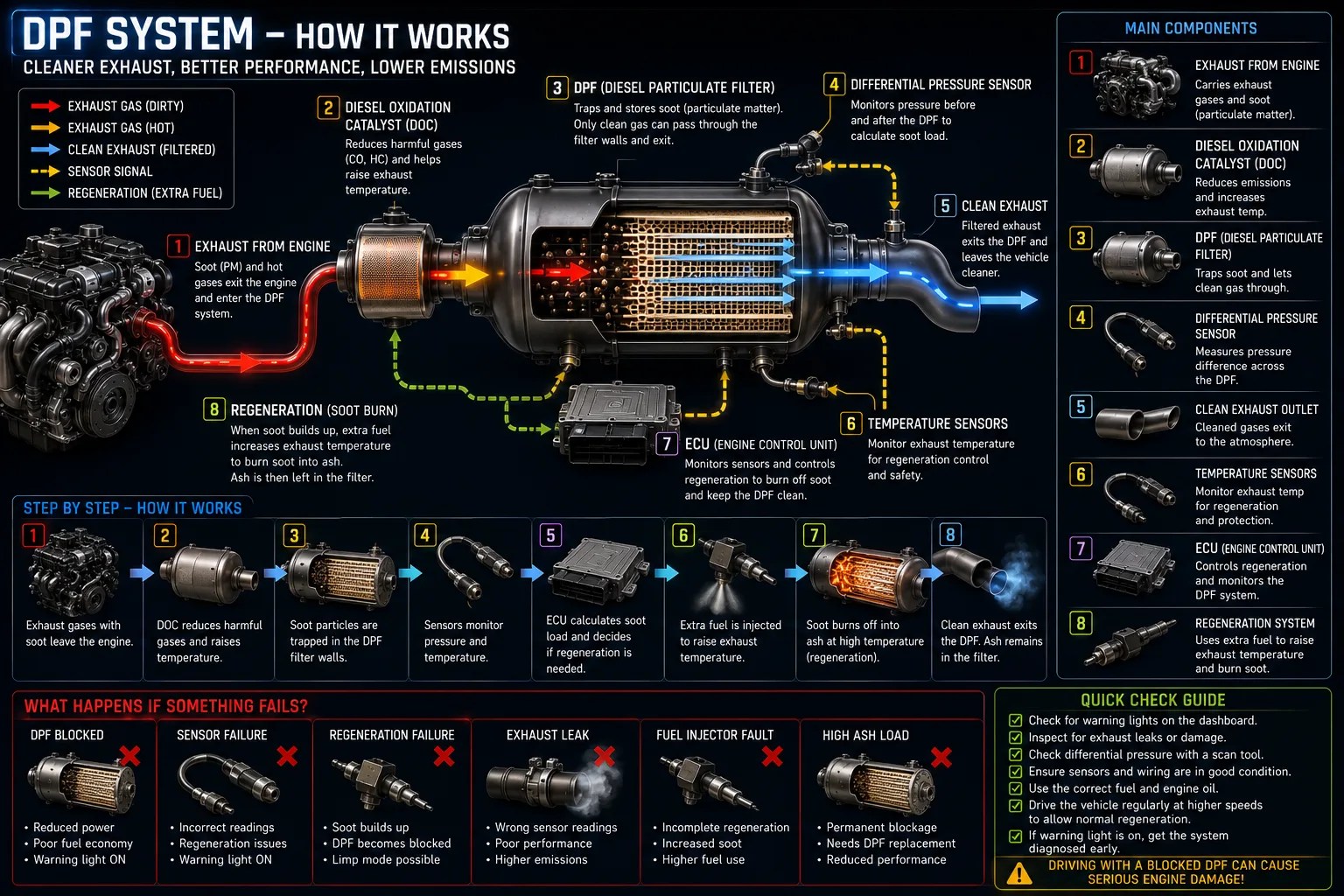
The filter itself sits in your exhaust system and traps soot particles — it catches around 80% of the nasty particulates that would otherwise float off into the atmosphere. Because it's a filter and not a magic disappearing box, it eventually fills up. Normally, the car handles this itself through something called passive regeneration: get it onto a motorway for a sustained 30–50 minutes at a decent cruise, the exhaust hits 600–700°C, and the soot simply burns off to a tiny amount of harmless ash. Job done, no warning lights, everyone's happy. If you never do that — if your diesel's entire existence is a 2.4-mile commute, a Saturday supermarket run, and the occasional drive to a petrol station to waste money on premium fuel — the car tries a fallback called active regeneration. The ECU quietly injects extra fuel to spike the exhaust temperature and force a burn cycle while you're driving. It needs about 10–30 minutes of steady progress to complete. If you park up after eight minutes because you've arrived home, the regen aborts half-finished, leaving extra soot and raw fuel residue in the system. Do this repeatedly and the filter loads up past the point of no return. That's where forced regeneration comes in. A mechanic connects diagnostic equipment directly to your ECU, commands a manual regeneration cycle, and supervises the whole process to make sure the filter actually clears. If the soot loading is very heavy, a chemical clean may be needed first — specialist fluid breaks down the blockage before the regen burns the remainder away. We do all of this at your address. You don't tow anything. You just put the kettle on.
“The snag is that they need heat — serious, sustained, motorway-speed heat — to burn that soot off and reset themselves.”
Sound familiar?
So what's behind it?
What we do — at your door
We arrive at your location with professional diagnostic equipment, connect to your vehicle's ECU, and read the actual soot loading percentage — so we know exactly what we're dealing with before we start, rather than guessing. If the filter is partially blocked, we'll run a forced regeneration cycle through the diagnostic system, monitoring exhaust temperatures and soot levels in real time to confirm the filter is actually clearing. If the loading is too severe for regen alone, we use specialist DPF cleaning fluid to break down the blockage first, then complete the regeneration cycle. We'll also scan for any underlying fault codes — EGR issues, injector faults, temperature sensor problems — that might have caused the blockage in the first place, because sorting the filter without addressing the root cause is just buying yourself the same problem again in three months. After the service we'll give you an honest debrief on what caused it and whether your driving habits mean a diesel is actually the right car for you. We won't be snarky about it. Much.
What affects the price
Several things affect what a DPF job costs, and we'll give you a proper quote once we know what we're looking at. The main factors: the severity of the blockage (a partial clog that responds to forced regen is a different job from one that needs chemical cleaning first), whether any underlying faults are contributing to the problem (EGR valve issues, for instance, need addressing at the same time or you're just filling the filter back up), the make and model of your vehicle (some DPFs are tucked away in places that make access genuinely creative), and whether the filter has been blocked so many times it's accumulated irremovable ash past the point where any regen helps — at which point replacement is the honest answer and we'll tell you that upfront. No invented numbers here, because a quote without seeing your car is just a guess with a figure attached.
Random knowledge you didn't ask for
Questions you're probably asking
Can I just take it on a long motorway drive and clear it myself?
Sometimes, yes — if the DPF warning light has only just come on and the soot loading isn't too high, a 30–50 minute motorway run at a steady 60–70mph can trigger a passive regeneration and clear it. If the engine management light has also come on, or you're in limp mode, the blockage is likely past the point where a Sunday drive will fix anything. At that stage, driving it hard risks damaging the filter further. Get it diagnosed first.
Why does my DPF keep blocking even after it's been cleared?
Because the underlying cause hasn't been fixed. A DPF that keeps blocking usually has a reason: almost always short-journey driving habits, but sometimes a contributing fault like a sticky EGR valve or a thermostat that's not getting the engine to full operating temperature. Clearing the filter without addressing those issues is exactly as effective as emptying a bath with the taps still running.
Is DPF removal a reasonable option if mine keeps causing problems?
Legally: no. Removing or blanking a DPF makes the vehicle an automatic MOT failure, illegal to drive on public roads, and typically voids your insurance. We don't remove DPFs. If yours is causing repeated, unfixable problems, the honest conversation is about whether a diesel is the right vehicle for how you actually drive — and we're happy to have that conversation.
How long does a forced regeneration take?
A diagnostic inspection and forced regeneration typically takes one to two hours on site, depending on soot loading and whether a chemical pre-clean is needed. We stay with the vehicle throughout and monitor the process to confirm the filter has actually cleared before we pack up and leave.
DPF Cleaning & Regeneration — sorted at your door
Stop procrastinating. Get a transparent quote and we'll come to you.