EGR Valve Cleaning & Replacement — Your Diesel's Clogged Arteries, Sorted
Your body, if you fed it nothing but deep-fried exhaust fumes, would eventually clog up. Your diesel's EGR valve has no such luxury of choice — that's literally its job. The Exhaust Gas Recirculation valve takes a portion of your exhaust gas and routes it straight back into the intake manifold, on purpose, by design. Clever engineers did this intentionally to lower combustion temperatures and reduce the nitrogen oxides (NOx) that turn our air into a 1970s LA photochemical special. The problem is that diesel exhaust is absolutely thick with soot and oil vapour, and over time that lot coats the EGR valve in a layer of carbonised gunk so dense it would make a cardiologist wince. It sticks. It builds. Eventually the valve either jams open, jams shut, or starts doing something in between that the engine really doesn't appreciate. That's where we come in — a mobile mechanic who'll show up at your drive, deal with the furring, and send you on your way without the cardiac episode.
See our upfront pricingYour diesel's EGR valve is basically furred arteries — recirculating soot-caked exhaust until the whole thing seizes. SOSCarFix cleans or replaces it at your door, anywhere in the UK.
How it actually works
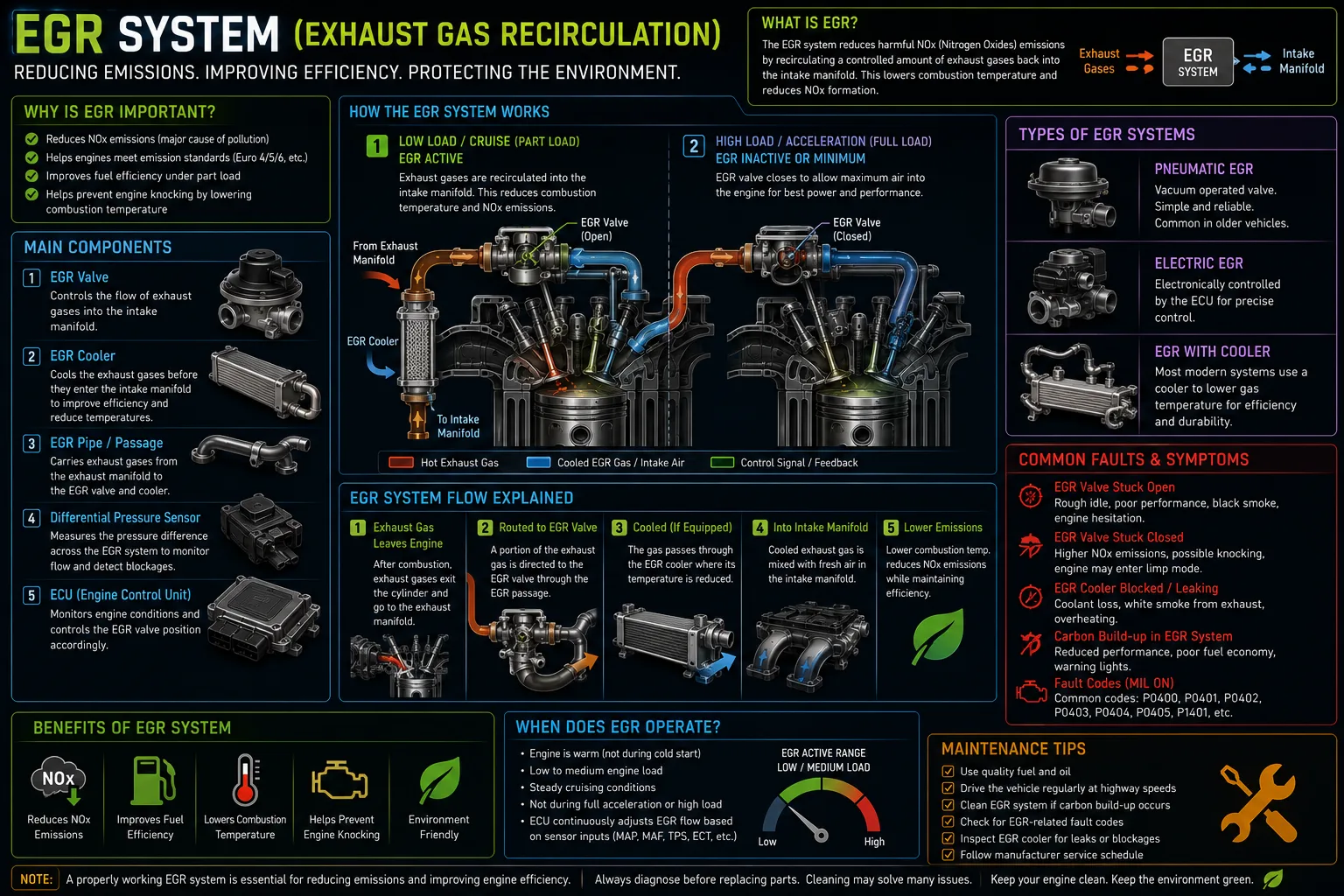
The EGR valve is controlled by your engine's ECU, which opens it at the right moment to bleed hot exhaust gas back into the combustion charge. This dilutes the oxygen in the cylinder, which lowers peak combustion temperatures, which means nitrogen and oxygen don't bond together into NOx above roughly 2,500°F. Less NOx, cleaner air, fewer angry letters from Brussels. Elegant, really. The complication is that diesel combustion produces a spectacular amount of particulate matter — soot, unburnt hydrocarbons, oil mist from the crankcase. All of that rides through the EGR system on repeat. On a petrol engine, a bit of carbon isn't the end of the world. On a diesel, especially one doing short runs around town and never properly warming up, the deposits build like furring in a kettle — except instead of limescale it's thick black carbon paste, and instead of your morning cuppa tasting a bit off, your engine starts running like a bag of spanners. A clean EGR valve cycles smoothly on ECU command. A partially clogged one doesn't fully open or close, meaning the wrong amount of exhaust gas gets in at the wrong time. The ECU notices, panics slightly, logs a fault code, and illuminates the engine warning light. A fully seized one sends combustion temperatures climbing, soot production up, and your DPF into a cycle of frantic regenerations trying to cope with the downstream mess. Our mobile mechanic assesses whether a chemical clean will restore full function or whether the valve itself has had enough — and gets on with whichever job needs doing, right where you're parked.
“Eventually the valve either jams open, jams shut, or starts doing something in between that the engine really doesn't appreciate.”
Sound familiar?
So what's behind it?
What we do — at your door
We come to you — driveway, car park, workplace, wherever the van has broken your spirit. Our mobile mechanic diagnoses the fault with a proper scan tool first, reading the live EGR position data and fault codes rather than guessing. If the valve is carboned up but mechanically and electrically sound, we clean it properly — removing it, clearing the deposits from the valve and passage, and getting it cycling freely again. If the valve has given up the ghost mechanically or the actuator's dead, we replace it with a quality part and clear the codes. We also check whether the EGR cooler and associated passages need attention, because sorting the valve while ignoring a compromised cooler is a bit like unblocking one artery and leaving the others to it. Job done on your drive, no recovery truck required.
What affects the price
The final quote depends on a few things that vary considerably between vehicles. The make, model, and engine determine how accessible the EGR valve actually is — on some diesels it's practically waving at you; on others it's buried under half the intake manifold and takes significantly longer to reach. Whether cleaning restores the valve or a replacement part is needed makes a substantial difference, as does the quality and availability of the replacement part for your specific engine. If the EGR cooler has also failed or the intake passages are severely carboned, that's additional work and parts. We'll always diagnose first and give you a clear quote before anything comes apart.
Random knowledge you didn't ask for
Questions you're probably asking
Can I just blank off the EGR valve and be done with it?
You can, and plenty of people do, but it's worth knowing what you're getting into. EGR deletes are not legal for road use on a vehicle required to meet emissions standards — which covers most post-2000 diesels. An MOT tester checking for emission-related modifications can fail the vehicle. It also tends to trigger persistent fault codes and warning lights unless you've had the ECU remapped to match. If your EGR is failing, fix it properly rather than blanking it and hoping for the best at MOT time.
How do I know if it needs cleaning or a full replacement?
That's precisely what proper diagnosis is for. We connect a scan tool, read the live position data from the EGR valve, and compare what the ECU is asking for against what the valve is actually doing. If the valve is responding but sluggishly due to carbon, cleaning usually restores it. If the actuator motor is dead, the position sensor has failed, or the valve housing is physically damaged, cleaning won't fix any of that — it needs replacing. We'll tell you which before we charge you for either.
Will cleaning the EGR valve clear the engine warning light?
Once the valve is moving correctly again, yes — we clear the stored fault codes with the scan tool as part of the job. If the light comes back on within a short drive, it means either the underlying problem wasn't fully resolved or there's a second fault elsewhere. We don't just clear codes and wave you off; we verify the valve is operating correctly on live data before we leave.
My diesel only does short local trips. Is that actually causing this?
It's a major contributing factor, yes. Diesel engines are designed to run at operating temperature for sustained periods. Short trips mean the engine never fully warms up, soot and moisture accumulate in the EGR passages rather than burning off, and carbon deposits build faster than on a car that regularly sees a motorway. If that's your main usage, it's worth being proactive about EGR health rather than waiting for the warning light to ruin your morning.
EGR valve cleaning vs replacement — which do I actually need?
Depends entirely on why it's failing. If it's carboned up but the actuator and position sensor are still alive, a proper clean — valve out, passages cleared, movement verified on live data — will often sort it. If the actuator motor has died, the sensor's given up, or the valve housing is physically damaged, cleaning is just polishing a corpse. The only honest way to tell the difference is scan tool data: we compare what the ECU's asking the valve to do against what it's actually doing. That takes ten minutes and tells you which repair you actually need before you spend money on the wrong one.
P0401 / P0402 EGR flow fault code — what does it mean?
P0401 is "insufficient EGR flow" — the ECU asked the valve to open and not enough exhaust gas came through. P0402 is the opposite: "excessive EGR flow" — too much gas when there should be less, usually a valve stuck open. In practice, the most common real-world cause of P0401 is a heavily carboned-up valve or passage that physically can't flow what the ECU expects. P0402 often points to a valve that's seized open or a failed position sensor feeding the ECU nonsense. Neither code tells you whether it needs cleaning or replacing — that takes live scan data comparing what the valve is commanded to do against what it actually does. Worth getting diagnosed properly rather than guessing parts at it.
EGR Valve Cleaning & Replacement — sorted at your door
Stop procrastinating. Get a transparent quote and we'll come to you.