DPF Additive Warning Light: The Tiny Tank With Surprisingly Big Consequences
Hidden under your PSA-group Peugeot, Citroen, or certain Ford diesel is a small reservoir of cerium-oxide-based fluid — Eolys, or its generic equivalent — that most owners have never heard of until a yellow warning light blinks on and the car starts stalling at inopportune moments. The additive is injected in tiny doses into the fuel tank, lowers the DPF regeneration temperature from roughly 600°C down to around 450°C, and lets regeneration happen during normal driving rather than requiring a heroic thirty-mile motorway charge. When it runs low, the car can't regen properly, the DPF chokes up, and you're one short journey away from an expensive blocked-filter situation. SOSCarFix comes to you, refills the additive tank, resets the level counter in the ECU, and gets your regeneration cycle back on track — before it escalates into something pricier.
See our upfront pricingYour Peugeot, Citroen or Ford diesel is moaning about additive. We come to you, refill the Eolys tank and silence it. Get a quote today.
How it actually works
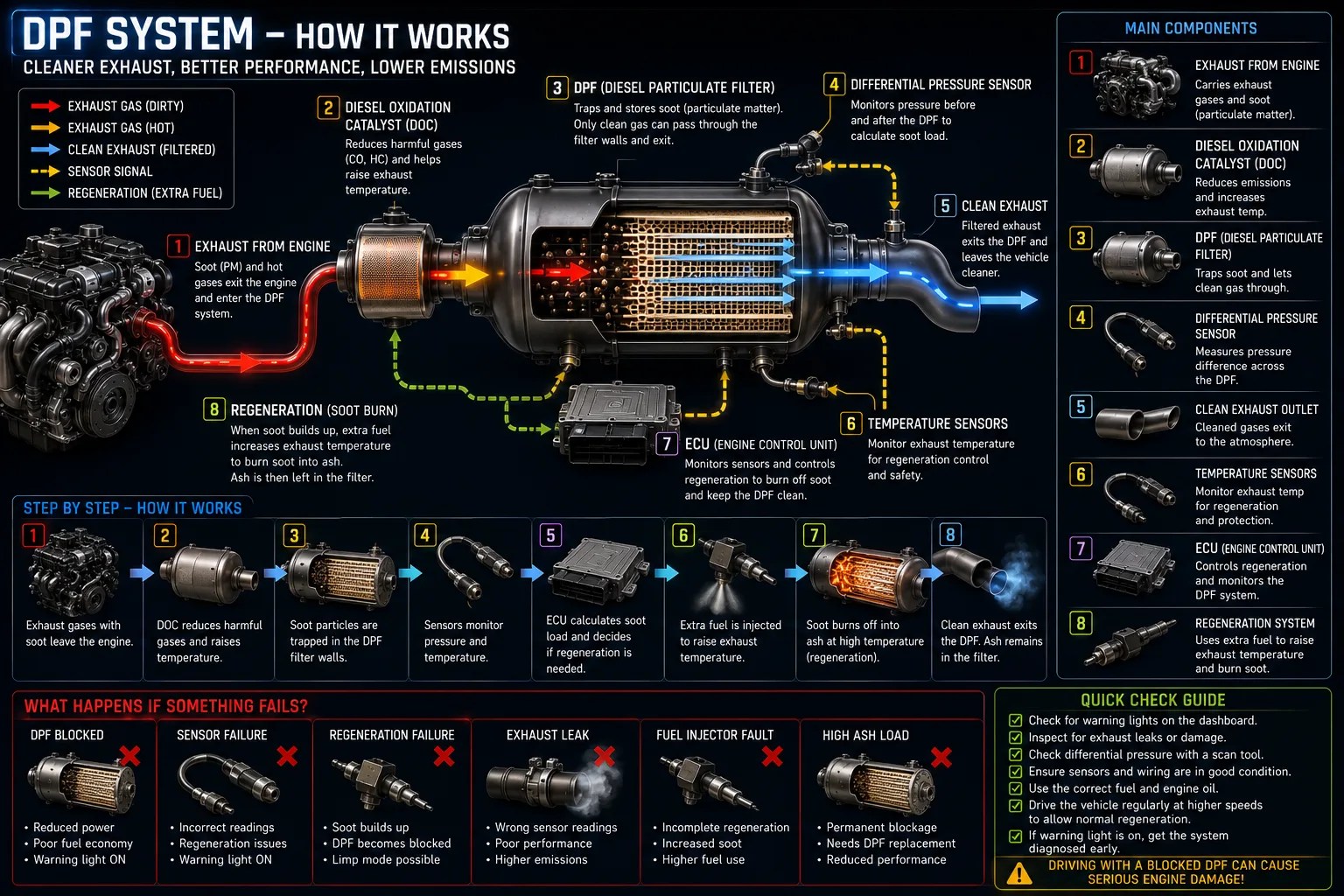
PSA's FAP (Filtre à Particules) system — found on many Peugeot 307/308/407/508, Citroen C4/C5/Berlingo and Ford Focus/C-MAX/S-MAX diesels of the mid-2000s through to mid-2010s — works differently to a standard DPF. Where most modern filters rely on high exhaust temperatures alone to burn off accumulated soot, the FAP system uses a catalyst: a cerium-based fuel additive (trade name Eolys, supplied in the UK mainly as Eolys Powerflex 176 or Eolys DPX 42 depending on system generation) stored in a separate 5-litre tank, usually near the fuel filler. An injection pump doses this additive into the fuel tank in extremely small quantities — we're talking a few millilitres per fill — where it mixes with the diesel. When the soot-loaded DPF triggers a regeneration cycle, the cerium-laced fuel burns at 450°C instead of the usual 600°C, meaning regeneration can happen while you're doing an ordinary 40-minute dual-carriageway run rather than requiring scorching motorway speeds. The catch is the additive tank holds roughly 5 litres and lasts perhaps 60,000–80,000 miles depending on use. When it's empty, regeneration either fails or runs inefficiently, soot builds up faster than it burns, and the filter blocks. The car's ECU tracks additive consumption and warns you when the tank is low — and again when it's critically low. At that second warning, it starts limiting how far you can go before forcing a stop.
Sound familiar?
So what's behind it?
What we do — at your door
We come to your home, workplace or wherever the car is sitting with its countdown ticking. First, we confirm the fault with a diagnostic scan — reading the additive level, soot load percentage and any stored codes — so we know exactly what we're dealing with before opening the additive cap. We use the correct Eolys fluid for your system generation (Powerflex 176 or DPX 42), fill the tank to the correct level, and then — critically — reset the additive counter in the ECU using diagnostic software. Without that reset, the car has no idea you've topped it up and will keep dosing incorrectly or ignore the fluid you've just added. We also check the DPF soot load reading and, if it's elevated, advise whether a forced regeneration or a diagnostic-guided regen run is needed to clear the backlog before you're back to normal. All of it on your driveway, no garage booking, no waiting for a courtesy car.
What affects the price
The cost of a DPF additive top-up service in the UK has a few moving parts: the fluid itself (Eolys is a specialist product and not cheap — genuine Eolys Powerflex 176 typically costs significantly more per litre than standard diesel additives, and you need a meaningful quantity for a full refill); the diagnostic time to confirm the fault, perform the top-up and reset the ECU counter correctly; and whether the DPF soot load is already high enough to need a forced regeneration at the same time. If the car has been running without additive for a while and the DPF is partially blocked, that adds time and complexity. Costs vary by vehicle and situation — SOSCarFix provides itemised quotes based on your specific car and what the diagnostic scan shows. No invented round-numbers here: we'd rather tell you honestly on the quote than surprise you on the invoice.
Random knowledge you didn't ask for
Questions you're probably asking
My car is counting down miles to a stop — can I still drive it to you?
Short answer: we'd rather come to you before it hits zero. Once the ECU reaches its limit it can prevent a restart, which turns a straightforward top-up into a recovery job as well. If you're in the last few hundred miles of the countdown, book a mobile visit now rather than chance it. If the car has already refused to start, we can still come out — we just need to know upfront.
Can I use any DPF additive or does it have to be Eolys?
It genuinely matters. PSA's FAP system is calibrated for specific Eolys formulations — either Powerflex 176 or DPX 42 depending on your vehicle and model year. Using the wrong concentration means the ECU doses incorrectly, which can either leave soot unburned (blocking the filter) or deposit too much ash (same result, longer timescale). Generic or 'compatible' additives vary in quality and concentration; we use the correct specification for your car.
Do you have to reset the ECU after topping up, or does the car detect the new level automatically?
You have to reset it — there is no level sensor in the additive tank on most FAP systems. The ECU tracks consumption mathematically (fuel added × dosing rate = additive used) and runs a counter. If you refill without resetting that counter, the car has no idea, continues dosing based on the old figure and will either over-dose (burning through the new additive too fast) or show the warning light again almost immediately. The ECU reset is a non-negotiable part of the job.
My DPF warning light is also on — is that related to the additive being low?
Almost certainly yes, if both appeared around the same time. When additive runs out, regeneration efficiency drops and soot builds up faster than it clears. The DPF soot load climbs until the ECU triggers the DPF warning alongside the additive one. Topping up the additive is step one; after that we check the soot load reading and may advise a forced regeneration to clear the backlog. In most cases this sorts both lights without needing to touch the filter itself.
Which cars actually need this service — is it just Peugeots and Citroens?
Primarily PSA-group vehicles: most Peugeot and Citroen diesels sold in the UK from roughly 2002 to 2015 with the FAP system. Ford also used the PSA FAP system in several models of the same era — Focus, C-MAX, S-MAX and Galaxy with the 1.6 and 2.0 TDCi engines sourced from PSA. If you're unsure whether your car uses Eolys, check for a secondary filler cap near the fuel filler or ask us — a quick VIN check and diagnostic scan confirms it.
DPF Additive Warning Light — sorted at your door
Stop procrastinating. Get a transparent quote and we'll come to you.