DPF Forced Regeneration: Your Diesel's Blocked Filter and the Short-Journey Lifestyle That Did It
The diesel particulate filter exists because someone, somewhere, decided that modern diesel exhausts should not visibly resemble a Victorian factory chimney. A worthy ambition. The DPF traps the soot particles your engine produces and periodically burns them off in a self-cleaning process called regeneration — a process that requires sustained high temperatures, meaning sustained motorway-speed driving, meaning the DPF was designed by engineers who assumed diesel owners would actually use their diesels on a dual carriageway occasionally. If your diesel's idea of a long journey is the school run followed by a Co-op car park, your DPF never gets hot enough to clean itself, the soot accumulates, the filter blocks, and your dashboard produces a warning light that the handbook describes as "urgent" in a font size that suggests mild disappointment. SOSCarFix comes to you, plugs in, reads the actual soot load figures, and tells you honestly whether a forced regeneration will sort it or whether you're past that point. No guessing, no unnecessary parts.
See our upfront pricingDPF warning light on from too many short runs? SOSCarFix diagnoses blocked filters and performs forced regen or advises removal — at your door. Get a quote.
How it actually works
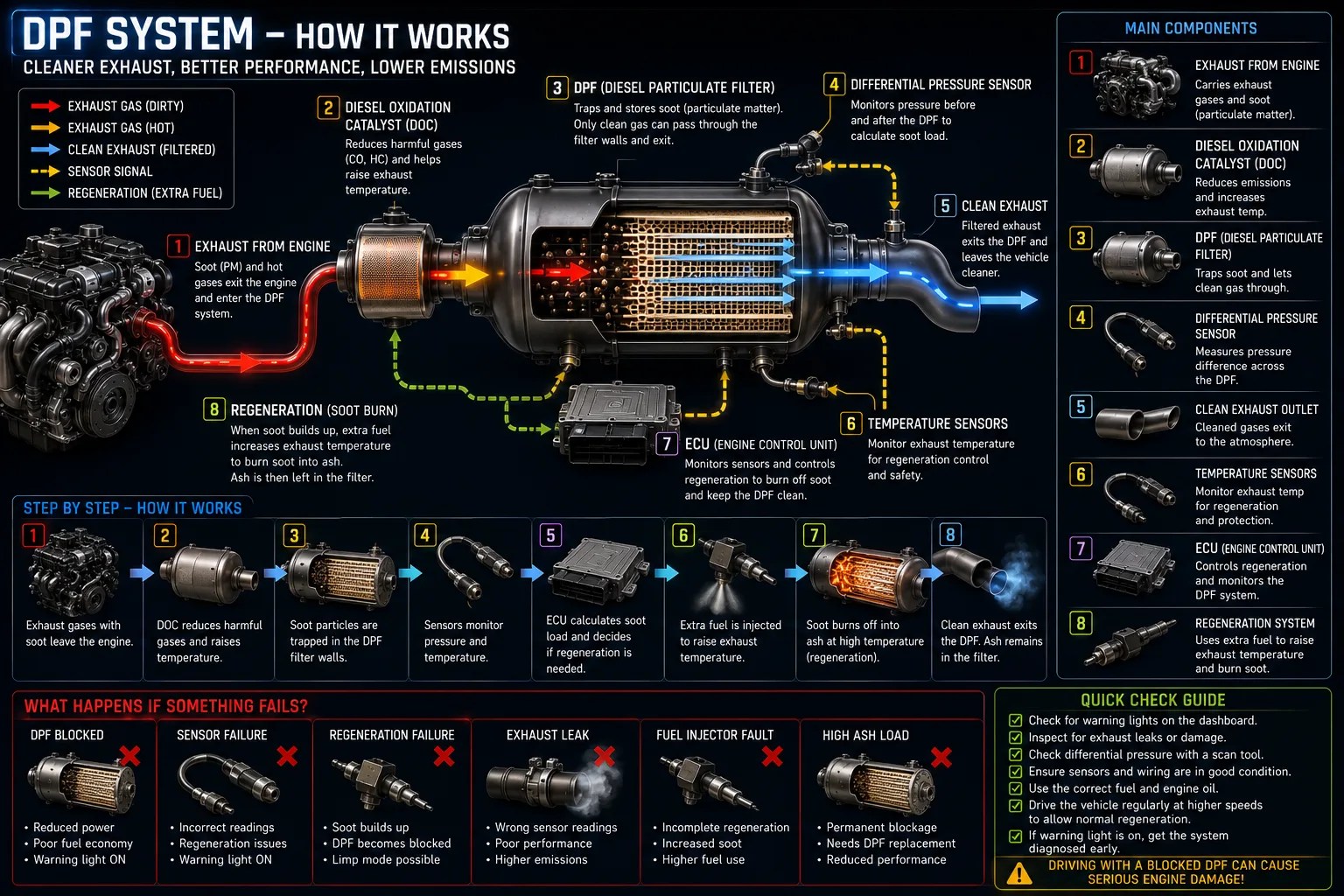
The diesel particulate filter sits in the exhaust system, downstream of the turbo and catalytic converter, and works by forcing exhaust gases through a honeycomb ceramic substrate with pores too small for soot particles to pass through. The soot builds up on the walls. Left alone indefinitely, this would clog the filter solid and suffocate the engine — so the ECU manages a process called passive regeneration, where, during sustained driving at higher rpm, exhaust temperatures climb above roughly 550–600°C and oxidise the trapped soot into CO2 and water. The filter effectively cleans itself, invisibly, on a good long motorway run. You never know it happened. Lovely. The problem is short journeys. Urban stop-start driving, school runs, commutes under ten miles — none of these get exhaust temperatures high enough or sustained long enough for passive regen to complete. Soot loading climbs. When it reaches a threshold (typically around 45% loading on most systems), the ECU triggers active regeneration: it injects extra fuel late in the combustion cycle, deliberately raising exhaust temperature to force a burn. But active regen also needs the car moving at a decent speed for ten to twenty minutes continuously — which, if you're doing the same short journeys, never happens either. The filter keeps filling. Above roughly 75–80% loading, the ECU gives up on self-cleaning and throws the DPF warning light. At this point, a forced regeneration — initiated via diagnostic software with the car stationary, running the engine at elevated revs under controlled conditions — is your last software-based option before you're looking at physical filter removal and cleaning, or outright replacement.
“No guessing, no unnecessary parts.”
Sound familiar?
So what's behind it?
What we do — at your door
We come to wherever your car has ground to an ignominious halt — your driveway, a supermarket car park, your workplace, or a layby where you're currently reconsidering your choice of diesel — and connect our professional-grade diagnostic equipment to your OBD-II port. We read the actual soot loading percentage from the DPF ECU data (not a guess based on the warning light, which only tells you something is wrong, not how wrong). We check DPF differential pressure, exhaust back-pressure, active regen history and failure codes, EGR status, and any related fault codes that might be preventing self-cleaning. If your soot loading is in the range where a forced regeneration is viable — broadly speaking, below about 90% on most systems — we run a static forced regen: engine held at controlled elevated rpm, exhaust temperatures raised under software-managed conditions, with live monitoring of DPF temperature and soot load throughout. The process typically takes 20–45 minutes. We clear the codes, verify the post-regen soot loading, and give you a straight assessment of filter health and driving advice that might actually prevent this happening again. If the loading is too high for a forced regen to succeed, or if the filter has physical damage, we tell you that too — along with the honest options, which are professional filter cleaning (off-car pressure wash and soak) or replacement, neither of which we recommend until we know forced regen won't sort it.
What affects the price
DPF forced regeneration costs in the UK vary based on a few honest factors. The diagnostic scan itself takes time and kit, so anyone doing it properly charges for labour. The forced regen procedure adds time on top — typically 20–45 minutes of attended, monitored regen — and the cost reflects that. Complexity scales with how many fault codes need clearing alongside the DPF code: if a faulty EGR valve has been preventing regen, sorting the regen without addressing the EGR just means you're back with the same problem within a few thousand miles, and a competent diagnosis picks this up. If your DPF is beyond forced regen, off-car ultrasonic or pressure-wash cleaning by a specialist is a middle option before replacement; replacement costs vary enormously by vehicle — a DPF for a common Ford or Vauxhall is a different number to one for a large BMW or Land Rover, and fitting time differs too. What you won't get from us is a forced regen charged as a full day's work, or a replacement filter recommended before we've established that regen genuinely won't work. The point of the diagnosis is to tell you which category you're actually in before any money is committed to parts.
Random knowledge you didn't ask for
Questions you're probably asking
Can I just drive on the motorway to clear the DPF myself?
Sometimes, yes — if the DPF warning light has only just come on and soot loading is still relatively low (typically below 70–75%), a sustained motorway drive of 20–30 minutes at 2,000–2,500rpm can allow a passive or active regen to complete and clear the light. But if the light has been on for a while, or if the car has entered limp mode, you're past the DIY motorway run stage: the soot loading is too high for the engine to self-clear, and attempting it risks overheating the filter. Get it scanned first — then you know what you're actually dealing with.
What happens if I just ignore the DPF warning light?
Nothing good. The warning light marks the point where the ECU has given up on automatic regeneration. Ignore it and soot loading continues to rise until the DPF is physically blocked, exhaust back-pressure climbs, and the engine enters limp mode or refuses to start. A blocked filter can also push oil contamination into the sump via failed regen attempts, damage the turbo through back-pressure, and trigger a cascade of additional fault codes. A forced regen at the warning-light stage costs a fraction of what a damaged turbo or replacement filter costs at the ignore-it-until-it-breaks stage.
Will a forced regeneration permanently fix my DPF?
A successful forced regen burns off accumulated soot and restores filter capacity — but it doesn't fix whatever caused the blockage in the first place. If that cause is purely driving style (short journeys, no motorway use), the filter will block again on the same timetable unless the driving changes. If a related fault — faulty EGR, pressure sensor, thermostat — was preventing self-cleaning, that fault needs addressing alongside the regen. We diagnose both as part of the visit, because clearing codes without finding the root cause is just postponing the next call-out.
My mechanic says I need a new DPF — do I actually?
Possibly, but it's not always the first option. A forced regen should be attempted first if soot loading is below the threshold where regen is viable. If forced regen fails, off-car professional cleaning (ultrasonic or pressure-wash by a DPF specialist) can restore filters that seem beyond saving and costs considerably less than replacement. Replacement is genuinely necessary when the filter substrate is cracked, physically damaged, or so ash-loaded from high mileage that even cleaning won't restore adequate flow. We won't recommend replacement without confirming the other options won't work.
Does a DPF delete solve the problem?
Legally: no, and we won't do one. Removing or bypassing a DPF has been illegal for use on UK public roads since 2014 — a car without its DPF will fail its MOT on a visual check of the exhaust system, and an emissions-related advisory will follow. The DVSA has been increasingly active about this. Track-only vehicles are a different matter, but if your car is on the road and insured for road use, a DPF delete voids insurance, makes the car fail MOT, and carries a fine. Sort the underlying problem — it's cheaper and less stressful than the alternative.
DPF warning light is on — what does it mean and how do I clear it?
It means your diesel particulate filter is too full of soot to clean itself — usually because it's never been on a long enough run to get hot enough to finish a regeneration cycle. The light is the ECU politely flagging that it's given up doing this automatically. If it's just come on and the car isn't in limp mode, a solid 25–30 minute motorway run at a steady 2,000–2,500rpm may still clear it. If it's been on for a while, or the car's lost power, you're past the DIY fix — soot loading is too high and you need a diagnostic scan and a forced regen before it becomes a much more expensive blocked-filter job.
DPF Forced Regeneration — sorted at your door
Stop procrastinating. Get a transparent quote and we'll come to you.