AdBlue Problems: When Your Diesel Decides It's an Activist
At some point, someone at the EU decided that diesel cars should carry a tank of automotive urea — essentially heavily processed wee — which gets squirted into the exhaust to neutralise the nitrogen oxides your engine produces. Noble ambition. The execution, however, has given rise to a whole ecosystem of faults that modern diesel drivers are only now discovering. Crystallised injectors. Dosing valves clogged with gunk that looks like yellow snow. NOx sensors convinced the air is poisonous. And the crowning achievement: a won't-start countdown that immobilises your car if you run the AdBlue tank dry. Your car is taking a principled stand for the environment and leaving you stranded in a Tesco car park to think about what you've done. SOSCarFix comes to you, diagnoses the actual fault with proper equipment, and sorts it — no garage queues, no panic, no lectures about emissions.
See our upfront pricingAdBlue warning lights, won't-start countdowns, injector crystals, NOx sensor faults — diagnosed and fixed at your door. No garage drop-off. Get a quote now.
How it actually works
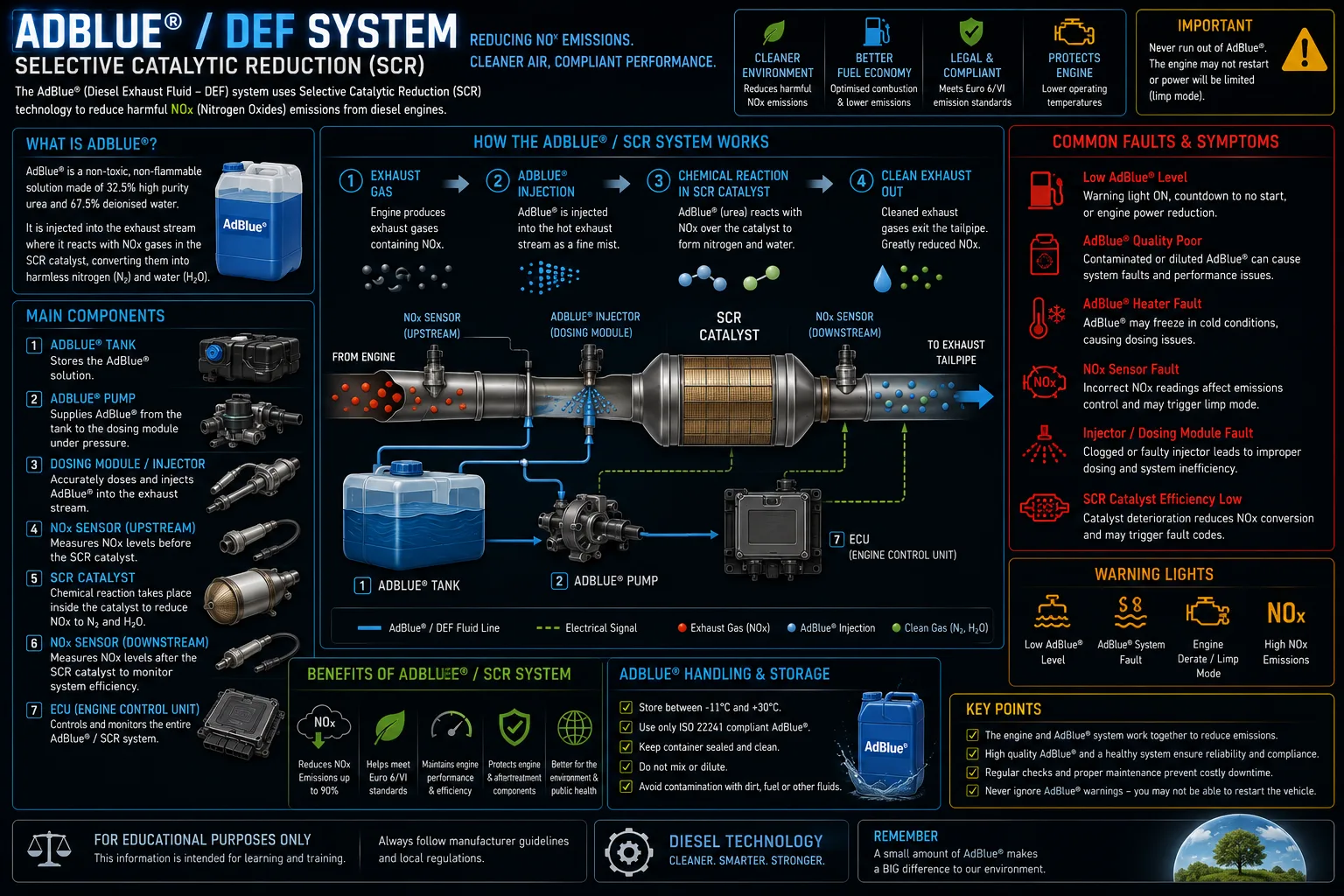
The Selective Catalytic Reduction (SCR) system is the mechanism that lets modern diesel engines pass Euro 5 and Euro 6 emissions standards without being strangled to the point of uselessness. Here's the chain: your engine's exhaust gases pass through a diesel particulate filter (DPF) first, then through the SCR catalyst. Just before the catalyst, a dosing module — basically a very precise pump and injector — sprays a fine mist of AdBlue (a 32.5% aqueous urea solution, standardised as AUS32 or ISO 22241) into the hot exhaust stream. The heat causes the urea to decompose into ammonia, which then reacts with the nitrogen oxides in the SCR catalyst to produce harmless nitrogen and water vapour. The whole thing is monitored by upstream and downstream NOx sensors, a temperature sensor, and a quality/level sensor in the AdBlue tank itself. When any link in that chain breaks — wrong fluid quality, a blocked injector, a failed dosing valve, a dead NOx sensor, a corroded wiring connector — the system logs a fault and starts its escalating protest. First you get a warning light. Then a mileage countdown to the next required service. Then, on many Euro 6 vehicles, a hard won't-start lockout that requires fault code clearance to release, even if you've topped up the fluid. It's a beautifully designed system when it works. When it doesn't, it's a masterclass in making a simple emissions problem feel catastrophic.
“The execution, however, has given rise to a whole ecosystem of faults that modern diesel drivers are only now discovering.”
Sound familiar?
So what's behind it?
What we do — at your door
We come to your driveway, car park, or roadside — wherever the car is, including wherever it has decided to enact its won't-start protest. We connect professional-grade diagnostic equipment (not a generic code reader from a motorway services vending machine) and read the full fault code history from the SCR control module, the engine ECU and the NOx sensor data stream. That tells us whether the problem is actually the AdBlue level, the injector, the dosing valve, a sensor, or a wiring fault before we quote you anything. We then carry out the fix on site: clearing locked-out start inhibitors once the root cause is resolved, replacing crystallised or blocked injectors, swapping failed NOx sensors, repairing corrosion in the wiring loom, and replacing dosing valves or pumps. We also top up AdBlue and verify the system is reading the correct fluid quality. What we won't do is clear the fault and wave you off hoping it doesn't come back. If it's a genuine catalyst issue or something the job genuinely requires specialist workshop equipment for, we'll tell you straight.
What affects the price
The cost of fixing an AdBlue or SCR fault in the UK varies quite a bit depending on what's actually failed — and here's the honest breakdown of why. A NOx sensor on a common platform (VW Group, Ford, Mercedes) is a relatively affordable part; on a rarer Euro 6 van or less mainstream diesel it can cost several times as much. The AdBlue injector sits in a hot, corrosive part of the exhaust and can be straightforward to swap or an absolute pig to extract if it's seized — that labour time is a real variable. Dosing module replacement is a bigger job and the part itself is not cheap. Wiring repairs are labour-intensive but parts-cheap. If the SCR catalyst itself needs replacing, that's a four-figure job on most vehicles and there's no shortcut. The won't-start lockout clearance is a short diagnostic job but requires the right equipment. And if someone has previously fitted an AdBlue emulator or delete device — which circumvents the system entirely and is illegal for road use under the Road Vehicles (Construction and Use) Regulations — that's not something we work with or recommend. If you've inherited one of those on a second-hand purchase, we can advise on reinstatement. Mobile diagnosis removes the recovery truck cost and the garage-queuing overhead, which on a fault like this (where you might otherwise need the car trailered) is a meaningful saving.
Random knowledge you didn't ask for
Questions you're probably asking
My AdBlue light came on — can I just top it up and carry on?
Yes, if you catch it early enough. The light typically comes on with several hundred miles to spare. Top up with proper ISO 22241 AdBlue (not a cheap no-name product) and the light should extinguish itself after a short drive once the level sensor is satisfied. If the countdown has already hit zero and the car won't start, a top-up alone may not clear the lockout — the fault code needs resetting by a diagnostic tool. Don't let it get that far.
My car has already locked out and won't start. Is it broken permanently?
No — but it's not a top-up-and-go fix anymore. Once a Euro 6 diesel triggers the start inhibitor, the ECU needs a diagnostic fault-clear alongside the AdBlue refill, and sometimes a short drive cycle to verify the system is genuinely working again. We come to the car wherever it is, top up, clear the lockout code, and confirm the system is happy before we leave. It's a nuisance, not a catastrophe.
Someone put the wrong fluid in the AdBlue tank. How bad is it?
Potentially quite bad. The AdBlue quality sensor will detect it quickly and log a fault. If you've just topped up with diluted or non-compliant urea, a full drain and flush of the tank and lines is needed before any damage reaches the SCR catalyst. If contaminated fluid has been running through the system for a while, catalyst damage is possible. Tell us exactly what went in and how long it's been running — that determines how drastic the fix needs to be.
Is AdBlue delete or an emulator legal in the UK?
No. Fitting an AdBlue emulator or SCR delete device to a road-going vehicle is illegal under the Road Vehicles (Construction and Use) Regulations and the Road Traffic Act. It's also an MOT failure — any MOT tester who checks the OBD for readiness monitors will see the SCR system flagged as not ready. Beyond legality, if you're involved in an accident and an investigator finds a defeat device, your insurance is in serious jeopardy. We don't fit or recommend them.
How do I know if it's the NOx sensor or the actual SCR catalyst that's failed?
This is exactly where proper diagnosis matters. A failed NOx sensor will log specific sensor-circuit codes and often show implausible or static readings in live data. A degraded catalyst will show the NOx conversion efficiency below threshold — but with both sensors reading sensibly. The distinction between 'the sensor is lying' and 'the catalyst is genuinely not working' requires live data analysis, not just reading the fault code number. Guessing and replacing the expensive part first is how people spend £800 on a sensor when the catalyst is fine, or vice versa.
AdBlue warning light on with a mileage countdown — what does it actually mean?
It means the ECU has detected that your AdBlue level is low enough to become its problem, not just yours. Euro 6 diesels are legally required to run the SCR system, so when AdBlue drops below a set threshold — typically around 1,500 miles' worth — the car starts counting down. Ignore it long enough and it hits zero: engine starts are then blocked until you refill and, in most cases, clear the lockout code with a diagnostic tool. It is not a suggestion. Top up with ISO 22241-spec AdBlue promptly; if you're already in the final few hundred miles, get someone out to you before it decides your morning plans are cancelled.
AdBlue Problems — sorted at your door
Stop procrastinating. Get a transparent quote and we'll come to you.