Wrong Fuel in Your Car: Here's What Not to Do Next (And What We'll Do Instead)
At some point today, roughly 400 British drivers will fill their diesel car with petrol, stare at the pump nozzle, feel a cold wave of existential dread, and then — fatally — wonder if they can just drive to the garage quickly. They cannot. And they shouldn't. The golden rule of misfuelling is so simple it almost hurts: do not start the engine. Do not turn the key. Do not even think about it. SOSCarFix will come to you — forecourt, car park, driveway, or layby of shame — drain your tank, flush the fuel system, and get you moving again. No tow truck required. No garage drop-off. Just a mobile mechanic turning up before you make the problem considerably, expensively worse.
See our upfront pricingPut petrol in your diesel? Step away from the ignition. SOSCarFix comes to you, drains the tank and flushes the system. Get a quote now.
How it actually works
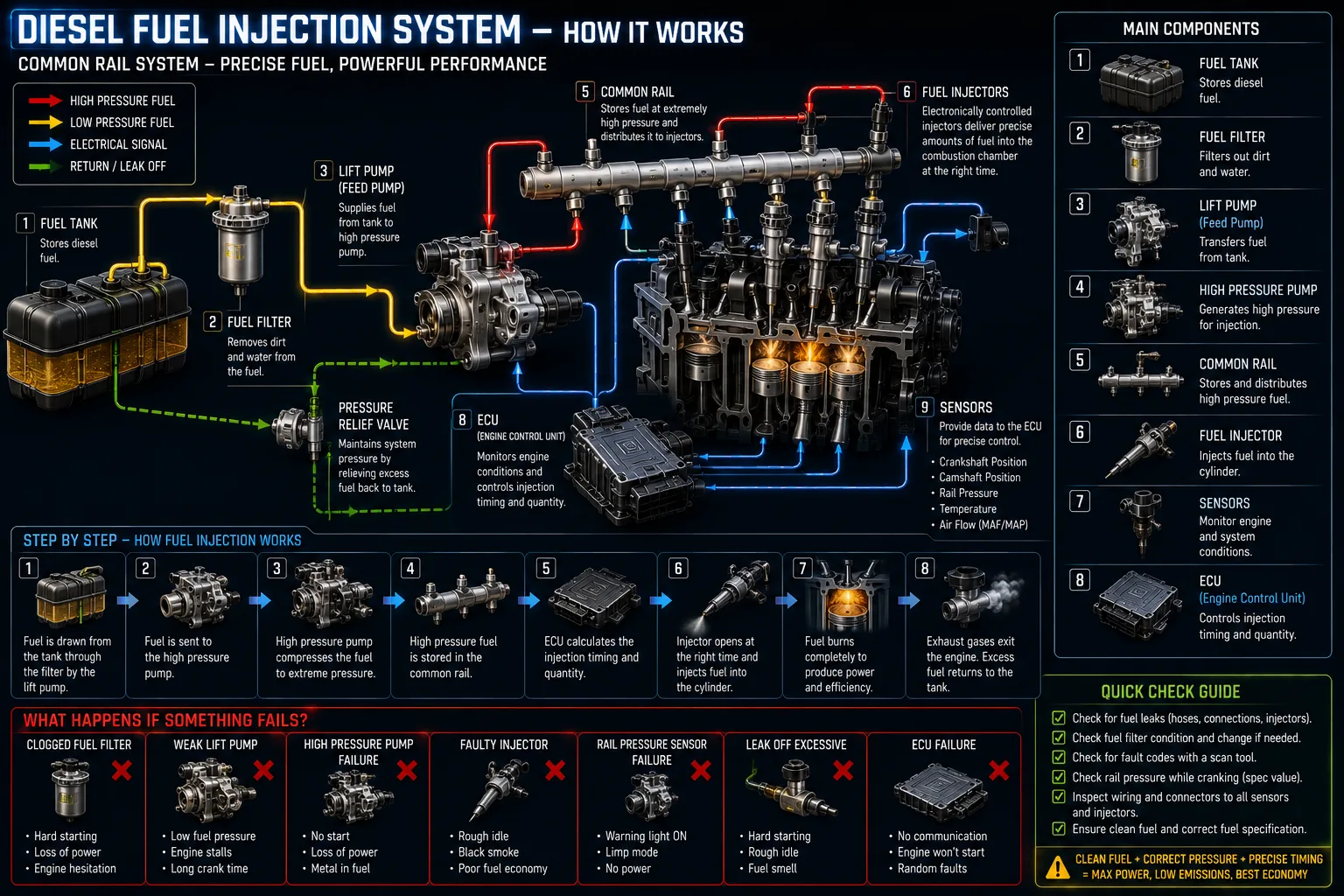
A diesel engine is not interchangeable with a petrol engine — they are fundamentally different in how they ignite fuel. Diesels compress air until it gets hot enough to ignite the fuel when it's injected; there's no spark plug involved. Petrol engines use a spark. The fuel systems reflect this: diesel fuel is actually an oily liquid that lubricates the high-pressure fuel pump and injectors as it passes through them. Petrol is a solvent. Put petrol into a diesel system and that lubricating film disappears, replaced by something that actively strips it away. Run the engine — even briefly — and the high-pressure pump starts running dry, generating fine metal swarf that contaminates the injectors, the fuel rail, and everything downstream. Modern common rail diesel systems run at pressures of 1,500 to 2,500 bar; they are astonishingly precise and astonishingly unforgiving of contamination. Diesel in a petrol car is the less catastrophic scenario: petrol engines can tolerate some diesel without the same hardware damage, though the car will run badly and you still need a drain. The key variable in either case is whether the engine was started. If you didn't start it, the contaminated fuel is still contained in the tank and fuel lines — expensive to drain, but containable. If you drove it, the contamination has reached the pump and injectors, and the bill rises sharply.
“Just a mobile mechanic turning up before you make the problem considerably, expensively worse.”
Sound familiar?
So what's behind it?
What we do — at your door
We come to you — wherever you've had the good sense to stop the car — and perform a full wrong-fuel recovery on site. We extract the contaminated fuel from the tank using specialist extraction equipment, flush the tank, drain the fuel lines and fuel filter, and replace the filter. If the engine was started and there's evidence of contamination in the high-pressure system, we'll assess the injectors and high-pressure pump for damage before recommending a path forward — because there's no point flushing a clean system into a contaminated pump. We then refill with the correct fuel, start the car and confirm it's running cleanly before we leave. We carry out a basic scan for fault codes thrown during the incident and clear any that are fuel-system-related and now resolved. You get an honest assessment of whether additional work is needed — high-pressure pump damage in particular isn't something we'll diagnose around, because getting that wrong costs far more than telling the truth upfront.
What affects the price
The cost of a wrong-fuel drain depends on several factors: how much wrong fuel went in, whether you started the engine, and how far the contamination spread. A straightforward drain-and-flush on a car that never turned over is the cheapest scenario — you're paying for time, extraction and disposal of the contaminated fuel, a new fuel filter, and the correct fuel to refill with. If the engine was started, the bill climbs: we may need to inspect or replace the high-pressure fuel pump (which can cost several hundred pounds for parts alone on a modern common rail diesel) and potentially the injectors too. Diesel in a petrol car is generally cheaper to resolve than petrol in a diesel, because petrol systems are more tolerant and there's no lubrication damage mechanism at play. As a rough guide, a no-start drain-and-flush is a fraction of the cost of a pump and injector job — which is exactly why not starting the car is the single most valuable thing you can do when you realise the mistake.
Random knowledge you didn't ask for
Questions you're probably asking
I've just put petrol in my diesel. What do I do right now, this second?
Stop. Don't start the engine. Don't turn the key to the accessory position if you can help it, as this primes the fuel pump. Put the car in neutral (or leave it in park), push it clear of the pump if you can, and call us. The contaminated fuel is still in the tank and lines — everything is recoverable at this point. The moment you start the engine, that calculus changes.
I accidentally started the engine. Is it ruined?
Not necessarily ruined, but the damage potential has increased. How bad it is depends on how long the engine ran, how much petrol went in, and how full the tank was. A brief crank on a mostly-diesel tank is far less damaging than driving several miles on a nearly-empty one. Switch off immediately, don't restart, and call us. We'll assess what we're dealing with honestly — including whether the high-pressure pump shows signs of contamination damage.
What about diesel in a petrol car — is that as bad?
Less catastrophic, as it turns out. Petrol engines use a low-pressure fuel system and spark ignition, so diesel passing through doesn't cause the same lubrication-stripping damage. The car will run poorly and smoke, and you still need a drain and flush, but the risk of expensive pump or injector damage is much lower. Still don't drive it deliberately — you'll foul the catalytic converter and possibly the oxygen sensors if you push it.
Will my insurance cover it?
Some comprehensive car insurance policies include misfuelling cover, and some breakdown policies (particularly RAC and AA) include wrong-fuel rescue as an add-on. Check your policy documents — if you have cover, you may be able to claim back the cost of the drain. Either way, call us first to get the car sorted: the longer contaminated fuel sits in a modern diesel system, the more expensive the conversation about the high-pressure pump becomes.
How long does a mobile wrong-fuel drain take?
A straightforward tank drain, line flush and fuel filter replacement typically takes around an hour to an hour and a half on site. Add time if the engine was started and we need to assess the high-pressure system, or if we're dealing with a more complex fuel system layout. We'll give you an honest time estimate when we quote, and we won't rush a job that needs to be done properly.
Wrong Fuel in Your Car — sorted at your door
Stop procrastinating. Get a transparent quote and we'll come to you.