P0087: Fuel Rail Pressure Too Low — The Code That Means Your Engine Is Starving, Not Stuffed
P0087 is your engine management system politely announcing that it asked for a certain fuel rail pressure, checked what it actually got, and found the two numbers had absolutely nothing in common. The rail is underdelivering — not enough pressure reaching the injectors — so the ECU does what any sensible thing does when starved of fuel: it panics, pulls power, and throws you into limp mode. On diesel engines this is almost always a fuelling problem working from the cheap end outwards: a clogged fuel filter is the villain more often than anyone likes to admit. SOSCarFix comes to you, reads the live rail pressure data before touching a single part, and works through the actual cause — rather than guessing with your wallet.
See our upfront pricingP0087 on your dash? Limp mode, cutting out, won't pull? We diagnose fuel rail pressure live — no guessing, no unnecessary part-swapping. Quote before we touch anything.
How it actually works
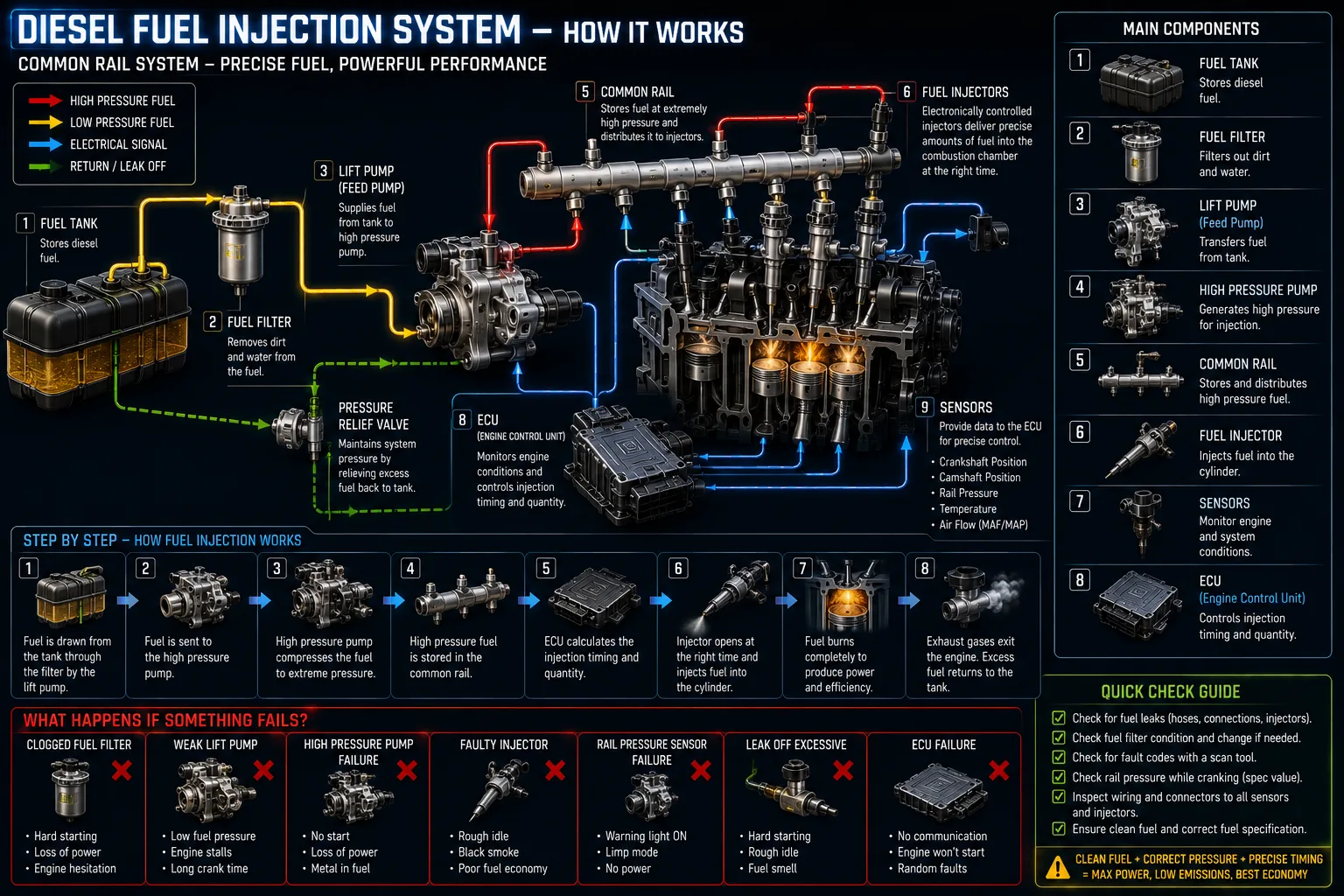
Modern diesel engines use a high-pressure fuel system that operates at genuinely eye-watering pressures — common rail diesel systems typically run at 1,600 to 2,500 bar at full load, depending on the engine. That pressure is the whole point: atomising diesel at such fine particle sizes that it combusts cleanly and efficiently, which is why diesel engines make good torque and reasonable economy at once. The system works in two stages. First, an in-tank lift pump (or a low-pressure pump at the filter housing) draws fuel from the tank and pushes it through the fuel filter to a high-pressure pump (HP pump) mounted on the engine. The HP pump then drives pressure up to operating levels and feeds the common fuel rail — a metal manifold that acts as a pressurised reservoir shared by all the injectors. A rail pressure sensor monitors this continuously and reports to the ECU, which trims the HP pump output via a pressure control valve (PCV) to match demand. P0087 fires when the rail pressure sensor reads lower than the ECU's commanded target — meaning the system demanded, say, 1,800 bar, got 900 bar back, and concluded something is blocking or failing upstream. The code is a result, not a diagnosis. Live rail pressure data across idle, cruise and hard acceleration is what actually tells you where the restriction or failure sits.
Sound familiar?
So what's behind it?
What we do — at your door
We come to you — driveway, car park, workplace — with a professional diagnostic tool capable of reading live rail pressure data, not just pulling fault codes and guessing. First we confirm P0087 is active, then we watch actual rail pressure at idle, under snap acceleration and at steady cruise. A healthy common rail diesel will spike to its target pressure instantly under demand; if pressure sags or flatlines, we know the system is genuinely underdelivering rather than misfiring a sensor reading. From there we work in logical, cost-ascending order: filter condition and fuel supply pressure at the HP pump inlet are checked before any expensive components are condemned. We carry filters for common diesel platforms, so if that's the cause, it's often sorted on the same visit. If the HP pump or lift pump needs replacing, we quote clearly and source quality parts — OEM or OE-equivalent — before returning to fit them. No part-swapping on a hunch, no upselling a £900 HP pump when the real culprit is a £30 filter.
What affects the price
Fuel filter replacement is at the cheaper end of diesel repairs — parts are inexpensive for most common platforms, labour is straightforward. In-tank lift pump replacement varies significantly by vehicle: on some diesels the pump is accessible via a top-mounted sender unit, on others the tank has to come out, which adds time. High-pressure pump replacement is a substantial job — the part alone for a Bosch CP4 or Delphi unit runs into hundreds of pounds before labour, and some applications require the injection system to be primed and bled correctly afterwards. Pressure control valves are moderately priced as standalone parts but labour access varies. A leak-back test to assess injector condition is a diagnostic step, not an immediate repair cost — injectors on common rail diesels are expensive, so confirming the diagnosis before ordering is essential. We always quote by job after diagnosis.
Random knowledge you didn't ask for
Questions you're probably asking
Does P0087 always mean my high-pressure pump has failed?
No — and assuming it does is an expensive mistake. P0087 means rail pressure was below target, which can happen because of a blocked filter, a tired lift pump, a leaking pressure control valve, a dodgy sensor, or leaking injectors, long before the HP pump is the issue. We read live pressure data and work from cheapest cause first. The HP pump is the last thing we condemn, not the first.
Can I keep driving with P0087 active?
In limp mode you have reduced power, but limp mode exists to protect the engine, not as a long-term driving strategy. If the root cause is fuel starvation, running the HP pump dry or at low inlet pressure accelerates wear on already expensive components. Get it diagnosed promptly — especially if you're noticing the car cutting out under load, which is also a safety concern on faster roads.
My car only goes into limp mode when I accelerate hard — is that still P0087?
Classic P0087 behaviour. At light throttle and low load the system doesn't demand maximum rail pressure, so a marginal filter or struggling lift pump can keep up. Stamp the throttle, demand spikes, the system can't deliver, pressure sags below threshold and the ECU pulls the plug. Live data under load — not just at idle — is what makes the diagnosis reliable.
I've just had a fuel filter change but P0087 is still there — what now?
A few possibilities: the code may be stored from before the filter was changed and hasn't been cleared and retested under load; the filter change may not have been the only issue (a lift pump running near the end of its life can present similarly); or the filter wasn't the cause at all. We'll clear the code, test with live data and establish whether the fault is still present and where the restriction actually sits.
Is P0087 only a diesel fault code?
P0087 can technically appear on petrol engines too — it means fuel rail pressure too low regardless of fuel type. However, in practice it's overwhelmingly a diesel diagnosis in the UK: common rail diesel systems operate at far higher pressures, have more failure points, and the consequences of low rail pressure show up immediately in driveability. On petrols it's much rarer and usually points to a failing low-pressure pump or a blocked sock/strainer in the tank.
P0087 — sorted at your door
Stop procrastinating. Get a transparent quote and we'll come to you.