Glow Plugs: The Unsung Heroes Your Diesel Ignores Until January
Petrol engines have spark plugs. Diesel engines have glow plugs — and if you've never thought about them, congratulations, they've been doing their job quietly all winter. They're small, cylindrical heaters that warm up the pre-combustion chamber or cylinder just enough for diesel to ignite on compression alone, because diesel doesn't have the luxury of a spark to cheat with. The catch: they live inside your engine's combustion chambers, exposed to roughly 850°C every time the engine fires, and diesel is not exactly a gentle environment. Over time they fail — slowly at first (one bad morning, the odd bit of white smoke) then decisively (you're not going anywhere). SOSCarFix comes to you, diagnoses which plugs have given up, and replaces them without the garage faff, which is particularly useful when your car is the thing not starting.
See our upfront pricingDiesel won't start in the cold? White smoke, rough running or a glow plug light? SOSCarFix replaces glow plugs at your door. Get a quote today.
How it actually works
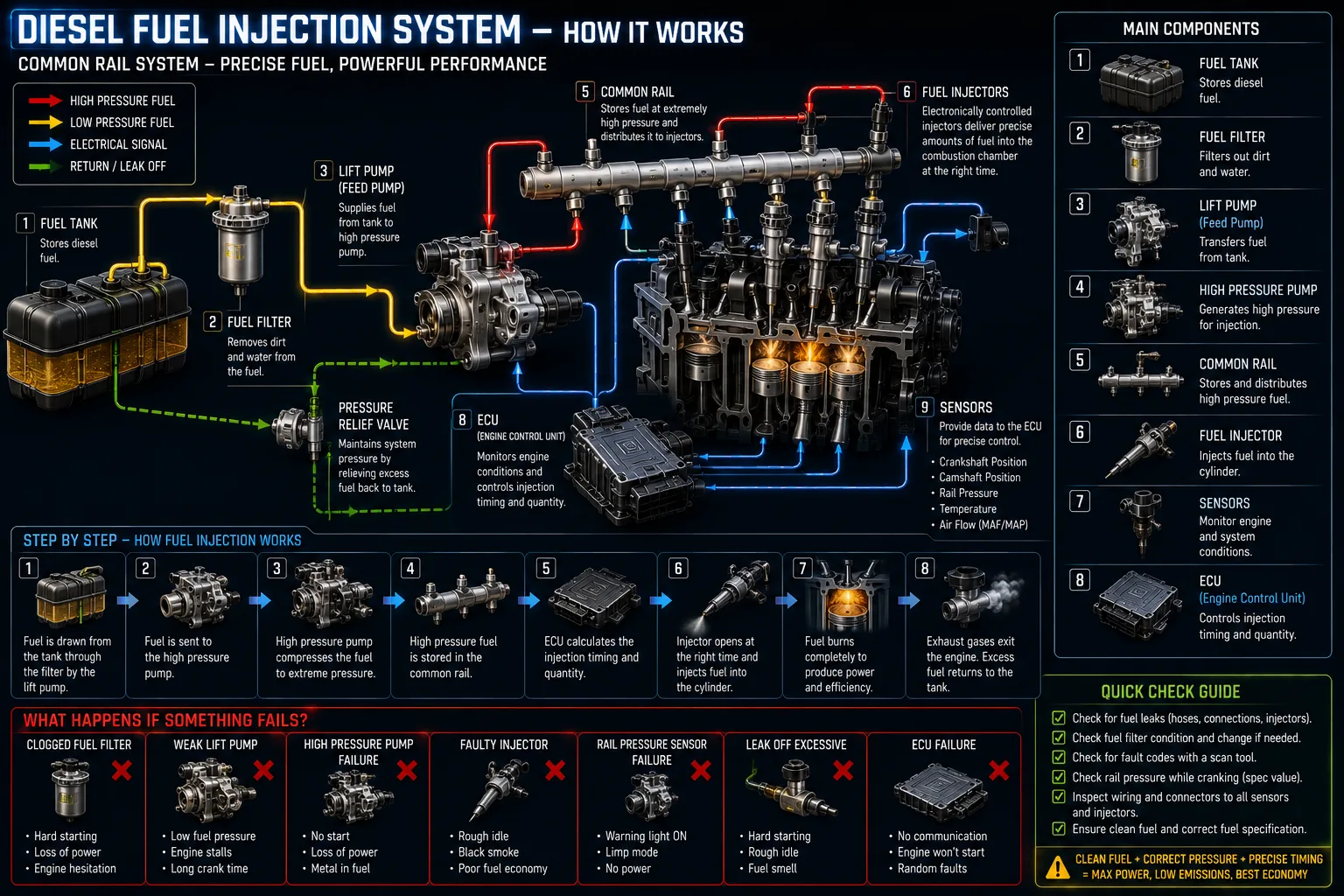
Diesel ignites by compression, not by spark — compress air enough and it gets hot enough to ignite fuel injected into it. Simple in principle; less simple when the engine is stone cold at 6am in November. Cold air is dense and pulls heat away fast, so the cylinder temperature after compression might not be enough to reliably fire the diesel. Enter glow plugs. Each cylinder has one. When you turn the ignition to position two (before cranking), the glow plug light flickers on while all four plugs heat their tips to anywhere between 700°C and 1,000°C in a matter of seconds. Once it goes out (or on modern engines, immediately on turn-key starts, because the pre-heat happens automatically), the engine is ready to crank. The plugs then continue working in an after-glow phase for up to three minutes, helping keep combustion stable until the engine warms up. Modern common-rail diesels are more tolerant than older pre-chamber designs, but a failing glow plug still means one cylinder firing late, poorly or not at all — which is exactly as much fun as it sounds on a cold commute.
“Over time they fail — slowly at first (one bad morning, the odd bit of white smoke) then decisively (you're not going anywhere).”
Sound familiar?
So what's behind it?
What we do — at your door
We start with a proper diagnosis before anything comes out — because ripping out glow plugs without checking is how you end up with a snapped plug embedded in the cylinder head, and nobody wants that conversation. Using a scan tool we pull live data and any stored fault codes to confirm it's the plugs rather than the relay, control module or wiring. We test glow plug resistance individually with a multimeter (a good plug reads near zero ohms; a failed one reads open circuit or wildly high). Once we know exactly which plugs have failed, we quote you on those — not a speculative full set unless that's genuinely warranted. Where possible we use penetrating fluid and heat to coax seized plugs out safely. We come to your driveway, car park or workplace, so even if your diesel has decided today is not a starting day, we can usually still reach it.
What affects the price
Glow plug replacement cost in the UK varies more than people expect. The plugs themselves range from around £8–£30 each depending on brand and vehicle — a quality OEM-spec plug from Bosch, NGK or Champion costs more than an unbranded one, and it's not a place to save money given they're living inside a combustion chamber. Labour is where it gets interesting: on an accessible modern diesel the job might take under an hour; on vehicles where the plugs are buried behind inlet manifolds, EGR pipework or injector wiring looms, labour time multiplies quickly. The genuinely expensive scenario is a seized or snapped plug — extracting a broken plug from a cylinder head is a skilled job that can take several hours and may require specialist tools or, in worst cases, the head coming off. That risk is higher on older, high-mileage vehicles and is why early diagnosis before they corrode solid is always the better plan.
Random knowledge you didn't ask for
Questions you're probably asking
Is it safe to drive with a faulty glow plug?
In mild weather with only one failed plug, you might get away with it — the car will probably start after a longer crank and run roughly until warm. In cold weather or with multiple failed plugs, you risk not starting at all. More importantly, the longer you leave it the more carbon deposits build up, and the more likely the plug is to seize in the head and turn a routine replacement into a far more expensive extraction job. So: driveable-ish, but inadvisable.
My glow plug light comes on while I'm driving, not just at start-up. What does that mean?
That's your diesel's general engine management warning light moonlighting as the glow plug symbol — confusing, but standard. When it stays on or flashes while driving it typically means a fault code has been logged, which could be a failed glow plug, a faulty control module, an emissions or fuel system issue, or something else entirely. A diagnostic scan is the only way to know what it actually is — don't assume it's definitely plugs without checking.
Do I need to replace all four glow plugs at once?
Not necessarily — if only one or two have failed and the rest test healthy, replacing just the faulty ones is perfectly reasonable. That said, if the plugs are original and the car has covered 80,000+ miles, fitting all four at once makes sense: the remaining ones are living on borrowed time, and you're already paying for the labour once. We'll give you an honest recommendation based on what our tests show.
How long does glow plug replacement take?
On most modern diesels with accessible plug locations — a VW Golf, Ford Focus or similar — it's a one to two hour job. Vehicles with plugs buried deep in the engine bay, or where corrosion makes extraction slow and careful, will take longer. If we find a seized plug when we get in there, we'll let you know before proceeding, because that changes both the time and the cost.
Can a faulty glow plug cause an MOT failure?
Not directly — the MOT doesn't test glow plugs themselves. But a failed glow plug that causes a rough cold start can produce excess smoke emissions during the MOT emissions test, which can fail you. An engine management light on the dash will also fail the MOT automatically. Fix the plugs before the test and you remove both risks at once.
P0670 fault code — what does it mean and is it the glow plug control module?
P0670 means the ECU has lost confidence in the glow plug control module — the separate unit that manages when and how hard each plug fires. It doesn't automatically mean the module is dead; wiring faults, a corroded multiplug and even a single shorted glow plug dragging down the circuit are all common real-world causes. Start by scanning all the related codes (P0671–P0678 flag individual cylinders) before condemning the module itself. A proper diagnostic will tell you whether it's a £15 connector or a £200 module — worth knowing before you guess.
Glow Plugs — sorted at your door
Stop procrastinating. Get a transparent quote and we'll come to you.