Fuel Leak: The Problem That Turns Your Driveway Into a Crime Scene and Your Engine Bay Into a Very Bad Idea
A small puddle under your car and a strong smell of petrol or diesel is not a charming personality trait. It is your fuel system telling you, in the most direct terms available to it, that flammable liquid is going somewhere it absolutely should not. Petrol ignites at a temperature your exhaust manifold reaches on a normal Tuesday. Diesel is less volatile but not, it must be said, fireproof. Either way, the gap between \"weeping fuel line\" and \"vehicle on fire\" is considerably shorter than people who drive around ignoring it would prefer to believe. The source could be a cracked rubber fuel hose, a corroded metal line that has given up after a decade of UK road salt, a leaking injector seal, a failed tank sender gasket, or a split filler neck — all of which have different fixes, different urgencies, and all of which require actual diagnosis rather than the classic British approach of winding down the window and hoping the smell goes away. SOSCarFix comes to you, finds the source with certainty, and does not let you leave without knowing exactly what you are dealing with.
See our upfront pricingPuddle under the car and a strong fuel smell? That's a fire risk, not a quirk. SOSCarFix diagnoses fuel leaks on your driveway. Don't drive it. Get a quote.
How it actually works
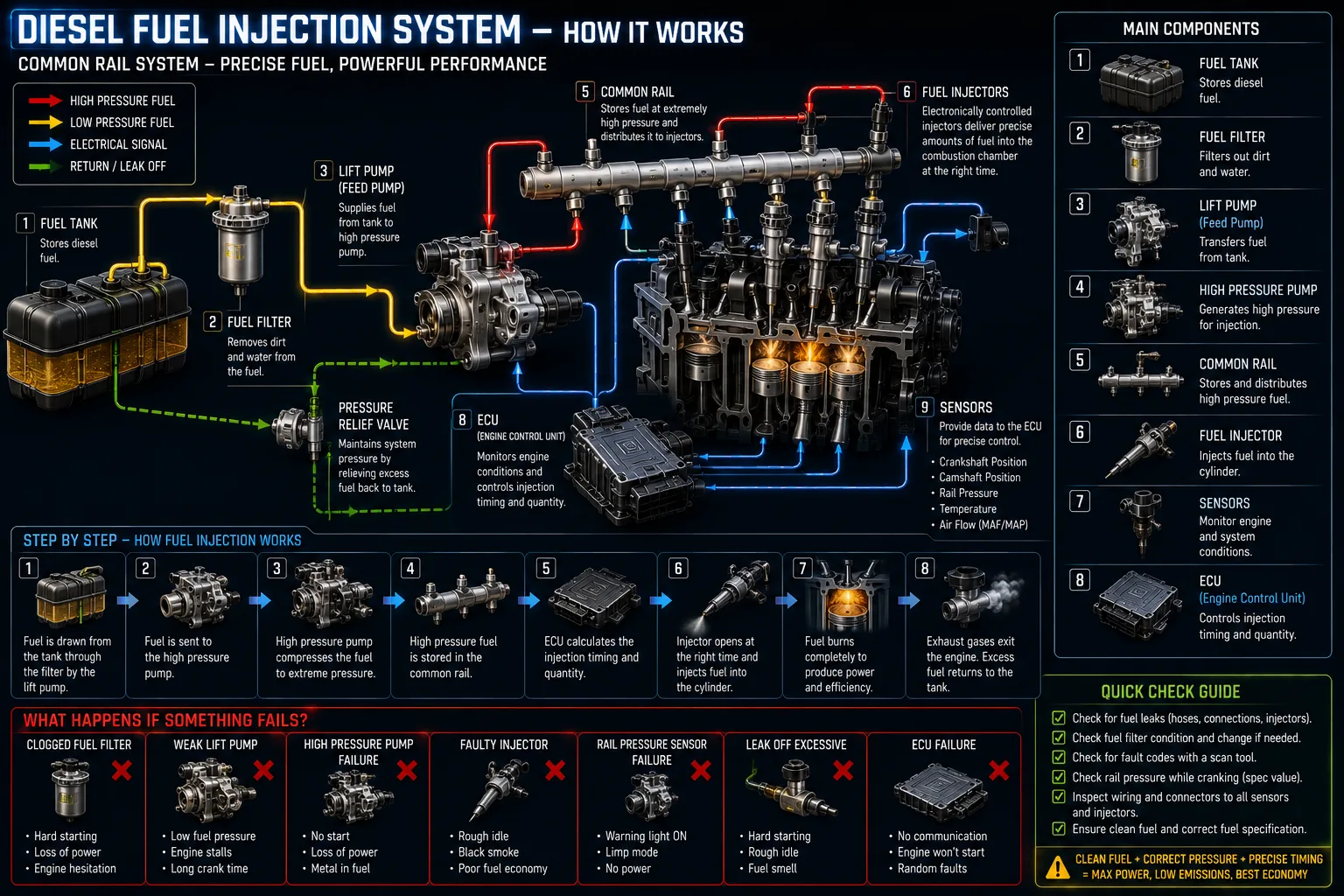
Your car's fuel system is a pressurised circuit that runs from the tank, through a pump (usually submerged in the tank itself on modern cars), along fuel lines to the engine, through a filter where one is present, and into a fuel rail feeding the injectors. On petrol port injection systems that pressure runs at around 3–4 bar. On modern petrol direct injection systems it is considerably higher — up to 200 bar at the high-pressure pump and rail, which means a breach in the high-pressure section is not a slow seep; it is an atomised mist of fuel near a hot engine. Diesel common rail systems operate at similar extremes, with high-pressure pipes connecting the rail to individual injectors at pressures that dwarf anything on the low-pressure side. The low-pressure side — tank, pump connections, sender unit seal, filler neck, breather hoses, and the return line on older systems — operates at much lower pressure but is no less capable of producing a meaningful leak. Rubber fuel hoses perish with age, particularly on UK cars where heat cycling is combined with the damp that accelerates surface cracking. Metal fuel lines that run along the sill or chassis rail sit in the salt spray thrown up by every wet road and can corrode through at a seam or bracket point with no external indication until you notice a stain on the driveway. The injectors themselves seal into the fuel rail and, on port injection engines, into the inlet manifold via O-rings that harden and crack over time. A weeping injector O-ring releases fuel at the engine end — right next to hot metal, the ignition system, and the exhaust. This is the scenario where acting promptly rather than finishing the week first becomes relevant. When we attend, we work systematically from the tank end forward and from the highest-pressure point backwards to find where the breach is, confirm it visually and with data, and give you an accurate picture of the repair before a single part is ordered.
“A small puddle under your car and a strong smell of petrol or diesel is not a charming personality trait.”
Sound familiar?
So what's behind it?
What we do — at your door
When SOSCarFix arrives at your location — and ideally the car is outside rather than in an enclosed garage where fuel vapour accumulates with predictable ambitions — we do not start by replacing the most expensive component and seeing whether the puddle stops. We start by establishing where the leak is coming from with certainty, because a fuel smell under a car could originate from six different locations and the repair cost difference between them is substantial. We carry out a full visual inspection of the accessible fuel system — tank exterior, sender unit area, fuel lines along the chassis, all rubber hose connections in the engine bay, fuel rail and injector bodies, fuel filter housing where present. We look for staining, wet residue, surface sheen on surrounding components, and any cracked or perished hose sections. On cars where the source is not immediately obvious externally, we run the engine and watch the system under live pressure, which often reveals a leak that does not appear at rest. For vapour-side leaks where the smell is present but no drip is visible, an EVAP smoke test introduces inert diagnostic smoke into the vapour circuit and shows precisely where it exits — the same technique used for EVAP system faults but equally applicable to any sealed section of the fuel vapour path. On diesel systems we pay particular attention to the high-pressure circuit, checking for the fine fuel mist or staining on the high-pressure lines and rail connections that indicates a high-pressure leak — not something to improvise around. Once the source is confirmed, we explain clearly what the repair involves, what parts are required, and whether the job is one we can complete on-site or whether it requires additional equipment or specialist facilities such as a ramp for undercar fuel line work. We will never proceed to a repair without your agreement on the cost, and we will never tell you a repair is straightforward when it is not.
What affects the price
The range is genuinely wide, and honesty demands we say so rather than quote a number that will either alarm you or mislead you. A rubber fuel hose replacement on a common UK car — Ford, Vauxhall, Volkswagen Group, Renault, Nissan — is an affordable repair in both parts and labour, particularly if the hose is in an accessible location in the engine bay. A set of injector O-ring seals for a port injection petrol engine is similarly modest in parts cost, though labour depends on how accessible the fuel rail is. A fuel filler neck replacement is variable: on some cars it is a straightforward trim-off-and-replace job; on others it is buried behind bumper sections or body panels. At the more substantial end: corroded steel fuel lines that run under the vehicle require sections to be fabricated or suitable replacement pipe to be run and formed correctly — not a lengthy job for an experienced mechanic but not a five-minute task, and on badly corroded cars the surrounding bracketry and unions often need attention too. A fuel pump sender unit seal replacement requires the pump assembly to be removed from the tank, which on some cars is accessed from inside the boot or under a rear seat and on others requires dropping the tank — a different afternoon entirely. High-pressure fuel system work on diesel common rail or petrol direct injection engines involves specialist fittings and in some cases torque specifications for high-pressure unions that require the correct tooling. Diagnostic time is always included before any repair is recommended, and we will always give you the cost breakdown before proceeding. If what we find is beyond the scope of a mobile visit — undercar line replacement on a vehicle requiring a ramp for safe access, for example — we will tell you that clearly rather than improvise.
Random knowledge you didn't ask for
Questions you're probably asking
Can I drive my car to a garage if it has a fuel leak?
The short answer is no, and the reason is not bureaucratic caution. A fuel leak means flammable liquid is in contact with hot engine components, exhaust surfaces, or electrical items that are all part of a running car. The risk is not theoretical — fuel fires are fast, and a car on fire on a public road is an emergency involving other people, not just yours. The correct course of action is to not start the engine and to get a mobile mechanic to come to the car, which is precisely what we do. If the car is already at a location where it cannot stay, call us before driving further.
What does a fuel leak smell like, and how do I tell petrol from diesel?
Petrol has a sharp, sweet, immediately recognisable smell that most people associate with filling stations — the aromatic compounds in unleaded petrol are highly volatile and detectable at very low concentrations. Diesel smells heavier, more oily, and slightly acrid — less immediately sharp than petrol but equally persistent on clothing and surfaces. In practice, if you are smelling either around your car when it is not being refuelled, the distinction matters less than the shared message, which is that something in the fuel system has breached and needs to be found.
The puddle under my car is not there every day — does that mean the leak is minor?
Not necessarily, and this is worth understanding. Many fuel leaks are pressure-dependent — the leak is active when the system is pressurised under a running engine and closes or reduces when the engine is off and the pressure drops. A car that leaks while running but not while standing can drip fuel onto hot exhaust components throughout a journey without ever producing the driveway puddle that would otherwise make the problem obvious. Intermittent or pressure-dependent leaks are not minor leaks; they are leaks that are harder to catch passively and easier to miss until the consequences make them unmissable.
My diesel has a strong fuel smell after a long run but nothing visible — what could that be?
On diesel common rail systems this can indicate a high-pressure fuel leak that manifests as atomised mist rather than a drip — the extremely high injection pressures involved mean that a micro-crack in a high-pressure pipe produces fuel vapour rather than liquid at the point of escape. It can also indicate a leaking injector return line or a weeping injector body seal. The absence of a visible puddle does not rule out a meaningful fuel loss, and on a diesel the additional concern is the DPF and exhaust temperatures involved in regeneration cycles. A diagnostic inspection is the right move, not waiting for the puddle to appear.
Will a fuel leak fail the MOT?
Yes, immediately and without appeal. A fuel leak of any kind — liquid fuel visibly seeping or dripping from any part of the fuel system — is classified as a dangerous defect under MOT assessment standards and results in an automatic failure that prevents the vehicle from being driven away from the test station under its own power. A strong fuel smell in the absence of a visible drip is also likely to result in a refusal to test or a failure depending on the tester's assessment. There is no category of fuel leak that the MOT considers acceptable.
Fuel Leak — sorted at your door
Stop procrastinating. Get a transparent quote and we'll come to you.