Diesel Oil Dilution: When Your Engine Oil Starts Moonlighting as Fuel
Your dipstick says the oil is above the maximum mark. You haven't added any oil. You're not a wizard. So what's happening? Congratulations — your diesel engine has been quietly mixing fuel into its own oil, a charming process known as oil dilution. Every time your DPF tries to clean itself and fails (because your commute is six miles and the motorway is a distant memory), raw diesel fuel washes down the cylinder walls and into the sump. The oil gets thinner, the level rises, and your engine bearings start working progressively harder under progressively worse lubrication. Left long enough, it stops being an inconvenience and starts being an engine rebuild. SOSCarFix comes to you — no garage faff, no waiting lists — and sorts out what's actually causing it before it costs you something truly unpleasant.
See our upfront pricingYour diesel oil level is rising and that's not a bonus. It's diluted with fuel. We diagnose oil dilution at your door — get a quote today.
How it actually works
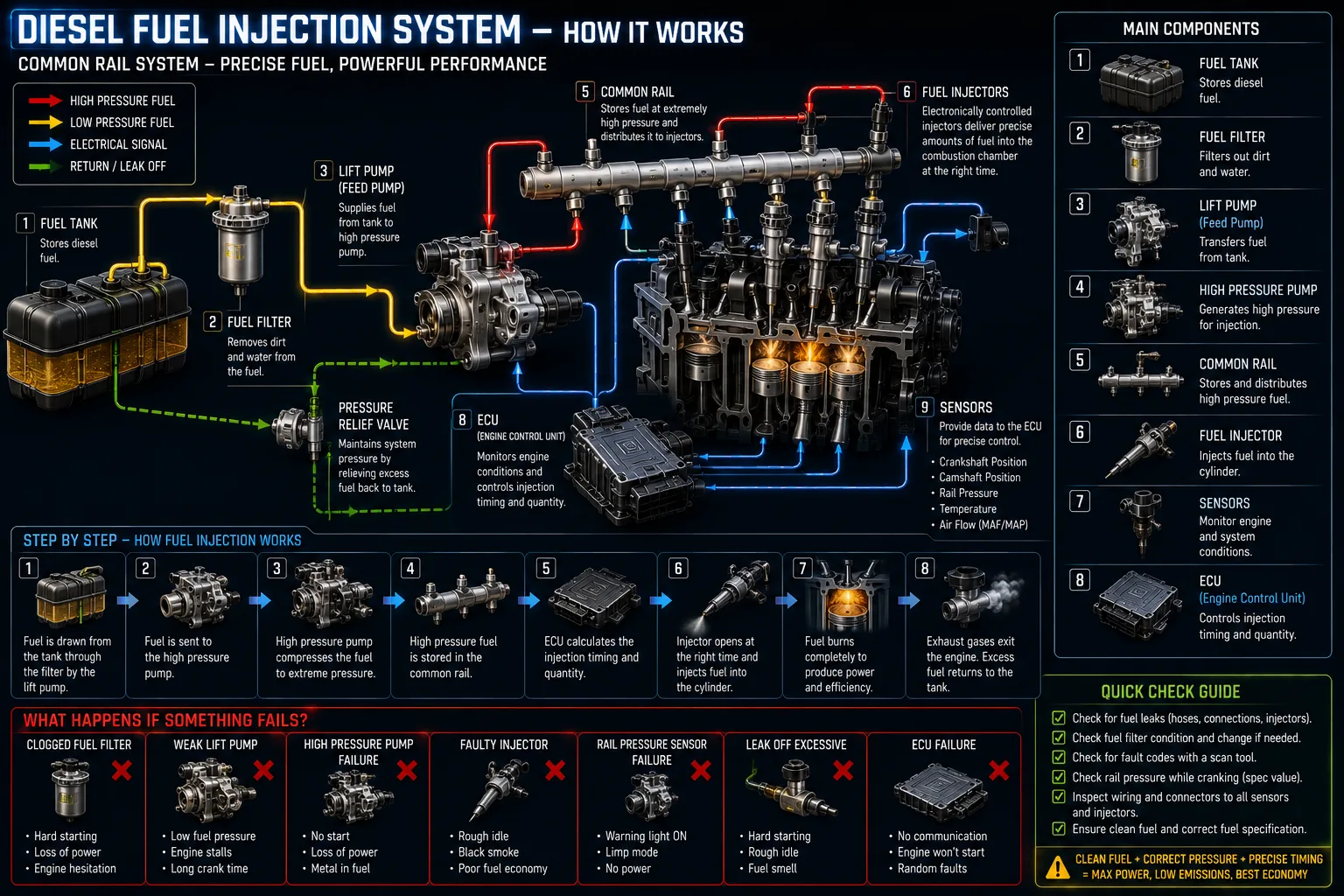
Diesel particulate filters accumulate soot. To burn that soot off, the engine runs a regeneration cycle — it injects extra fuel late in the combustion stroke to raise exhaust temperatures to around 550–600°C, hot enough to oxidise the soot into CO2. That works brilliantly on a 40-minute motorway run where everything gets properly hot and the regen completes before the engine switches off. On a short urban commute — nipping to Tesco, school run, quick trip to the office — the engine never gets up to full operating temperature. The regen either never starts, or more dangerously, starts and doesn't finish. The extra injected fuel doesn't fully combust. Instead, it migrates past the piston rings (which are slightly loose at cold operating temps) and drains into the sump oil. Do this repeatedly over weeks and months and you end up with oil that's 5%, 10%, even 15% diesel by volume. That might not sound dramatic until you understand that engine oil's entire job is to maintain a protective film between metal surfaces under enormous pressure. Diesel fuel is an excellent solvent. It dissolves that film. Bearings, cam lobes, and cylinder walls then experience metal-on-metal contact at thousands of RPM. The other risk — less common but spectacular when it happens — is diesel runaway, where diluted oil in the sump becomes combustible enough to act as fuel itself, causing uncontrolled engine over-revving. That one ends very badly indeed.
“Congratulations — your diesel engine has been quietly mixing fuel into its own oil, a charming process known as oil dilution.”
Sound familiar?
So what's behind it?
What we do — at your door
We come to you — driveway, car park, wherever the car is sitting with its quietly deteriorating oil — and start with a proper diagnosis rather than a guess. First we pull the dipstick and check the actual oil level and smell it. Not glamorous, but diagnostic. Then we plug in professional-grade scan equipment to read live DPF data: soot loading percentage, regen status, how many regens have completed versus how many were aborted, and accumulated fuel injected into the sump since the last oil change. That number, when it exists in the data, is particularly illuminating. We check injector coding to look for balance rate deviations that suggest a leaking or over-fuelling injector. We check coolant temperature live data to rule out a faulty thermostat. We look at EGR operation. We assess whether the DPF itself is genuinely blocked (requiring a forced regen or professional clean) or simply never getting the opportunity to complete a passive regen because the car lives a very short-journey life. Based on all of that, we give you an honest recommendation — whether that's a forced DPF regeneration, injector testing, a thermostat replacement, an oil change with the correct diesel-spec oil, or a frank conversation about whether a diesel engine suits your actual driving pattern. We don't quote parts before we've done the diagnosis. We find out what's wrong first.
What affects the price
Cost varies significantly depending on what's actually causing the dilution. A forced DPF regeneration using professional software sits at the lower end. Injector testing and replacement ranges from modest to considerable depending on whether one injector has failed or several are contributing. A thermostat replacement is typically straightforward. If the oil has been badly diluted for an extended period and bearing wear is suspected, that diagnostic changes the conversation entirely — compression testing and oil pressure assessment become relevant. An honest oil change with quality long-life diesel-spec oil (typically 5W-30 or 0W-30 to manufacturer spec — not whatever was cheapest at Halfords) is part of any fix. We don't quote made-up price ranges because they're only ever accurate for someone else's car. What we can tell you is that diagnosing and fixing this now costs meaningfully less than replacing an engine that wore out because nobody noticed the oil was thinning.
Random knowledge you didn't ask for
Questions you're probably asking
My oil level is above max but I haven't added any oil — is this definitely diesel dilution?
It's the most likely culprit on a diesel that does short journeys, but it's not the only possibility. A failed head gasket can allow coolant into the oil (you'd also notice coolant levels dropping and possibly a mayonnaise-like residue under the oil cap). However, oil smelling of diesel combined with a rising level on a short-trip diesel is oil dilution until proven otherwise. Get it diagnosed rather than guessing — the fix depends entirely on the cause.
Can I just change the oil and carry on driving?
You can, and it'll fix the immediate problem — for a while. But if the underlying cause (failed regen cycles, leaking injector, thermostat fault) isn't addressed, the new oil will dilute again, possibly faster. You'd also be resetting the DPF soot counter without actually clearing it if the DPF is blocked. Changing the oil without diagnosing why it diluted is the automotive equivalent of mopping the floor with the tap still running.
I only do short journeys — can I still run a diesel?
Honestly? With some effort, yes. You need to take the car on a regular 30-40 minute motorway run at least once a week — not optional, not occasional, genuinely part of owning a DPF-equipped diesel. Some owners set a calendar reminder. That forced extended run lets passive DPF regeneration complete and keeps oil dilution manageable. If that's not realistic for your lifestyle, a petrol or hybrid might genuinely suit you better. We'll tell you that straight, because selling you a diagnosis on a car that's fundamentally the wrong tool for the job doesn't help anyone.
How often should I change the oil if I have this problem?
Far more frequently than the manufacturer's service interval assumes — because that interval was calculated for a car that does mixed driving and completes its regen cycles. If your car regularly fails to regen, annual oil changes are too infrequent. Every 5,000–6,000 miles or six months (whichever comes first) is a sensible approach until the root cause is fixed. Use the correct manufacturer-specified diesel-spec oil — typically a low-SAPS 5W-30. The spec is on the oil filler cap or in the handbook.
Is diesel runaway actually a real risk or just an internet horror story?
It's real, though not common. It requires the oil to be significantly diluted and the crankcase vapour system to be ingesting fumes into the air intake — conditions that develop over an extended period of neglect rather than a few short trips. The risk rises sharply once oil dilution exceeds around 8-10% and the car is under load. It's not a reason to panic about one missed regen, but it is a reason to address persistent oil dilution promptly rather than watching the dipstick climb and hoping for the best.
Diesel Oil Dilution — sorted at your door
Stop procrastinating. Get a transparent quote and we'll come to you.