Your Wheels Are Having an Argument: How Tracking Gets Them Back on Speaking Terms
Wheel alignment — also called tracking, because the British motoring world decided one name wasn't confusing enough — is the precise art of making sure all four wheels point in the same direction and sit at the angles the manufacturer intended. Not the angles they've drifted to after you clipped a kerb at 4mph while parallel parking in front of witnesses, and definitely not the angles your suspension settled into after that pothole swallowed your front-left on the A-road you've been avoiding ever since. When alignment goes wrong, the car starts to have opinions. It wants to veer left. Your steering wheel sits at a slight tilt even when you're going dead straight. And your tyres — which you paid actual money for — quietly destroy themselves from the inside edge outward, wearing unevenly in ways that neither look right nor feel right. SOSCarFix comes to you, sorts the geometry, and saves you from a perfectly preventable tyre replacement happening six months too early.
See our upfront pricingCar pulling left, steering wheel on the wonk, tyres chewing themselves? Mobile wheel alignment across the UK — we come to you. Get a quote today.
How it actually works
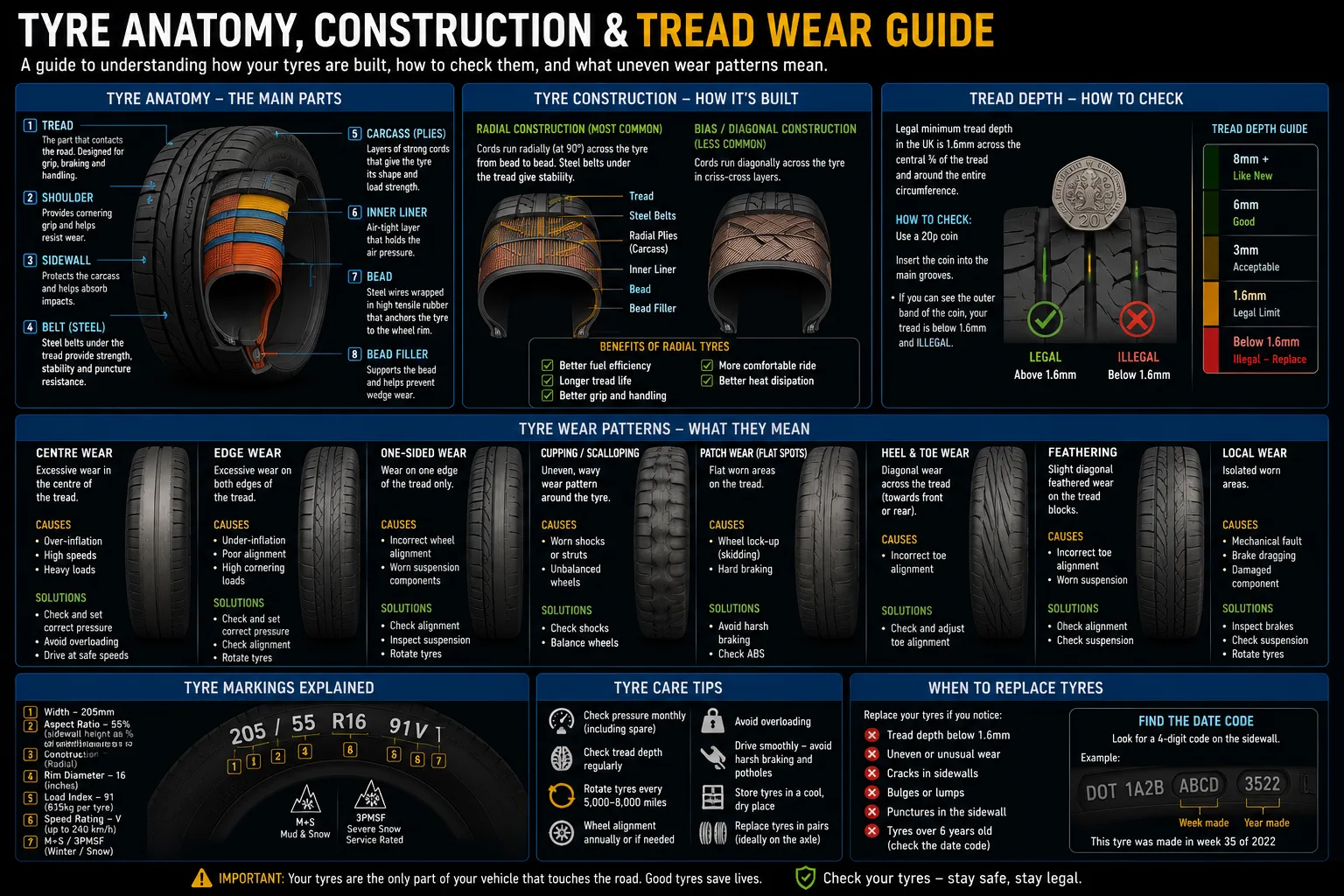
Wheel alignment is geometry, and geometry doesn't care about your feelings. Each wheel has three key angles: toe (whether the front of the tyre points inward or outward relative to the car's centreline), camber (whether the wheel leans in or out when viewed from the front), and caster (the angle of the steering axis, which primarily affects steering feel and straight-line stability). Every car manufacturer specifies the exact values for all three, and those values are set to balance tyre wear, steering response, and handling stability. When one or more of those angles drifts — as they do, because you live in a country with the road surface of a dried riverbed — the tyres stop rolling cleanly and start scrubbing. Toe-out, for instance, means each front tyre is trying to roll away from the other; the resulting friction heats the rubber on the inner edges and shreds it. Camber that's gone negative beyond spec wears the inner shoulder. A mismatched caster on one side makes the car pull relentlessly toward that wheel. A proper alignment check reads all these angles with calibrated equipment, compares them to the manufacturer's tolerances, and adjusts the rods and joints that actually control those angles — most commonly the track rod ends and toe adjustment on the front axle. On cars with adjustable rear geometry, the back gets done too. You get a before-and-after printout showing the numbers, because showing the numbers is how you know it's been done properly rather than just eyeballed.
“Your steering wheel sits at a slight tilt even when you're going dead straight.”
Sound familiar?
So what's behind it?
What we do — at your door
SOSCarFix is a mobile operation, which means the alignment check comes to you — driveway, office car park, or the flat bit of road outside your house that passes for level. We use calibrated 3D alignment equipment, not a bloke squinting down the side of your car with a tape measure (that's not alignment, that's optimism). The process involves attaching targets to all four wheels, taking initial angle readings against your car's manufacturer specification, adjusting the adjustable components — most often the front toe via the track rod ends, and rear toe where geometry permits — and confirming final readings. You get a printout showing the before and after values so you can see what was wrong and what it's now set to. If we spot worn components that are causing the misalignment — knackered track rod ends, for instance — we'll tell you honestly, because chasing alignment on worn parts is a waste of everyone's afternoon. We don't invent problems or pad the job. We fix what needs fixing, check our work, and let you get back to driving straight.
What affects the price
Wheel alignment in the UK typically varies based on whether you're having a two-wheel (front axle only) or four-wheel alignment, the type of car (standard saloon or hatchback versus a wider-track performance car or 4x4 with complex rear geometry), and whether any components need replacing to allow the adjustment in the first place — a seized track rod end or a worn adjuster bolt makes alignment impossible until the part is renewed. Independent and specialist workshops tend to charge differently from franchise chains, and mobile pricing reflects the convenience of not being asked to sit in a waiting room watching daytime television. The biggest hidden cost of not doing alignment isn't the alignment job itself — it's the pair of tyres you'll replace prematurely because the car was running at the wrong angle for eight months. A decent set of tyres costs multiples of an alignment check; the maths is not complicated.
Random knowledge you didn't ask for
Questions you're probably asking
How often should I get a wheel alignment check in the UK?
Most manufacturers suggest every 12 to 18 months, or whenever you fit new tyres — because putting fresh rubber on a car with drifted geometry is like buying new shoes and then walking on the sides of your feet. After any significant kerb or pothole impact, sooner. There's no legal MOT requirement for alignment itself, but badly worn tyres caused by misalignment can result in an MOT failure on tyre condition.
Will a wheel alignment fix my car pulling to one side?
Often, yes — but pulling to one side has a few potential causes, and alignment is the most common. Unequal tyre pressures (easy to check first, free to fix) can cause mild drift. A significantly worn tyre on one side can pull. And occasionally a brake calliper that's binding slightly on one side will drag the car toward it. A proper alignment check will reveal whether geometry is the culprit or whether something else needs investigating.
Can you do wheel alignment if my car has been lowered?
Yes, but with a caveat: lowering a car changes ride height and therefore camber and caster angles. Whether those angles can be corrected back to spec depends on whether the car has adjustable top mounts, camber bolts, or adjustable control arms. Some lowered cars are running geometry that physically cannot be fully corrected without additional adjustable components. We'll tell you honestly what's achievable rather than charging you for an alignment that can only get partway there.
My steering wheel is crooked but the car drives straight — does that need fixing?
Yes. A crooked steering wheel usually means the toe is set correctly on one side but not the other, or that a previous alignment was done without properly centering the steering rack first. It looks daft, it'll catch you out the moment the road camber changes, and it's the sort of thing that niggles indefinitely if not sorted. It's also the kind of detail a proper alignment check catches and corrects as standard.
Do I need four-wheel alignment or just the front?
If your car has a fixed rear axle (many older or simpler vehicles do), there's nothing to adjust at the back and front-axle alignment is all that's needed. If you have independent rear suspension — which most modern cars do — four-wheel alignment is worth doing because rear toe affects how the car tracks at motorway speeds and how the front alignment actually needs to be set to compensate. We'll advise which applies to your specific car before we start.
What causes uneven tyre wear?
Usually misaligned wheels — if your car's pulling to one side or your steering wheel sits off-centre, your tyres are scrubbing the road at a slight angle instead of rolling cleanly. The result is uneven wear across the tread, sometimes feathering on the inner or outer edge. Knackered suspension components, potholes (cheers, British roads), and even a minor kerb clip can all knock your alignment out. Left unchecked, you'll bin a set of tyres in half the time. Get the alignment checked and you'll sort the wear before it costs you more than it should.
Your Wheels Are Having an Argument — sorted at your door
Stop procrastinating. Get a transparent quote and we'll come to you.