Puncture Repair: Because Life's Too Short to Call the AA and Wait Three Hours in a Layby
A flat tyre is one of those uniquely miserable experiences that manages to be both completely mundane and completely ruinous at the same time. It's never a flat tyre in your driveway on a sunny Saturday morning. It's always at 7:45am in the rain outside an industrial estate in Basildon when you've got a meeting at nine. Here's the thing your average garage doesn't advertise: not every puncture needs a new tyre, and not every puncture CAN be repaired — legally. There's a British Standard for this (BS AU 159, since you asked) that governs exactly what's repairable and what isn't, and frankly the industry has been winging it for decades. SOSCarFix comes to wherever your unfortunate car is sitting — driveway, car park, roadside, the Tesco Express that's definitely not open yet — assesses the puncture properly, and either repairs it correctly or tells you straight that you need a new tyre. No upsell, no drama, no three-hour wait.
See our upfront pricingFlat tyre at home, work or roadside? SOSCarFix assesses, repairs or replaces on the spot — BS AU 159 compliant, no garage faff. Get a quote today.
How it actually works
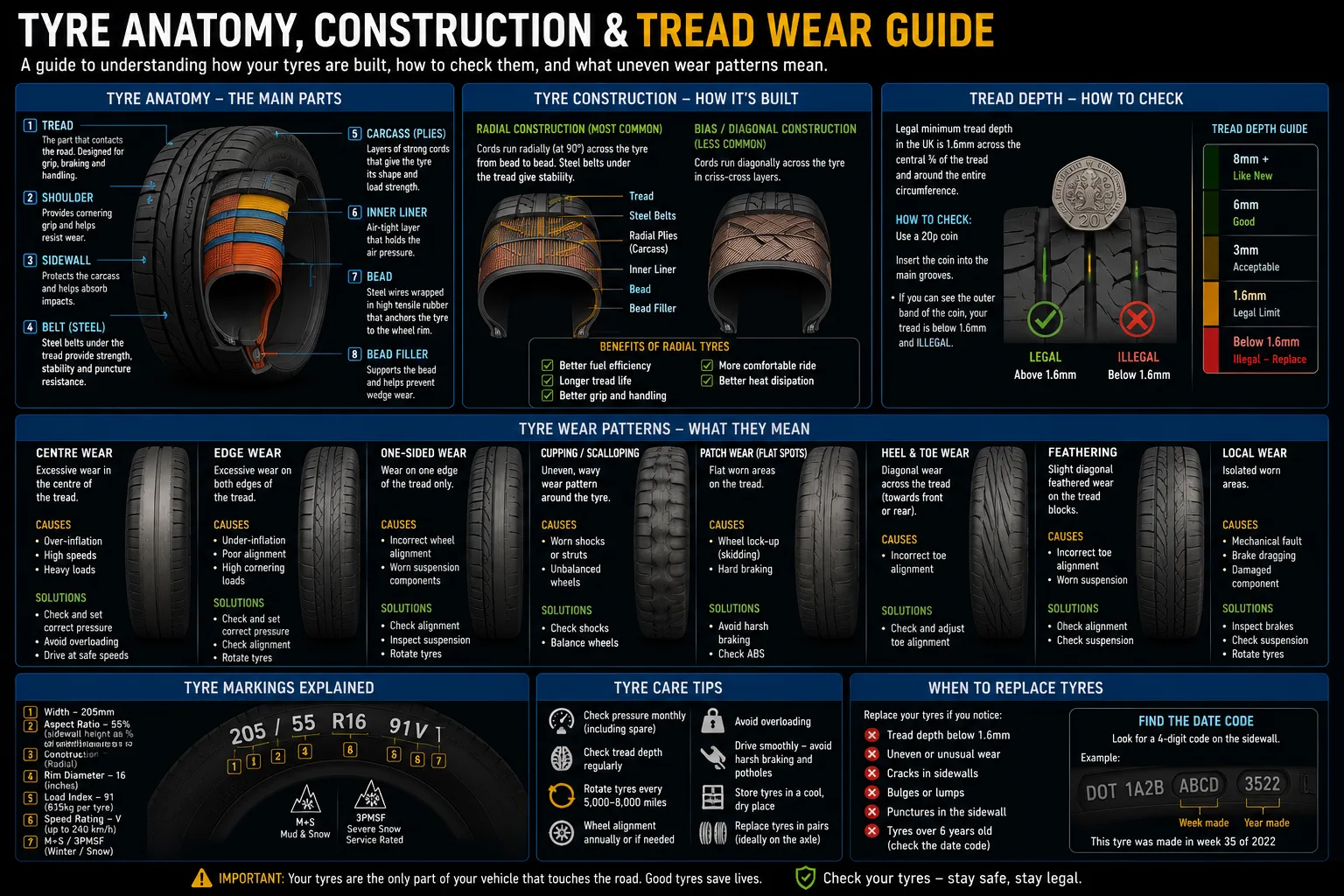
Puncture repair sounds simple — pull the nail out, shove something in the hole, done. Except if that's what your local tyre shop is doing, they're fitting a plug-only repair, which is fine for getting home and not fine as a permanent fix under BS AU 159. The correct repair for a puncture in the legally repairable zone is a mushroom patch (also called a patch-plug or combination repair): the tyre comes off the rim, the inner liner is inspected, the hole is prepared and sealed from inside with a vulcanising patch, and the stem of the patch passes through and is trimmed flush on the outside. The result is airtight, structurally sound, and — crucially — legal for continued road use. Where it gets complicated is the rules about where on the tyre a puncture can be repaired. The central tread zone (the inner three-quarters of the tread area, no closer than 25mm from either shoulder) is the only repairable zone. Anything in the shoulder, sidewall, or within that 25mm exclusion zone is a bin job — no exceptions, no matter how much you paid for the tyre last month. Damage larger than 6mm in diameter is also non-repairable. Two or more punctures closer than 40mm apart? Same answer. These aren't arbitrary rules — a sidewall repair can fail catastrophically at speed because sidewalls flex constantly, and a patch in that zone will eventually work loose. We assess your specific puncture against these criteria before we touch anything, and if it's non-repairable, we'll tell you why rather than just charging you for a new tyre and hoping you don't ask questions.
“It's always at 7:45am in the rain outside an industrial estate in Basildon when you've got a meeting at nine.”
Sound familiar?
So what's behind it?
What we do — at your door
We come to your location — driveway, car park, office, roadside — with the equipment to assess and repair your puncture properly. We inspect the damage, confirm whether it falls within the BS AU 159 repairable zone (central tread, no larger than 6mm, not within 25mm of the shoulder, not previously repaired in the same area), and if it's repairable, we remove the wheel, demount the tyre, prep and vulcanise a mushroom patch from the inside, remount, balance, refit, and set your pressures correctly. If the puncture is non-repairable — sidewall damage, too close to the shoulder, too large, or a second repair in the same tyre — we tell you straight and, if you need a replacement tyre, we can supply and fit one on the spot. We also check the valve condition while we're at it, because half of what people call slow punctures is actually a perished valve that costs about £3 to sort. No garage. No wait. No recovery truck. We turn up, we fix it, you drive away.
What affects the price
Puncture repair cost in the UK varies based on a few honest factors: a standard mushroom patch repair on a regular passenger car tyre is genuinely one of the cheaper things we do, but the price changes if you're running run-flat tyres (which cannot be repaired once driven on flat, so you're looking at replacement), low-profile performance rubber (more fiddly to demount without damaging the wheel), or TPMS sensors that need relearning after the wheel comes off. A valve replacement is usually minimal cost for a standard rubber valve, but if you have a TPMS sensor-equipped valve the sensor itself can be significantly more expensive. If the puncture is not repairable, you're looking at a replacement tyre, and cost varies enormously by size and brand — budget rubber and premium rubber are both legal, but they don't perform the same in the wet. We'll give you honest options without pretending budget tyres are dangerous or that you need a premium set when a decent mid-range would serve you perfectly well. Callout cost, repair or replacement, and VAT are all quoted upfront. No surprises on the invoice.
Random knowledge you didn't ask for
Questions you're probably asking
Can every puncture be repaired?
No, and anyone who tells you otherwise is either misinformed or just selling you a repair they shouldn't. Under BS AU 159, a puncture is only repairable if it's in the central three-quarters of the tread, no closer than 25mm from the shoulder, no larger than 6mm in diameter, and isn't joining forces with another nearby puncture. Sidewall damage, shoulder punctures, and impact damage to the inner liner are all non-repairable — full stop. A tyre in that condition needs replacing.
What's a slow puncture and why is mine not going flat properly?
A slow puncture is usually caused by a small nail or screw that partially seals itself in the tread, a valve core that's slightly loose or perished, or a bead seal that's weeping air around the rim. The tyre loses pressure gradually over hours or days rather than immediately. It's tempting to just keep topping it up — and plenty of people do, for months — but you're driving on a tyre that's intermittently under-inflated, which damages the sidewall structure over time. Sort it properly.
I've still got the nail in the tyre. Should I pull it out?
Please don't. That nail is currently acting as its own bung. Remove it and you go from a slow puncture to a rapidly very flat tyre. Leave it exactly where it is, drive as little as possible, and let us come to you. We'll remove it in a controlled environment where we can immediately begin the repair process rather than watching your tyre empty itself onto your driveway while you hold a nail and regret your choices.
My tyre has a bulge on the sidewall — is that a puncture?
No, a sidewall bulge is not a puncture and it cannot be repaired. It means the internal cord structure of the tyre has broken — usually from a pothole impact or kerb strike — and the inner liner is all that's holding the air in. That's not a repair situation, that's a 'replace before it blows at speed' situation. A bulging tyre is also an MOT failure and technically an offence to drive on. Get it replaced. We can supply and fit a replacement wherever you are.
My car has run-flat tyres. Can they be repaired after a puncture?
Almost certainly not, if you've driven on them. Run-flats can sustain limited low-speed driving when flat — that's the point — but the internal reinforced sidewall takes significant heat and stress damage in the process. Most tyre manufacturers explicitly state their run-flats are non-repairable after zero-pressure use. If you caught the puncture immediately and didn't drive on it at all, there's a small chance it's still within repair limits, but realistically you're looking at a new tyre. The trade-off for not needing a spare wheel is paying for replacements rather than repairs.
Puncture Repair — sorted at your door
Stop procrastinating. Get a transparent quote and we'll come to you.