Your Tyre Tread Is Illegal: What 1.6mm Actually Means (And Why 3mm Is the Honest Answer)
Tyres are the only part of your car that actually touches the road — four palm-sized contact patches doing an enormous amount of work involving grip, water dispersal, steering and not dying. And yet the UK legal minimum is 1.6mm of tread across the central three-quarters of the tyre's width. That is roughly the thickness of a two-pound coin rim, and at that depth your tyre has already been in a long, slow decline for the last few months. The government mandates 1.6mm because below it you have statistically crossed into genuinely alarming stopping-distance territory. Most tyre professionals quietly set their personal limit at 3mm — the point where wet-weather performance starts to fall off the cliff. SOSCarFix will come to your driveway, check your tread properly, and fit new tyres on the spot. No garage, no booking a courtesy car, no sitting in a waiting room smelling of old coffee.
See our upfront pricing1.6mm is the law. 3mm is where your brakes start lying to you. Check your tread, avoid a £2,500 fine, and get SOSCarFix to sort it at your door.
How it actually works
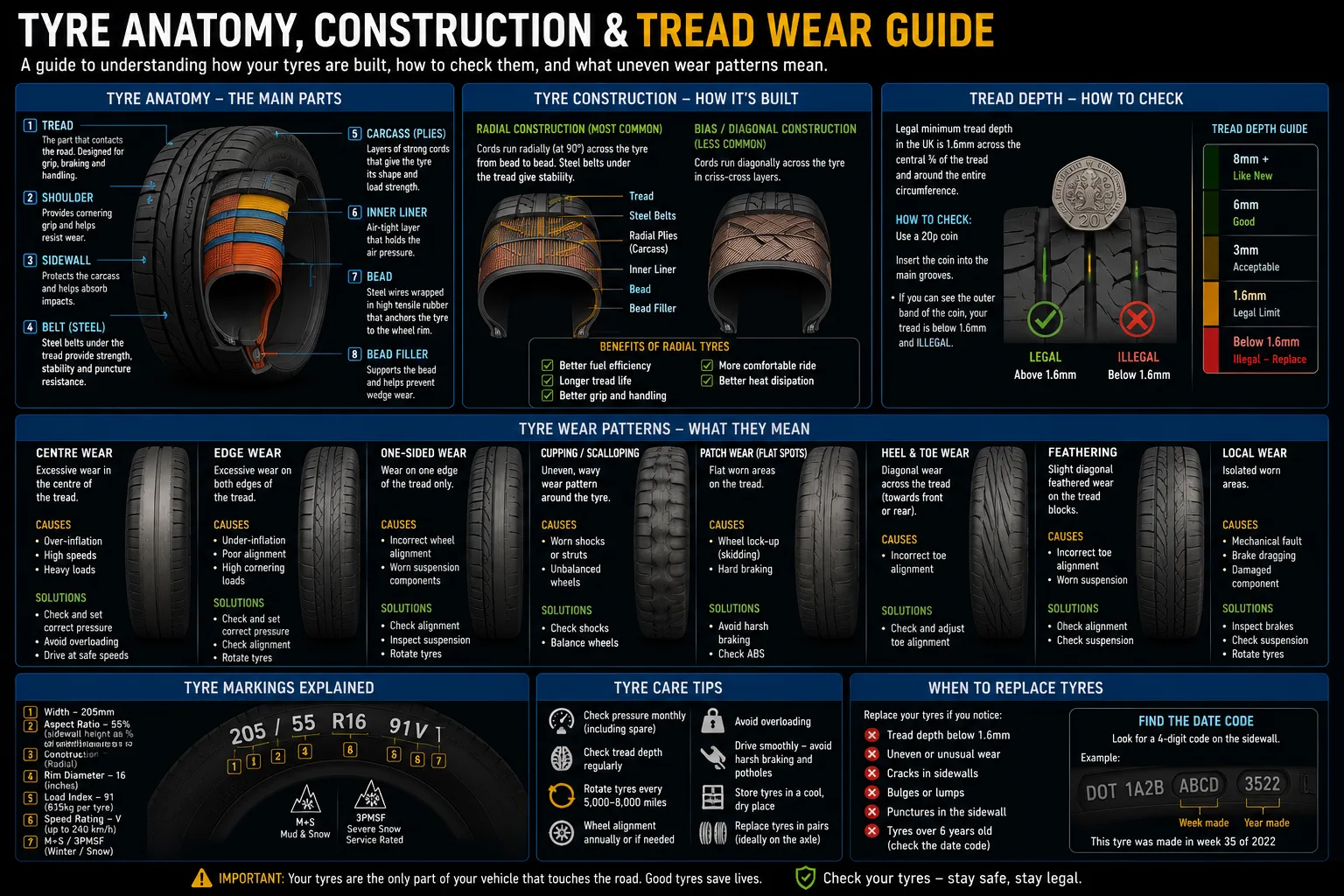
A tyre tread is not just grippy texture for aesthetics. Those channels — the circumferential grooves running around the tyre — exist to displace water. At motorway speed in wet weather, each tyre needs to shift roughly a bucketful of water per second from between the rubber and the road surface. If the channels are too shallow to do that, a layer of water builds under the tyre and you lose contact with the tarmac entirely. That is aquaplaning — a properly terrifying moment where the steering goes light and you become a passenger. UK law (Road Vehicles [Construction and Use] Regulations 1986, since you asked) requires a minimum of 1.6mm of tread depth across the central three-quarters of the tyre's width, all the way around the circumference. New tyres start life at around 7–8mm. The wear indicators — small rubber bridges moulded into the main grooves — sit at exactly 1.6mm; if your tread is flush with them, you are at the legal limit. The 20p test is the well-known rough check: push a 20p coin into the main groove. The outer band of a 20p is roughly 2–3mm wide. If you can see the outer rim of the coin above the tread, you are at or below the legal limit and should not be driving on that tyre. It is quick, it is free, and it is something you could do right now in the car park.
“6mm because below it you have statistically crossed into genuinely alarming stopping-distance territory.”
Sound familiar?
So what's behind it?
What we do — at your door
We come to you — driveway, work car park, wherever the car is sitting — and check all four tyres with a calibrated tread depth gauge (not just the 20p, though that works fine as a heads-up). We measure the central three-quarters at multiple points across the width and around the circumference, note any uneven wear patterns that might indicate an underlying issue like alignment or suspension wear, check tyre age (the DOT code gives you the week and year of manufacture — tyres over 5–6 years old often need replacing regardless of tread), and give you a straight assessment. If tyres need replacing, we carry stock or source the size you need and fit them on the spot, torquing the wheel bolts to the correct specification. If we spot uneven wear pointing to a tracking or suspension issue, we'll tell you what to look at next — rather than fitting fresh tyres onto a car that will eat them again in six months.
What affects the price
Tyre prices vary enormously by size, speed rating, and brand tier. A budget tyre in a common size (e.g. 205/55 R16) will cost considerably less than a premium brand in the same size, and very low-profile, run-flat or larger SUV/4x4 sizes cost significantly more. Premium brands (Michelin, Continental, Bridgestone, Pirelli) typically cost more upfront but often outperform cheaper alternatives in independent wet-braking tests — sometimes by several car lengths at 50mph, which is worth bearing in mind. Fitting, valve replacement and old-tyre disposal fees apply on top. If your car also needs a wheel alignment reset after fitting — and it often should, especially if uneven wear was the reason you needed new tyres — that is a separate job. We will quote for everything before we start.
Random knowledge you didn't ask for
Questions you're probably asking
What is the exact UK tyre tread legal limit?
1.6mm across the central three-quarters of the tyre's width, measured continuously around the full circumference. It applies to cars, light vans and trailers. Motorcycles have their own rules. Below 1.6mm anywhere in that zone and the tyre is illegal — not 'approaching illegal', not 'borderline' — illegal, right now, £2,500 and three points per corner if you are stopped.
Is 2mm of tyre tread OK to drive on?
Legally, yes — 2mm is above the 1.6mm minimum. Practically, not really. At 2mm your wet-weather stopping distances are already significantly longer than a tyre with 4mm or more. Most tyre professionals use 3mm as their working replacement threshold in the UK because we get wet roads roughly eleven months a year and the performance drop from 3mm to 1.6mm is measurable and real. If you are at 2mm, you should be planning replacement now, not watching it hit 1.6mm.
Can a car fail its MOT for tyre tread?
Absolutely — and it is one of the more common MOT failure points. A tyre at or below 1.6mm is an automatic fail. So is a tyre with a cut, bulge, lump, exposed cord or ply, or any damage to the sidewall. The tester will also fail a tyre that is the wrong size or speed rating for the vehicle, or where different types of construction (radial vs cross-ply) are mixed on the same axle.
What does uneven tyre wear actually mean?
It means something upstream is wrong. Centre wear = tyre has been over-inflated. Edge wear = under-inflated. One-sided wear = tracking (wheel alignment) is out, or a suspension component is bent or worn. Feathering = alignment issue. Cupping or scalloping = a worn shock absorber. Fitting new tyres without fixing the root cause just means you will destroy the new tyres too, probably faster. We note wear patterns and flag what to investigate.
How long does a mobile tyre fitting take?
A single tyre is typically 20–30 minutes on your driveway. A full set of four is usually done in under 90 minutes. The car does not need to go anywhere — we bring the equipment to you, including the tyre changing machine for the bead, a balancing setup, and a torque wrench for correct wheel bolt tightening. You carry on with your day.
Your Tyre Tread Is Illegal — sorted at your door
Stop procrastinating. Get a transparent quote and we'll come to you.