Mobile Tyre Fitting: New Rubber, Zero Garage Faff
Tyres are the only part of your car that actually touches the road — four contact patches roughly the size of your hand, each one doing the braking, steering and grip that keeps you pointing the right direction at speed. They are also, consistently, the part of the car people leave until they're dangerously bald, visibly cracked, or literally flat. At which point, the traditional solution involves calling a tyre centre, booking an appointment, driving there on a rim you shouldn't be driving on, sitting in a waiting area watching daytime television, and parting with money while someone tries to upsell you a wheel alignment package. SOSCarFix does it differently. We bring the tyres to you — your driveway, your office car park, or the very layby you've limped into — fit them properly, balance them correctly, and disappear. No appointment-only faff, no upselling theatre, no daytime television.
See our upfront pricingPuncture, blowout, or illegal tread? We bring the tyres to you — driveway, office, or roadside. Fitted, balanced, sorted. Get a quote now.
How it actually works
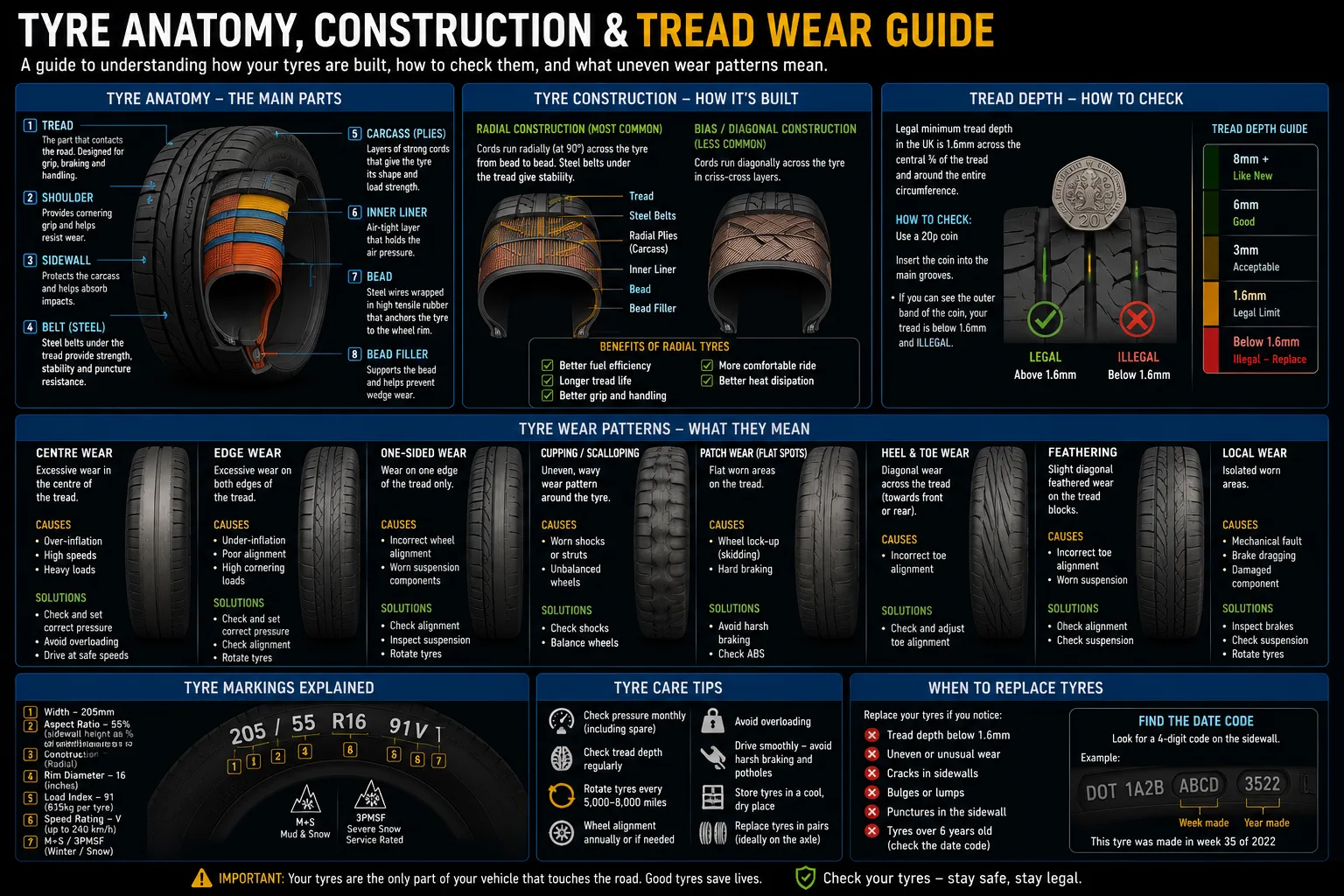
A tyre is a reinforced rubber carcass — layers of fabric and steel belts bonded to a rubber compound — inflated to a specific pressure so it forms the correct contact shape with the road. The tread pattern is not decorative: it channels water away from the contact patch to prevent aquaplaning. As the tyre wears, the tread gets shallower. In the UK, the legal minimum tread depth is 1.6mm across the central three-quarters of the tyre, around the full circumference. Below that, stopping distances increase sharply in the wet, you face a fine of up to £2,500 per tyre, and you'll fail your MOT. Most tyre manufacturers consider 3mm to be the genuinely safe limit in British weather — the last millimetre and a half of legal tread performs notably worse than fresh rubber in the wet. When we fit a new tyre, we demount the old one, check the wheel rim for damage or corrosion (both of which cause air loss), mount the new tyre using the correct equipment, and then balance the wheel — adding small weights to counteract any slight weight imbalance that would otherwise cause vibration through the steering at motorway speeds. A tyre that's fitted but not balanced is a tyre fitted badly. We don't do that.
“They are also, consistently, the part of the car people leave until they're dangerously bald, visibly cracked, or literally flat.”
Sound familiar?
So what's behind it?
What we do — at your door
We arrive at your location — driveway, office car park, roadside layby, or wherever the car has ended up — with the right tyres already loaded. You tell us the size, we source the correct replacement in the brand and compound that suits your car and budget; if it's an emergency, we carry a range of common sizes. We demount the old tyres using proper mobile tyre equipment (not improvised leverage and hope), inspect the wheel rim for damage, corrosion or any reason it might not hold a seal, mount the new tyre, inflate it to the manufacturer's specification (which is printed in your door sill or handbook, not 32psi across the board), and then balance the wheel with a calibrated balancer before it goes back on the car. We check and reset TPMS sensors where fitted, and if you have a locking wheel nut, we'll need the key — or a quiet word about that situation. Old tyres get taken away with us for proper disposal. If the job is a simple puncture and the tyre qualifies for repair under British Standard BSAU159 (puncture in the central three-quarters of the tread, no bigger than 6mm, no previous inadequate repair), we'll patch it from inside the tyre correctly rather than immediately suggesting a new one. Because that's what's actually warranted.
What affects the price
Tyre cost in the UK varies enormously and is driven by a few honest factors: the tyre size (a 235/35 R19 costs considerably more than a 185/65 R15 because there is simply more material and the manufacturing is more precise), the brand and compound (budget tyres from brands you've never heard of are cheaper upfront and genuinely perform worse in independent wet-weather braking tests, sometimes by several car lengths; mid-range and premium brands — Michelin, Continental, Bridgestone, Pirelli and the tier below — cost more and stop shorter), and whether your car requires run-flat tyres, which carry a significant price premium over conventional equivalents. For performance and SUV sizes, expect a meaningful premium over standard family car fitments. Our mobile fitting charge covers coming to you, the fitting itself, balancing, and disposal of the old tyre — everything in one number, no "balancing is extra" small print. We'll always quote before we start and only proceed when you're happy. Locking wheel nut removal, TPMS sensor replacement, or a full alignment check are quoted separately if needed.
Random knowledge you didn't ask for
Questions you're probably asking
Can you really fit tyres at the roadside, or do I need to get the car somewhere?
We can and do fit tyres at the roadside — it's one of the most common reasons people call us. If you've had a blowout or a flat and you're in a safe-ish position (on a driveway, in a car park, or on a road with sensible clearance), we can bring the tyre to you and fit it on the spot. We'd strongly prefer you weren't on a live motorway hard shoulder — that's recovery-truck territory, not mobile-fitter territory.
How do I know what tyre size I need?
It's printed on the sidewall of your existing tyre in a format like 205/55 R16 91V — three numbers followed by a letter-and-number load and speed rating. If all four tyres are flat and you genuinely can't read it, it's also in your vehicle handbook and usually on a sticker inside the driver's door sill. Tell us your reg and we can look it up. Don't guess — fitting the wrong size creates speedometer errors, affects ABS calibration, and can cause handling problems.
My tyre has a nail in it — does it need replacing, or can it be repaired?
Possibly repaired, depending on where the nail is. UK standard BSAU159 allows repair of punctures in the central three-quarters of the tread, up to 6mm in diameter, with no previous dodgy repair on top. Punctures in the sidewall or outer shoulder cannot be safely repaired — the sidewall flexes too much for a patch to hold — and those tyres need replacing. We assess it properly before automatically suggesting a new tyre.
Do I need to replace tyres in pairs?
On the same axle, ideally yes — mismatched tyres (different brands, compounds, or significantly different wear levels) on the same axle create handling imbalances, particularly in emergency situations. If budget is the constraint, prioritise replacing the worst tyres first, but be aware that mixing a near-new tyre with a nearly-worn one on the front axle is less than ideal. We'll give you an honest assessment, not an automatic 'you need four' speech.
What's wrong with part-worn tyres?
They're cheap and that's genuinely about where the advantages end. UK Trading Standards investigations have repeatedly found that most part-worn tyres sold in this country have structural damage, previous inadequate repairs, or inadequate tread — and a significant proportion are sold illegally. The saving over a new budget tyre is often marginal. The tyre is the thing stopping you when something goes wrong at 70mph, and 'it was cheap' is a very unsatisfying thing to be thinking about in that moment.
Why is my tyre making a rhythmic thumping or wom-wom noise?
That pulsing, drum-like noise that speeds up with the car is nearly always a flat-spotted or out-of-round tyre — caused by hard braking, sitting still for months, or a tyre that was already worn unevenly. Could also be a failing wheel bearing (the noise won't change if you swap tyres) or a seriously unbalanced wheel. Either way, it won't sort itself out — a mobile tyre fitting visit can confirm whether it's a replacement job or something underneath that needs a garage look.
Mobile Tyre Fitting — sorted at your door
Stop procrastinating. Get a transparent quote and we'll come to you.