Your Tyres Are Older Than You Think: The Definitive Guide to Tyre Age, Date Codes and Dry Rot
Tyres are the only part of your car in contact with the road — four patches of rubber roughly the size of a postcard each — and most drivers treat them as an afterthought right up until they're not. Here's the uncomfortable truth: a tyre can look fine, have legal tread depth, pass a casual glance, and still be structurally compromised by age. The rubber compound degrades from the inside out, long before the cracks you'd notice on a Sunday morning. SOSCarFix comes to you — driveway, car park, office layby — checks the actual date codes stamped into the sidewall, inspects for cracking and perishing, and fits replacement tyres on the spot. No faff, no waiting for a tyre shop to squeeze you in.
See our upfront pricingYour tyres might have plenty of tread left and still be quietly killing you. We explain the DOT date code, the 5/10-year rules, and fit new ones at your door.
How it actually works
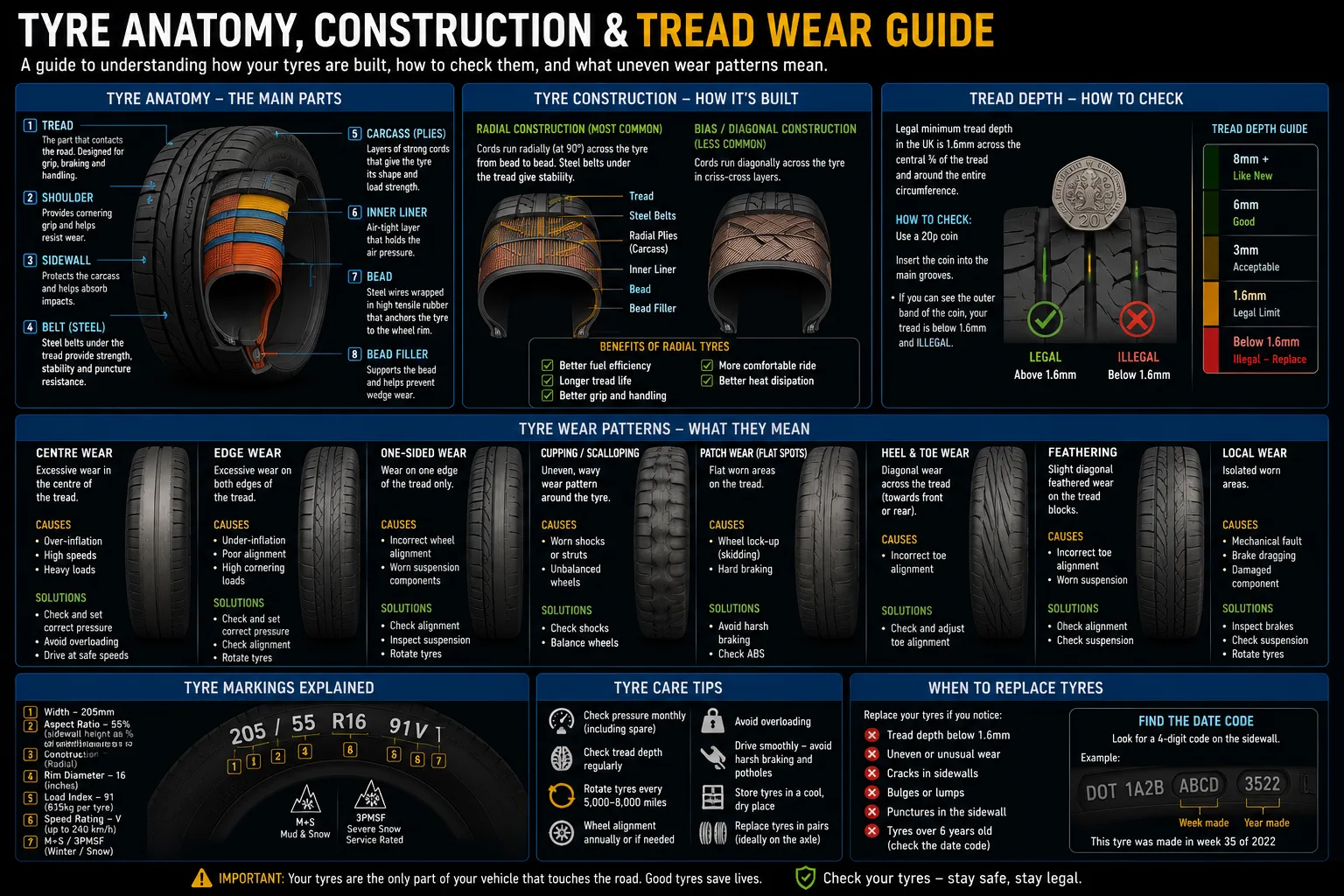
Every tyre made since 2000 carries a DOT (Department of Transportation) code on the sidewall — specifically, a four-digit week/year stamp at the end of the full DOT string. The first two digits are the week of manufacture; the last two are the year. So "2318" means the 23rd week of 2018 — that's June 2018. Find that code and you know exactly how old your rubber is, regardless of how new the car looks or how much tread remains. Why does age matter if the tread's fine? Because rubber is a polymer, and polymers oxidise and crack over time — accelerated by UV light, heat, ozone and the general indignity of British weather. The internal structure (the plies, belts and bead) can degrade before the outer surface shows obvious cracking. A tyre that's been sitting on a slowly-deflated spare for eight years might look presentable and still blow out on the motorway. The industry-standard guidance (followed by most manufacturers, the British Tyre Manufacturers' Association and tyre fitters) is: inspect from 5 years old; replace by 10 years regardless of tread depth or visual condition. Spare tyres are included in that count. Some manufacturers — notably Michelin and Continental — say 10 years is the absolute limit even with zero apparent wear. Others recommend 6 years as the inspection trigger and 10 as the hard stop. The MOT test doesn't have a specific age-based fail criterion, but an MOT tester can and should fail a tyre showing visible cracking or perishing that in their professional judgement compromises safety.
“The rubber compound degrades from the inside out, long before the cracks you'd notice on a Sunday morning.”
Sound familiar?
So what's behind it?
What we do — at your door
We come to you — wherever you and the car happen to be — and start by reading the DOT date codes on all four tyres plus the spare. We tell you exactly how old each one is and give you an honest assessment of their condition: tread depth measured with a gauge (legal minimum is 1.6mm across the central three-quarters of the tread; we recommend 3mm as the sensible replacement point), sidewall inspection for cracking and perishing, and a check for bulges or deformation. If replacements are needed, we fit them on site. No booking a tyre centre, no sitting in a waiting room watching daytime television, no being upsold a full four-tyre set when only two need doing. We tell you what's actually needed, we do it at your car, and we carry away the old rubber.
What affects the price
Tyre replacement cost depends on the size and specification of the tyre (a 195/65 R15 on a family hatchback is a very different price to a 275/35 R20 on something that didn't need to be that wide), the brand tier chosen (budget, mid-range or premium — we'll discuss the trade-offs honestly), and whether you need one tyre or an axle set. We don't invent prices here — tyre costs vary too much by size and market to quote ranges that would be meaningful. What we charge on top of the tyre itself is the mobile fitting labour: you're paying for us to come to you, which saves you the cost and inconvenience of getting the car to a tyre centre and back. We'll give you a clear itemised quote covering the tyre(s) and fitting before any work starts.
Random knowledge you didn't ask for
Questions you're probably asking
Does an old tyre fail an MOT automatically?
Not on age alone — the MOT test doesn't have a specific year-based fail criterion for tyres. However, an MOT tester can and should fail a tyre showing visible deterioration: cracking, perishing, bulging or any condition that in their professional judgement makes it unsafe. 'It's got loads of tread' is not a defence if the sidewall is crazing. Age-related deterioration is grounds for a defect advisory or outright rejection — the tester's call.
How do I find the date code on my tyre?
Look for the DOT code on the sidewall — it's a string starting with 'DOT' followed by alphanumeric characters. The last four digits are what you want: week number then year. So '1421' means the 14th week of 2021, which is April 2021. It's sometimes on the inner-facing sidewall rather than the outer, so you might need to crouch down and look past the wheel. We check all four plus the spare as standard.
My tyres look fine and have loads of tread — do I really need to replace them based on age?
Yes, honestly. Tread depth is a legal minimum, not a safety guarantee. Aged rubber loses grip, particularly in the wet, and the internal structure can degrade long before the outside looks alarming. Tyre manufacturers, the BTMA and most tyre industry bodies say 10 years is the hard limit regardless of visual condition. Beyond that, you're gambling on a component that has four contact patches between you and the road — a fairly modest place to cut corners.
What about nearly-new tyres on a second-hand car?
This is the trap. A car with 15,000 miles on the clock might appear to have plenty of life left in the tyres — but if it's a 12-year-old car and the tyres are original, the maths still doesn't work in your favour. Always check the DOT code when buying second-hand. If the previous owner didn't know how old the tyres were, they probably didn't know to check either.
Does the spare tyre age the same way as tyres in use?
Yes — sometimes faster. A spare tyre that's been sitting in the boot, possibly underinflated and out of sight for years, has been cooking in heat and isn't getting the slight conditioning benefit of regular use. Most people never check the spare. Check it. It's the tyre most likely to be oldest, and also the one you'll need in an emergency, at night, in the rain, on the hard shoulder of the M20.
Your Tyres Are Older Than You Think — sorted at your door
Stop procrastinating. Get a transparent quote and we'll come to you.