Vacuum Leaks: The Engine Fault That Thinks It's Invisible
Air is supposed to enter your engine through one route only: past the air filter, past the mass airflow sensor, through the throttle body, and into the intake manifold. Every milligram of it gets measured so the ECU can add precisely the right amount of fuel. A vacuum leak is an uninvited extra air inlet — a crack in a hose, a perished gasket, a brake servo weeping — and the engine has absolutely no idea it's there. The result is a fuel mixture that's permanently lean, an idle that hunts or runs high, fault codes that point everywhere at once, and mechanics who replace parts while the real culprit quietly hisses in the corner. SOSCarFix brings a smoke machine and the right diagnostic method to your driveway, finds the leak, and fixes it — without you ever visiting a garage.
See our upfront pricingHissing, hunting idle or a P0171 lean code? SOSCarFix finds vacuum leaks with a smoke test and fixes them at your door. No garage needed — get a quote.
How it actually works
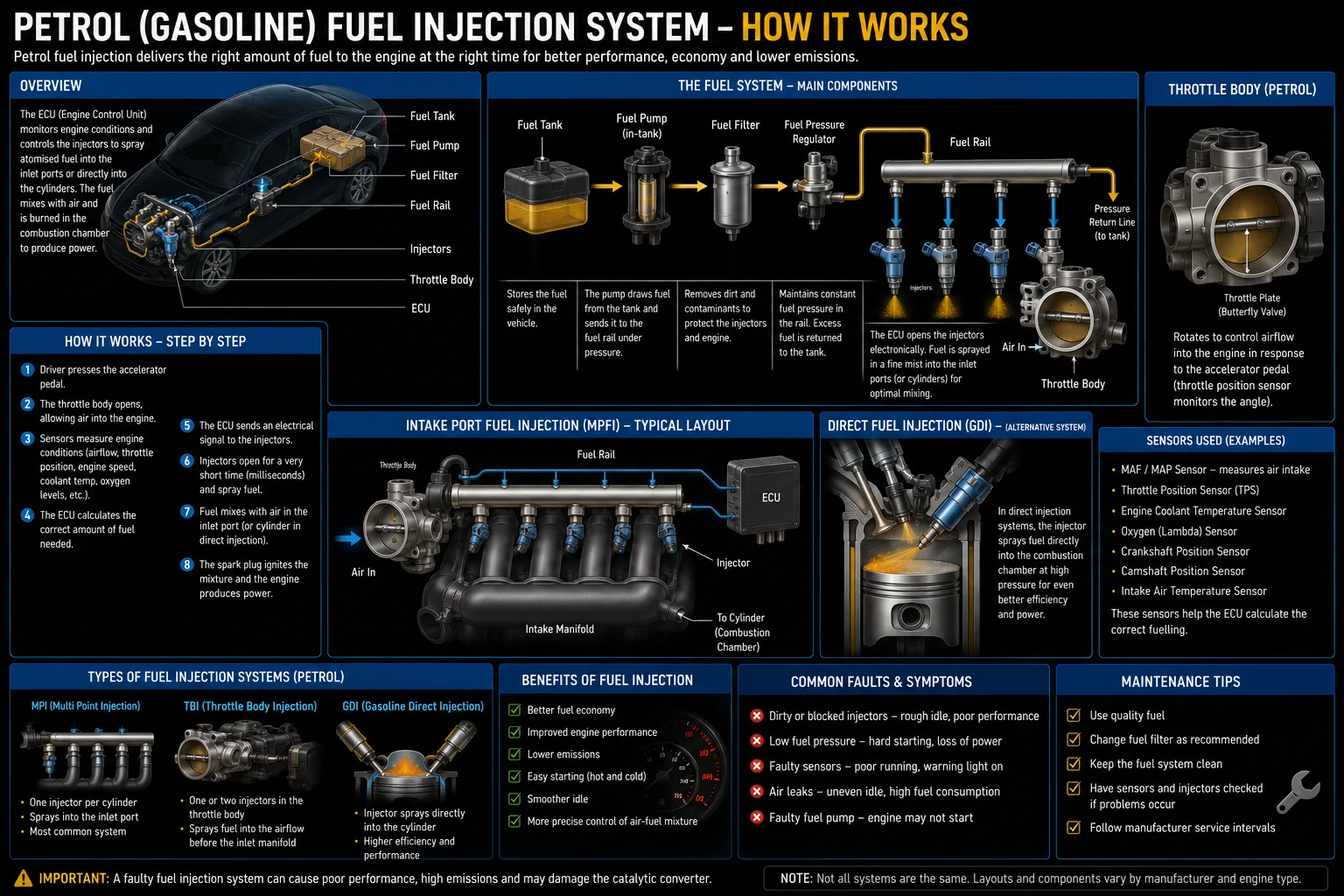
Your engine is built around a pressure difference. At idle, the throttle is nearly closed, so the pistons pulling down on their intake strokes create a strong vacuum in the intake manifold — roughly -0.5 to -0.7 bar below atmospheric pressure. That vacuum is intentional and useful: it operates the brake servo, pulls the EGR valve, controls the variable cam timing system, drives vacuum-actuated components, and keeps your idle steady by telling the ECU exactly how much air is coming in. The problem with vacuum is that it sucks. Literally. Any tiny crack, split hose, loose clamp or failed gasket becomes an air inlet — and unmetered air is the enemy. The lambda (oxygen) sensors downstream detect a lean mixture and the ECU tries to compensate by adding more fuel; this is called positive fuel trim. If the leak is large enough, the ECU can't fully compensate and a P0171 (system too lean, bank 1) code gets stored. Idle quality suffers because the engine is fighting an air supply it can't control — hence the classic hunting, surging or high-idle symptoms. The correct way to find a vacuum leak is a smoke test: a purpose-built machine pressurises the intake system with a dense, harmless smoke (at low, safe pressure), and the smoke billows out of any leak — even pinhole cracks that are completely invisible to the naked eye. Other methods exist (carb cleaner spray, an ultrasonic detector) but smoke testing is the definitive, safe, professional approach. Once found, the fix is usually a hose, a gasket, or a clip — straightforward, unglamorous, and highly effective.
“Every milligram of it gets measured so the ECU can add precisely the right amount of fuel.”
Sound familiar?
So what's behind it?
What we do — at your door
We come to you — driveway, car park, workplace — with a proper automotive smoke machine, live diagnostic equipment and the experience to read what the data is actually saying. First we plug in and read the full fault code set and live data: fuel trim figures tell us immediately how hard the ECU is compensating and how big the leak likely is. Then we pressurised the intake system with smoke at controlled, safe pressure and watch. Every leak — whether it's a pinhole in a hose behind the inlet manifold or a weeping brake servo pipe — shows itself as a plume of white smoke. No guesswork, no squirting flammable carb cleaner near a hot engine. Once we've found every leak point (there's often more than one), we quote for the repair on the spot. Most fixes are completed the same visit: hose replacement, gasket swap, new servo pipe. We clear the codes, monitor the fuel trims to confirm the repair, and hand the car back running properly — without you leaving your postcode.
What affects the price
Cost varies mainly by what's leaking and how involved it is to access. A simple split vacuum hose or a loose inlet duct clip is low parts cost and quick labour. An intake manifold gasket is a bigger job — particularly on V6 engines or cars where the manifold is buried under ancillaries — and will cost more in labour time. A brake servo or its vacuum hose is a specific replacement job; the servo itself is a genuine parts cost. The smoke test diagnostic charge covers the time, equipment and expertise to find the fault accurately — it's what stops you paying for the wrong fix. We quote clearly before starting any repair, with no hidden extras for the visit. All parts sourced to OE-equivalent quality minimum.
Random knowledge you didn't ask for
Questions you're probably asking
I've got a P0171 lean code — is that definitely a vacuum leak?
P0171 (bank 1 lean) means the ECU is adding more fuel than it should to keep the mixture correct. That can be a vacuum leak — but it can also be a weak fuel pump, a clogged injector, a dirty or failing MAF sensor, or a lazy lambda sensor. The code is the starting point, not the diagnosis. We look at live fuel trim data and run the smoke test to confirm the actual cause before recommending any parts.
Can I drive with a vacuum leak?
Often yes, at least in the short term — the car will usually run, just roughly. The main concerns are a lean mixture accelerating engine wear over time, a potential MOT failure on emissions, and — critically — if the brake servo is involved, reduced braking assistance. A heavy or wooden brake pedal means get it looked at straight away, not next week.
Why is my idle hunting or surging? Could it be a vacuum leak?
A hunting idle — where the revs rise and fall in a slow cycle at rest — is a classic vacuum leak symptom. The ECU is trying to stabilise the idle speed against an air supply it can't measure or control. It's not always a vacuum leak (it can also be an idle control valve or throttle body deposit), but it's one of the first things we check with live data and a smoke test.
My mechanic already replaced parts for a lean code but it came back. Why?
Because replacing parts based on a code without confirming the root cause is the most expensive way to not fix a car. Lean codes get MAF sensors and lambda probes thrown at them routinely, when a £4 rubber hose with a split in it is the real culprit. A smoke test would have found it in twenty minutes. We diagnose first, replace second.
Does a vacuum leak affect my MOT?
Indirectly, yes. A significant vacuum leak causes a lean mixture, which pushes up CO and NOx emissions and can cause an MOT emissions failure. A stored engine management light is an automatic MOT failure regardless of cause. And a failed brake servo diaphragm could fail on braking efficiency. So yes — a vacuum leak has MOT consequences on more than one front.
Vacuum Leaks — sorted at your door
Stop procrastinating. Get a transparent quote and we'll come to you.